
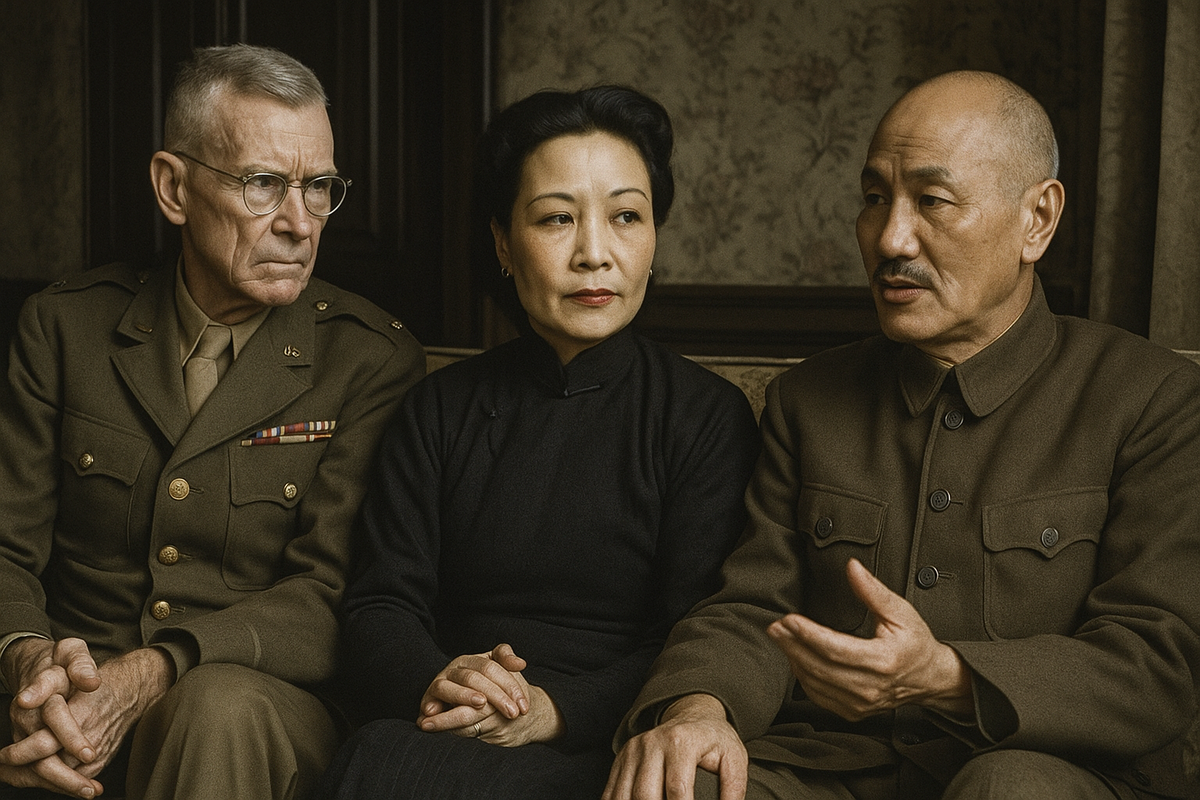
When America Held an Inquest
The Saturday Evening Post and the question that haunted a nation after China fell to Communism
On January 7, 1950, millions of Americans opened their mailboxes to find a question staring back at them—not printed as a headline, but embedded in the very fabric of the magazine they held. The Saturday Evening Post had published the first installment of Joseph Alsop's explosive series: "Why We Lost China."
The timing was surgical. Only three months earlier, Mao Zedong had declared the People's Republic of China from atop Tiananmen Gate. Chiang Kai-shek's Nationalist government—Washington's ally, recipient of billions in American aid—had collapsed. In living rooms across the country, the question burned: How did this happen?
Alsop's answer was not what readers expected. This was not a story of grand strategy gone wrong or Soviet cunning. It was a story of two men who despised each other—and how their feud may have changed the fate of Asia.
The Anatomy of a Disaster
"The Feud Between Stilwell and Chiang" read like a postmortem conducted while the body was still warm. Joseph Alsop, who had served as a Lend-Lease coordinator in China during the war, wrote with the authority of a witness. He knew the players. He had watched the alliance fracture from the inside.
On one side stood General Joseph "Vinegar Joe" Stilwell—legendary for his physical toughness, famous for his contempt of what he called "the peanut" (his private name for Chiang). Stilwell was brave, relentless, and utterly incapable of diplomatic compromise. He believed Chiang's armies were corrupt and incompetent. He said so. Loudly.
On the other stood Generalissimo Chiang Kai-shek, fighting a war on two fronts: the Japanese invasion from without, Mao's Communist insurgency from within. Chiang needed American support to survive. What he got was Stilwell—a commander who distrusted him, undermined him, and demanded control of Chinese forces as the price of American aid.
Between them stood Madame Chiang Kai-shek—Soong Mei-ling—perhaps the most formidable figure of all. Wellesley-educated, fluent in English, politically astute, she became her husband's voice in Washington and Stilwell's most effective opponent. When Stilwell demanded Chiang's removal from command, it was Madame Chiang who orchestrated the general's recall.
Alsop's narrative made one thing clear: this was not a policy failure. It was a human failure, a clash of egos with geopolitical consequences.
Historical Record
Publication: The Saturday Evening Post
Issue Date: January 7, 1950
Article: "Why We Lost China: The Feud Between Stilwell and Chiang" by Joseph Alsop
Cover Artist: John Falter
Context: Published three months after Mao's declaration of the People's Republic of China
Democracy in Session, Empire in Collapse
The cover of the January 7, 1950 issue carried no hint of the turmoil inside. John Falter's painting depicted the joint session of Congress from January 5, 1949—over 200 faces rendered in meticulous detail, President Truman among them. It was American democracy at its most ceremonial, captured at the moment when the very alliances that democracy depended on were unraveling overseas.
The symbolism was unintentional but perfect. While Congress convened in optimism, Chiang's government was already crumbling. While Americans celebrated their postwar prosperity, Mao's armies were sweeping south. The painting and the article existed in ironic counterpoint—one celebrating order, the other dissecting chaos.
The Soong Family and the Architecture of Influence
Alsop understood that to explain the Stilwell-Chiang feud, he had to explain the Soong family—one of the most powerful and divided dynasties in modern Chinese history. Madame Chiang was a Soong. So was her sister, Soong Ching-ling, who had married Sun Yat-sen and later aligned with the Communists. Another sister had married H.H. Kung, Chiang's finance minister.
The Soongs were bankers, politicians, revolutionaries. Their wealth was American-connected, their loyalties fractured. Understanding them meant understanding how Chinese politics and American foreign policy had become impossibly entangled—and why Stilwell's blunt military approach was doomed from the start.
Alsop laid this out not as conspiracy, but as context. The feud was personal, yes—but it was also structural, embedded in the complexity of modern China and America's failure to comprehend it.
What Alsop Knew That Washington Didn't
The article's power came from its refusal to simplify. Alsop did not exonerate Chiang or lionize Stilwell. He showed both men as they were: flawed, stubborn, trapped by circumstance and temperament.
Stilwell was right that Chiang's armies were often poorly led and riddled with corruption. But Stilwell was also rigid, dismissive of Chinese political realities, and tone-deaf to the fact that Chiang was fighting for survival against an enemy Stilwell barely acknowledged—the Communists.
Chiang was right that his situation was impossible, that Stilwell's demands were unrealistic. But Chiang was also evasive, resistant to reform, and more focused on hoarding strength for the coming civil war than on defeating Japan.
The tragedy, Alsop suggested, was that both men might have been managed—if Washington had understood what was at stake. Instead, Franklin Roosevelt kept Stilwell in place too long. George Marshall later tried to broker peace between Nationalists and Communists, failing to grasp that Mao had no interest in compromise.
By the time Americans read Alsop's article in January 1950, it was too late. The question was no longer whether China could be saved. It was whether anyone in Washington had understood China at all.
The Cold War Reads Its Autopsy
For Saturday Evening Post readers in 1950, this was not history. It was current events with the ink still wet. Senator Joseph McCarthy would soon claim that Communist infiltration had "lost" China. The Korean War would erupt six months later, bringing American soldiers face-to-face with Chinese troops under Mao's command.
Alsop's article arrived at the hinge moment—when the debate over "Who lost China?" was beginning, when Americans were searching for explanations, scapegoats, lessons. The Post gave them a narrative: not treason or conspiracy, but miscalculation, hubris, and the fatal consequences of personal animosity.
The article was journalism, but it was also something rarer—a real-time attempt to understand a catastrophe while its architects were still alive, still arguing, still blaming each other.
Why This Issue Matters Now
The January 7, 1950 Saturday Evening Post is more than a collector's item. It is a primary source—a window into how Americans processed one of the most significant geopolitical shifts of the twentieth century.
Historic Immediacy
Published three months after Mao's victory, it captured American shock and confusion in real time, before the official narratives hardened.
Joseph Alsop's Series
This was the opening chapter of "Why We Lost China," one of the most influential pieces of Cold War journalism. Owning this issue means owning the beginning of a debate that shaped U.S.-Asia policy for decades.
John Falter's Cover
The joint session painting is a masterwork of illustrative journalism—a symbol of democratic idealism at the moment when American confidence abroad was cracking.
Cold War Artifact
For historians and collectors, this issue represents the transition from World War II alliance to Cold War confrontation. It is the moment when Americans began asking not just "What happened?" but "Who is to blame?"
This is not a magazine that sat unread. It was studied, argued over, saved. It was evidence in a national debate.
The Weight of Paper, The Permanence of Print
In an age when news evaporates within hours, vintage magazines carry a different authority. They were meant to be kept. Families passed them around. Barbers displayed them. Libraries bound them. They were tangible records of how a generation understood its moment.
The Saturday Evening Post was mainstream America's mirror—neither radical nor reactionary, but earnest, curious, and unafraid of complexity. To hold this issue is to hold what ordinary Americans held in 1950, to see what they saw, to confront the same questions.
That permanence is why these magazines endure as historical artifacts—not relics, but evidence.
Explore the Archive That Shaped American Memory
If you're drawn to the moments when journalism became history, our collection of original Saturday Evening Post magazines offers direct access to the 20th century's defining debates—from the Great Depression through the Cold War, civil rights, and beyond.
Browse The Saturday Evening Post Magazine CollectionWhether you're a collector, historian, or custodian of family memory, these issues are more than paper. They're the primary sources of how America understood itself—preserved, intact, waiting to be read again.