📖 About this Collection
Chevy Chase: The Smirk That Broke the Fourth Wall
The Legend & The Legacy
Before the era of viral clips and algorithm-driven celebrity, Chevy Chase became one of the most recognizable comic faces in America through a medium that demanded you show up: live television, the silver screen, and the glossy, ink-heavy pages of the print press. As an original cast member of Saturday Night Live beginning in 1975, he didn't merely perform comedy — he deconstructed it, weaponizing deadpan irony and physical pratfalls with an Ivy League's cool detachment. His "Weekend Update" segments redefined political satire for a post-Watergate generation starved for irreverence, and his departure from SNL for Hollywood superstardom was itself a cultural event, dissected in real time by a public who got their entertainment news not from a feed, but from a magazine rack. Through the late 1970s and into the 1980s — the golden arc of his reign — readers eagerly flipped past perfume inserts and cigarette ads to land on profiles of the man who somehow made falling down look like genius.
Inside the Archive
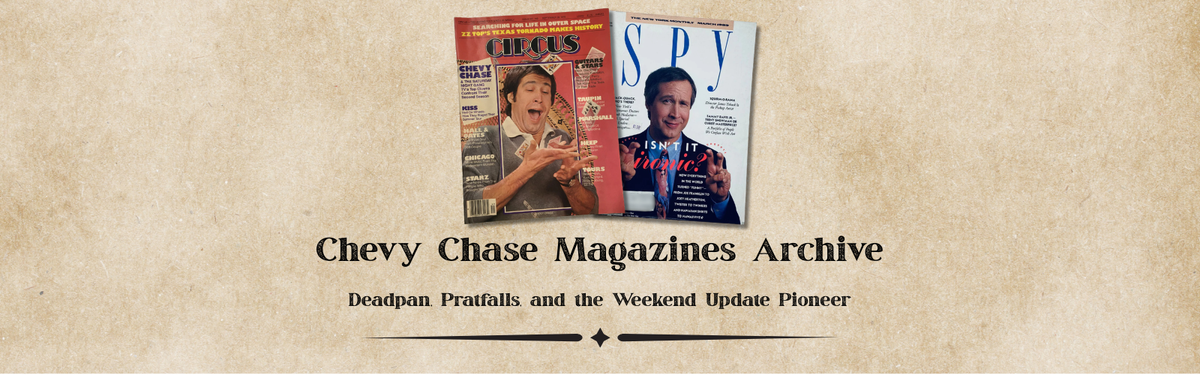
The magazine coverage of this era's preeminent comic star was rich, candid, and thoroughly of its cultural moment. Photographers frequently captured him mid-smirk, in the studied casualness that was his signature — open collars, easy posture, the suggestion that he was always slightly in on a joke the rest of the room hadn't heard yet. Rolling Stone, the defining document of post-counterculture America, profiled him extensively during his SNL and early film years, treating him with the same editorial weight it reserved for rock gods and political renegades. People magazine, then in its ascendant years as the nation's most-read celebrity weekly, placed him on its covers and inside its centerfolds as the approachable face of a new Hollywood cool. Meanwhile, TV Guide chronicled his television legacy with a consistency that reflected just how deeply he had lodged himself into the American living room — not merely as a performer, but as a fixture of the weekly ritual of gathering around the set.
Curator's Checklist: Highlights Often Include
- Early SNL features (1975–1976): Coverage from the original season of Saturday Night Live, when critics and culture writers were scrambling to make sense of a new and genuinely dangerous comedy program — and one performer who seemed to be stealing the whole show
- Hollywood breakthrough profiles: Entertainment and general-interest magazines marking his transition from television upstart to bona fide film star, particularly around the releases of Foul Play (1978) and Caddyshack (1980)
- The Vacation franchise era: A wave of family-oriented and mainstream press coverage tied to the beloved National Lampoon's Vacation series throughout the 1980s, capturing him at the peak of his box-office relevance
- Late-night and awards season coverage: Profiles and photo features from his years as a frequent awards host and talk show presence, offering a more reflective look at the comedian as an evolving public figure
- Retrospective and legacy pieces: Later print coverage from the 1990s that began situating him within the broader history of American sketch comedy and SNL's cultural mythology
The Collector's Value
There is something irreplaceable about holding a physical magazine from the height of Chevy Chase's cultural moment — the slight give of aged newsprint beneath your fingertips, the faint ghost of ink and paper that no digital archive can replicate, the full-page advertisements for Tab cola and Atari games that frame his image in its true, breathing context. These are not mere collectibles; they are primary source documents of a specific, unrepeatable slice of American pop culture, artifacts that capture how a nation processed its appetite for irreverence through the carefully curated pages of the press. The editorial choices, the pull quotes, the cover typography — all of it tells a story about who we were when we found this man funny, subversive, and utterly magnetic. For collectors of Saturday Night Live and classic television memorabilia, golden-age Hollywood comedy, or 1970s and '80s American pop culture ephemera, these publications offer an unfiltered, tactile window into an era that shaped modern entertainment as we know it. Explore the current available inventory below and find the piece of that history that belongs in your collection.