📖 About this Collection
Chris Cornell: Voice of the Infinite, Preserved in Print
The Legend & The Legacy
Before streaming algorithms and social media timelines flattened the music world into a single, scrolling feed, discovering an artist meant hunting — flipping through the glossy pages of a magazine at a record store, reading a cover story on a tour bus, or tearing out a photograph and pinning it to a bedroom wall. Chris Cornell inhabited that tactile world completely. As the creative engine behind Soundgarden and a founding voice of the Seattle grunge movement, he emerged in the late 1980s as something genuinely rare: a rock vocalist of operatic range married to a songwriter's literary instinct. Through the epochal early 1990s — when grunge detonated mainstream rock culture and sent shockwaves through fashion, film, and youth identity — the press treated Seattle's scene not merely as a musical trend but as a generational statement. Cornell stood at its center, brooding and magnetic, a figure who carried the spiritual weight of classic rock while dragging it into something rawer and more urgent. His later work with Audioslave and as a solo artist ensured that print media returned to him again and again across three full decades of career, tracing an arc from underground cult hero to genuine rock immortal.
Inside the Archive
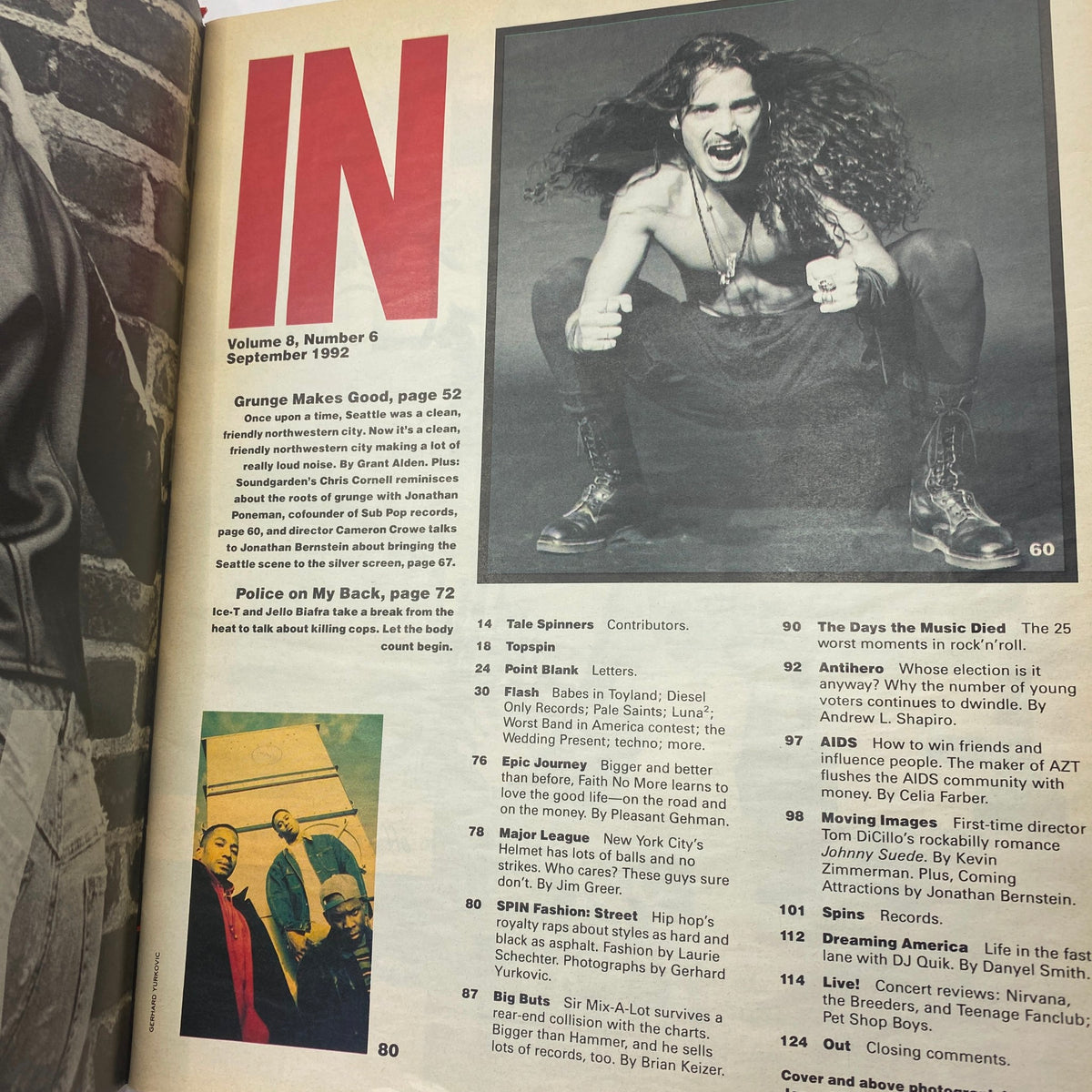
Vintage magazine coverage of Cornell reflects the full cinematic drama of the man himself — photographers frequently leaned into chiaroscuro portraiture, shadow and contrast framing that extraordinary face and those imposing, dark eyes in ways that felt more like fine art than promotional material. Editorial tone in the early Soundgarden years tended toward the reverent and the anthropological, with writers treating the Pacific Northwest scene as a civilizational rupture worth documenting seriously. Rolling Stone was perhaps the definitive chronicler of his ascent, placing Soundgarden and the grunge moment within the broader sweep of American rock history across multiple landmark issues of the early-to-mid 1990s. Kerrang! and Metal Hammer in the United Kingdom covered him with particular devotion, recognizing in Soundgarden a band that honored the structural traditions of heavy music while transcending them entirely. Spin, the era's essential alternative music bible, brought a sharper critical and cultural lens to its Cornell coverage, situating him within the anxious, ironic, post-everything spirit of Generation X with essays and profiles that still read as essential documents of the period.
Curator's Checklist: Highlights Often Include
- Soundgarden breakthrough coverage from the Badmotorfinger and Superunknown release eras (1991–1994), when the music press was grappling in real time with grunge's conquest of the mainstream
- Solo portraiture and career retrospectives from the late 1990s and early 2000s, documenting his post-Soundgarden evolution and the deeply personal Euphoria Morning period
- Audioslave-era features spanning 2001–2007, in which critics and interviewers wrestled with questions of artistic reinvention and the unlikely pairing with former Rage Against the Machine instrumentalists
- Festival and live performance coverage — including Lollapalooza and major European festival documentation — capturing his legendary stage presence in full-bleed, high-contrast concert photography
- Retrospective and tribute issues from music publications marking Soundgarden reunions or reflecting on the lasting cultural imprint of the Seattle scene and its most enduring voices
The Collector's Value
There is something a digital file will never replicate: the experience of holding a 1994 issue of Rolling Stone and feeling the particular weight of its coated paper stock, the slight yellowing at the margins that whispers of time genuinely passed, the faint ghost of aged ink that rises when you open the page — and then finding, inside, a full-spread photograph of Cornell in his prime, surrounded by advertisements for long-discontinued cassette players and leather jacket brands that no longer exist. These surrounding artifacts are not distractions; they are the full atmosphere of a specific cultural moment, preserved accidentally and perfectly. The magazine becomes a time capsule, not just of the artist, but of the entire world that produced and consumed him. For collectors of grunge and alternative rock memorabilia, serious music history ephemera, or 1990s cultural artifacts, these publications offer an irreplaceable primary source — proof, held in the hands, that this music and this voice mattered enormously to the world that first heard them. Explore the current available inventory below and find the issue that calls to you.