📖 About this Collection
David Koresh: Prophet, Flame, and the Weight of Waco
The Legend & The Legacy
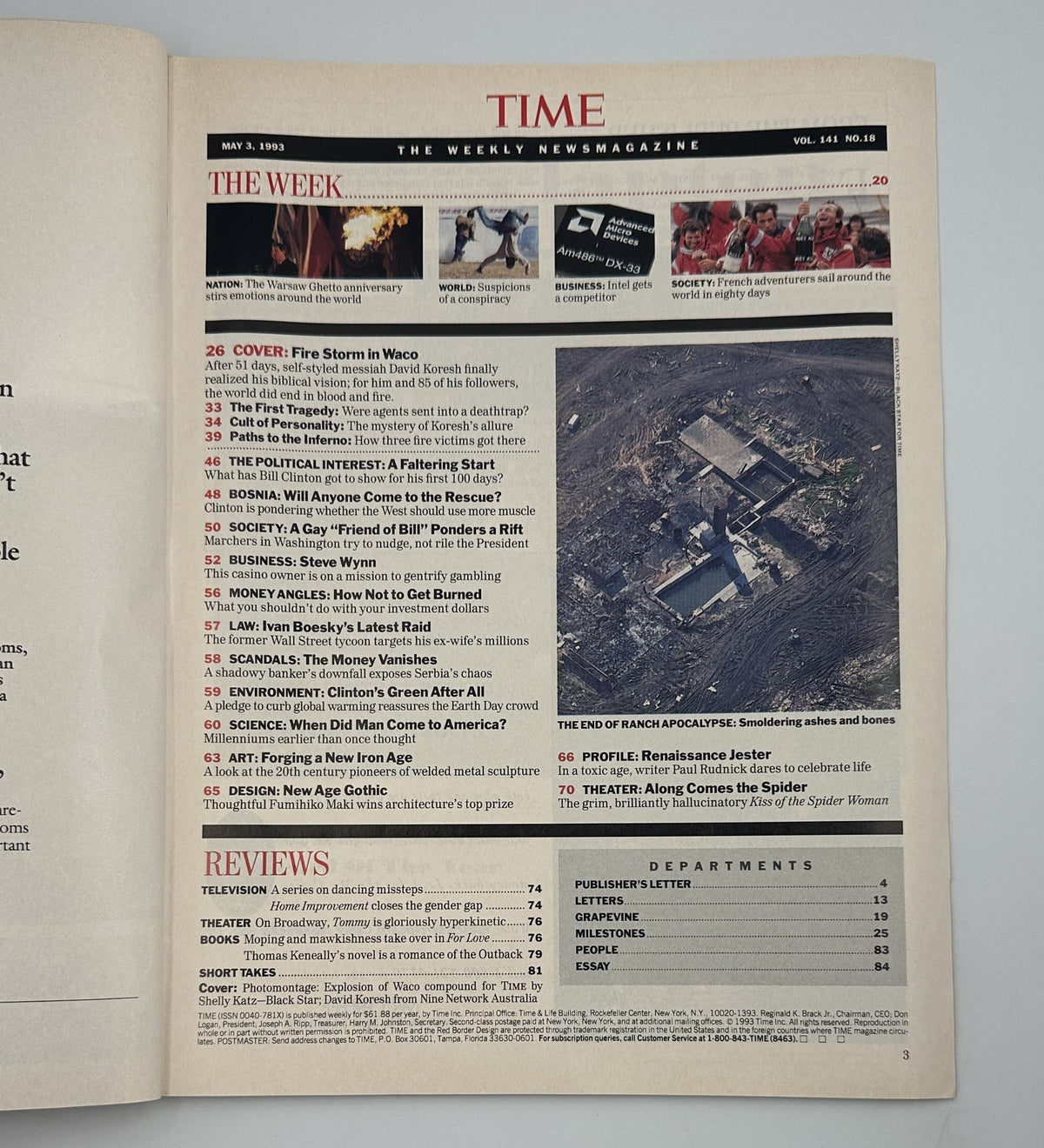
In the early 1990s, before the internet collapsed the distance between event and public consciousness, the story of David Koresh and the Branch Davidians unfolded in real time across the printed page — each new development arriving in households not as a notification, but as ink on paper, deliberate and permanent. The 51-day siege at Mount Carmel Center near Waco, Texas, in 1993 became one of the most intensely covered domestic crises of the post-Cold War era, a story that forced America to reckon with questions of religious liberty, federal authority, and the psychology of belief. For readers picking up their weekly newsmagazine from a drugstore rack or a mailbox, the charismatic preacher who commanded absolute devotion from his followers was simultaneously a figure of fascination and profound unease — a story that felt both impossibly foreign and urgently American.
Inside the Archive
The coverage surrounding the Waco siege and its aftermath was sweeping, urgent, and deeply photographic in character — editors leaning heavily on aerial imagery of the compound, portraits of federal agents in tactical gear, and the haunting still frames pulled from news footage that defined the visual language of the crisis. The editorial tone shifted dramatically across the arc of the story: early coverage carried the breathless energy of a breaking standoff, while post-fire issues turned elegiac, investigative, and politically charged. Time and Newsweek dedicated multiple cover stories and interior spreads to the siege, the fire, and the Congressional fallout that followed, their dueling takes shaping public opinion for years to come. People magazine brought a more human-interest lens, profiling survivors, former members, and the families caught in the tragedy's wake. Internationally, publications such as Paris Match framed the events as a window into American extremism and the volatile intersection of guns, God, and government — giving European readers a portrait of a nation in psychological conflict with itself.
Curator's Checklist: Highlights Often Include
- Siege coverage issues from spring 1993 — weekly newsmagazines documenting the standoff's tense chronology, federal negotiations, and the ATF's initial raid, often featuring dramatic compound photography and tactical maps
- Post-fire retrospectives from mid-to-late 1993, in which editors and journalists grappled with the catastrophic conclusion of the siege, the death toll, and early questions of governmental accountability
- Congressional hearing coverage from 1995, revisiting Waco alongside the Oklahoma City bombing and reigniting national debate about the Bureau of Alcohol, Tobacco and Firearms and the FBI's conduct
- Cult and new religious movement features — broader thematic pieces in which the Branch Davidians served as a central case study, appearing in psychology-adjacent publications, religious journals, and general interest magazines exploring the anatomy of belief and charismatic leadership
- Anniversary and retrospective issues from the mid-to-late 1990s, reassessing the legacy of Waco as it became a touchstone for the American militia movement and a recurring reference point in the culture wars
The Collector's Value
There is something irreplaceable about holding a magazine from April or May of 1993 — feeling the slight curl of a cover that was once thumbed through in a waiting room or spread across a kitchen table, the ink slightly faded at the edges, the advertisements inside selling cars and cologne to a world that had no idea what the decade still held. These are not reprints or digital scans; they are primary source artifacts, physical witnesses to a moment of national trauma and reckoning, surrounded by the full cultural context of their time — the political advertisements, the pop culture ephemera, the editorial cartoons that speak to a specific and unrepeatable American mood. For collectors of American political history, true crime and cult studies, or 1990s cultural documentation, these publications offer an unfiltered, contemporaneous record that no documentary or retrospective can fully replicate. Explore the current available inventory below and discover which pieces of this extraordinary, troubling chapter of history are waiting to find a permanent home in your collection.