
📖 About this Collection
Diane von Furstenberg: The Woman Who Wrapped the World in Freedom
The Legend & The Legacy
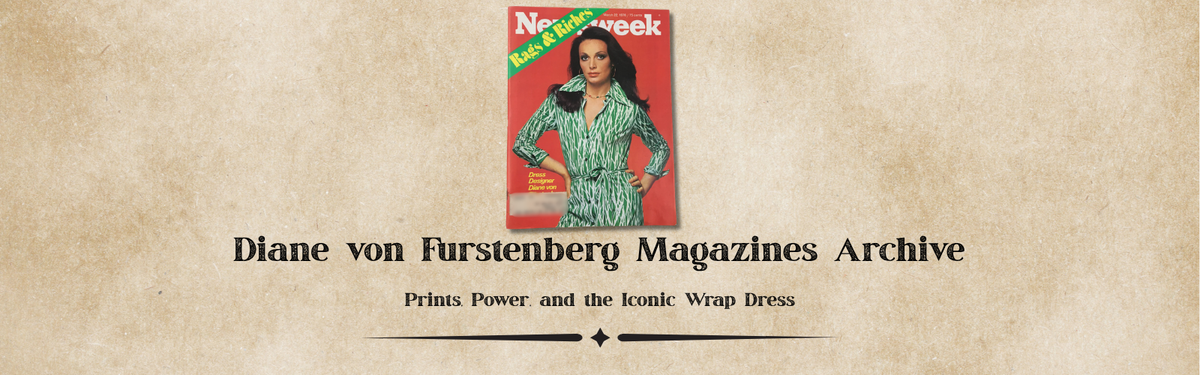
In the mid-1970s, a young Belgian-born princess walked into the offices of Vogue with a suitcase full of jersey-knit dresses and walked out having changed fashion forever. Diane von Furstenberg's wrap dress — deceptively simple, infinitely flattering, and radiating a quiet confidence — became the defining garment of the liberated woman. At its peak in 1976, she was selling twenty-five thousand dresses a week, and her face graced the covers of magazines not merely as a designer, but as a symbol: of female independence, of European glamour transplanted into American ambition, of a woman who had consciously chosen herself. In an era before social media, before instant celebrity, the public fell in love with her through the glossy pages of monthly magazines — through long-form profiles, intimate studio photography, and the kind of sustained editorial attention that turned a fashion story into a cultural document. She was not just selling a dress. She was selling a way of being a woman.
Inside the Archive
The magazines of the 1970s and early 1980s treated DVF as both muse and mogul, a rare dual framing that made her editorial coverage exceptionally rich. Photographers captured her in her Manhattan studio surrounded by bolts of jewel-toned fabric, or in her Seventh Avenue showroom, always photographed with an ease and sensuality that matched the spirit of the clothes themselves. Vogue — both American and international editions — was perhaps her most faithful chronicler, running cover features and multi-page fashion spreads that cemented her aesthetic as the visual language of the decade's modern woman. People magazine brought her to a broader American readership, framing her story through the irresistible lens of a real-life princess who had reinvented herself as a self-made entrepreneur. Meanwhile, Women's Wear Daily, the indispensable bible of the fashion trade, tracked her rise, her commercial dominance, and her eventual reinvention in the 1990s with the rigorous, insider authority that no other publication could match. The photography throughout this era — warm, natural-lit, intimate — reflected a world where fashion journalism was still an act of genuine storytelling.
Curator's Checklist: Highlights Often Include
- The Wrap Dress Years (1973–1979): Collectors frequently seek out fashion spreads and cover features from this golden window, when the wrap dress was a genuine cultural phenomenon and the designer herself was its most compelling advertisement.
- The "I'm a Woman" Campaign Coverage: Editorial features and trade press from the mid-1970s documenting her landmark self-promotional campaign — one of the first times a designer placed themselves, rather than a model, at the center of their own brand story.
- Society & Lifestyle Profiles: Coverage in shelter and society publications capturing her dual life as a Manhattan tastemaker and a figure at the intersection of European aristocracy and American creative ambition.
- The Reinvention Era (1990s): After a decade largely spent abroad, her return to American fashion was covered as a second act narrative — pieces from this period offer a fascinating contrast to the bolder, more triumphant coverage of her earlier peak.
- International Press: French, Italian, and German fashion publications offer a distinctly different perspective — treating her less as an American success story and more as a European émigré who conquered the New World, lending these issues a collector's rarity and a transatlantic point of view.
The Collector's Value
To hold an original magazine featuring Diane von Furstenberg from the height of her cultural moment is to hold the era itself — the particular weight of thick, coated paper stock; the slight amber warmth of ink that has deepened gracefully over five decades; the surrounding advertisements for Halston perfume, Pan Am flights, and Virginia Slims cigarettes that reconstruct, with startling completeness, the world she dressed. These are primary sources, not reprints — objects that existed in the same cultural moment they recorded, passed through the hands of real readers who lived inside that history. The editorial photography alone, often shot by the great image-makers of the 1970s fashion world, represents a visual archive of extraordinary depth. For collectors of vintage fashion history, second-wave feminist cultural artifacts, or 1970s Americana and design, these publications offer something no digital archive can replicate: the full, sensory, irreducible experience of the original moment. Explore the current available inventory below and discover which pieces of this extraordinary legacy are waiting to find their next keeper.


