📖 About this Collection
Jacques Cousteau: The Ocean's Poet in Print
The Legend & The Legacy
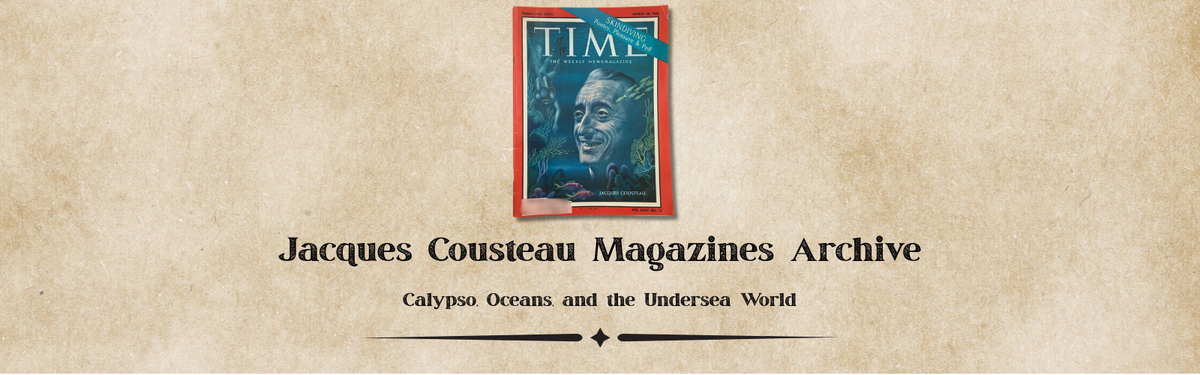
Before the age of streaming nature documentaries and satellite ocean sensors, the world's understanding of the deep sea arrived by post — folded between glossy covers, delivered to living rooms, and read by lamplight. Jacques-Yves Cousteau was, for much of the latter twentieth century, the singular human face of the ocean's mystery. From his earliest underwater films in the 1940s through the beloved television series The Undersea World of Jacques Cousteau — which captivated audiences across more than a dozen countries throughout the late 1960s and 1970s — this French naval officer turned ocean philosopher made the abyss feel intimate. He did not merely study the sea; he narrated it in a voice so calm and authoritative that millions of readers and viewers trusted him as both scientist and sage. Print media was the engine of that mythology. Long before a clip could go viral, a single photograph of the Calypso cutting through the Mediterranean, or of the Captain himself — masked and finned, suspended in impossible blue — could define the public imagination for a generation.
Inside the Archive
Vintage magazines of the 1950s through the 1980s approached Cousteau with the reverence typically reserved for heads of state or space explorers. Editorial photographers aboard and alongside the Calypso captured sweeping wide-angle seascapes, intimate portraits of the man at the helm, and otherworldly underwater imagery that had never before appeared on a printed page — imagery that editors framed with a sense of genuine wonder, because the world genuinely had not seen it before. National Geographic was perhaps his most natural editorial home, producing landmark features that paired his deep-sea expeditions with breathtaking full-spread photography and cartographic spreads of unexplored ocean terrain. Life magazine brought him to the broadest American readership, contextualizing his work within the era's spirit of exploration and Cold War-era scientific ambition. Across the Atlantic, Paris Match celebrated him as a French national hero, publishing glamorous, humanizing portraits of the explorer that underscored his romance and elegance as much as his intellect — the poet of the depths as much as the scientist.
Curator's Checklist: Highlights Often Include
- Expedition coverage of the Calypso voyages — features documenting landmark journeys to the Red Sea, the Antarctic, the Amazon, and the Indian Ocean, often accompanied by hand-drawn maps and expedition photography taken at depth
- Television tie-in issues — editorial spreads published in conjunction with the premiere seasons of The Undersea World of Jacques Cousteau (1968–1976), when the series commanded some of the largest audiences in American and European broadcast history
- Conservation and environmental advocacy pieces — particularly from the 1970s onward, as the Captain became an outspoken voice on ocean pollution, coral reef degradation, and the ethics of marine exploitation, generating pointed editorial coverage in science and current affairs publications
- Obituary and tribute issues from 1997 — a rich collecting category, in which international publications across France, the United States, and beyond produced sweeping retrospectives on his life's work, often reprinting iconic archival photography
- Niche and international titles — French-language science and geography publications, early scuba diving and marine enthusiast magazines, and mid-century popular science journals that chronicled his co-invention of the Aqua-Lung and the dawn of recreational diving
The Collector's Value
There is something irreplaceable about holding one of these issues — feeling the slightly waxy resistance of a 1970s National Geographic cover beneath your fingertips, catching the faint mineral scent of decades-old ink pressed into paper stock that no algorithm can replicate. These are primary sources: untouched records of the moment the world first saw photographs of a coral reef in color, or read dispatches from a ship sailing where no camera had gone before. The advertisements surrounding those editorial features are themselves a time capsule — mid-century travel brands, early scuba equipment, oceanographic instruments — deepening the experience of the era with every turned page. For collectors of marine history and oceanography, vintage natural history and exploration ephemera, or mid-century French cultural heritage, these publications offer an irreplaceable tactile connection to one of humanity's great scientific adventurers and the golden age of exploration journalism. Browse the current available inventory below, and claim your piece of the deep.