📖 About this Collection
James Earl Ray: The Man Behind the Crime That Changed a Nation
The Legend & The Legacy
In April 1968, a single gunshot in Memphis, Tennessee, shattered not only a life but the conscience of an entire civilization. The assassination of Dr. Martin Luther King Jr. sent shockwaves through America and the world, and the subsequent manhunt for the escaped fugitive — James Earl Ray — became one of the most gripping, morally charged criminal pursuits of the twentieth century. For sixty-five days, Ray eluded law enforcement across international borders, transforming from a petty criminal into a figure of global infamy. In an era before cable news alerts or social media threads, the public turned to one thing above all else for context, analysis, and imagery: the printed page. Newspapers and magazines became the battlefield of public discourse, where outrage, grief, political reckoning, and the search for truth were fought out in ink and photography on newsstands from Harlem to London.
Inside the Archive
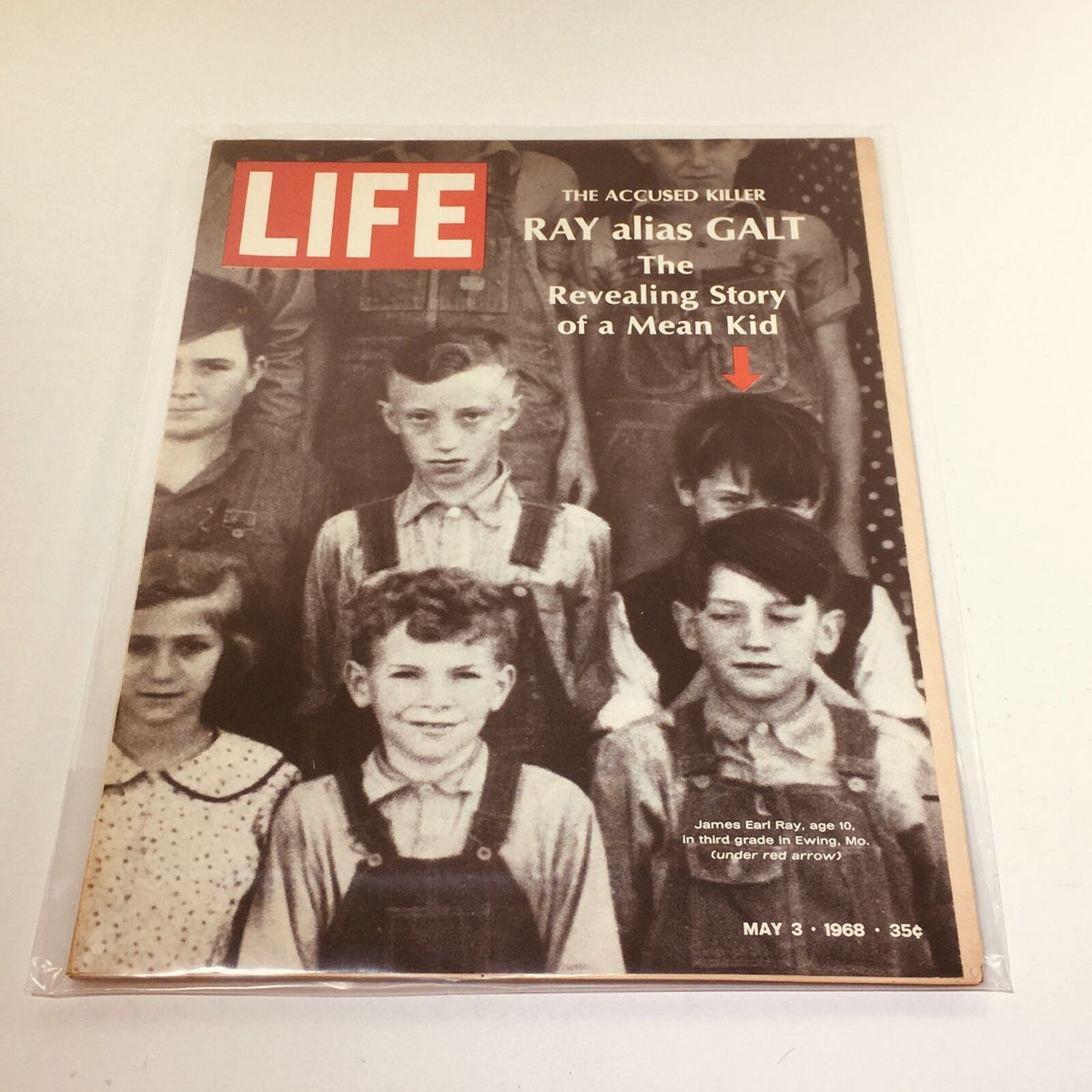
The coverage surrounding Ray's capture, trial, and imprisonment was sweeping and relentless, touching publications across every register of print journalism. Life magazine — the preeminent visual chronicle of American life — devoted significant editorial space to the assassination's aftermath and the fugitive's eventual arrest at Heathrow Airport, pairing stark documentary photography with deeply reported narratives that attempted to make sense of an incomprehensible act. Jet and Ebony, essential voices of the Black American experience, covered the story with particular moral gravity, contextualizing it within the ongoing struggle for civil rights and the profound human cost of racial hatred. International publications such as Paris Match and Der Spiegel tracked the story with the fascination of outside observers watching America wrestle with its deepest contradictions, offering photography and editorial perspectives that domestic outlets rarely captured. The visual language of this coverage was unflinching — courtroom sketches, prison photographs, FBI wanted posters reproduced across glossy spreads — all framed by the editorial gravitas of an era when print journalism was the undisputed authority on world events.
Curator's Checklist: Highlights Often Include
- Assassination & Aftermath Issues (April–June 1968): Publications from the immediate weeks following Dr. King's murder, often featuring memorial tributes, photographs from the Lorraine Motel, and early reporting on the unidentified suspect — among the most historically significant issues of the entire decade
- The Manhunt Coverage: Issues documenting the extraordinary international search for the fugitive, including his use of aliases and his remarkable movement through Canada, Portugal, and England before his arrest in London
- Trial & Sentencing Features: Coverage from early 1969 surrounding Ray's guilty plea and his ninety-nine-year sentencing, including analysis of the legal proceedings and persistent questions about conspiracy
- Recantation & Conspiracy Debates: Later-era magazine features from the 1970s and 1990s examining Ray's recanted confession and his persistent — and deeply controversial — claims that he did not act alone, a story that continued to captivate investigative journalists for decades
- Civil Rights Movement Retrospectives: Anniversary issues and commemorative publications from the 1970s onward that revisit the King assassination within the broader arc of American history, placing the convicted man's role in lasting cultural and political context
The Collector's Value
To hold one of these original issues is to hold a primary document of history at its most turbulent — a tactile connection to the moment the world stopped and tried to understand itself. The slightly brittle paper stock, the deep saturation of mid-century photographic printing, the faint perfume of aged ink, and the surrounding advertisements for automobiles and cigarettes and household goods all conspire to place you, unmistakably, there — in a living room in 1968, turning pages with shaking hands. These are not reprints or digital facsimiles; they are the original vessels through which a stunned public first processed one of the defining crimes of the modern era. For collectors of civil rights history, true crime and criminal justice ephemera, or 1960s American political and cultural artifacts, these publications offer an irreplaceable depth of context, visual documentation, and period authenticity that no secondary source can replicate. Explore the current available inventory below and discover which pieces of this singular, sobering chapter of history are waiting to find a new home.