
📖 About this Collection
Jawaharlal Nehru: Architect of a Nation, Voice of a New World
The Legend & The Legacy
In an age before satellite feeds or scroll-driven timelines, the world came to know Jawaharlal Nehru through the weight of ink on paper — through front-page dispatches, long-form portraits, and the considered editorial voice of the mid-twentieth century press. As India's first Prime Minister and one of the founding architects of the Non-Aligned Movement, the Cambridge-educated statesman occupied a singular place in the global imagination: a philosopher-leader who wore a rose in his achkan while drafting the destiny of nearly four hundred million people. From the charged final years of British colonial rule to the soaring idealism of Tryst with Destiny, from the trauma of Partition to the Bandung Conference of 1955, his journey was one of the defining stories of the postwar world — and readers in Delhi, London, New York, and Moscow followed it, issue by faithful issue, through the printed page. He was not merely a political figure to be reported on; he was a symbol, a contradiction, and a hope — the personification of a civilization's awakening that editors and correspondents around the globe scrambled to interpret for their audiences. In an era when a single magazine cover could shape international opinion, the first Prime Minister of India commanded those covers with a quiet, unshakeable authority that few world leaders of any generation have matched.
Inside the Archive
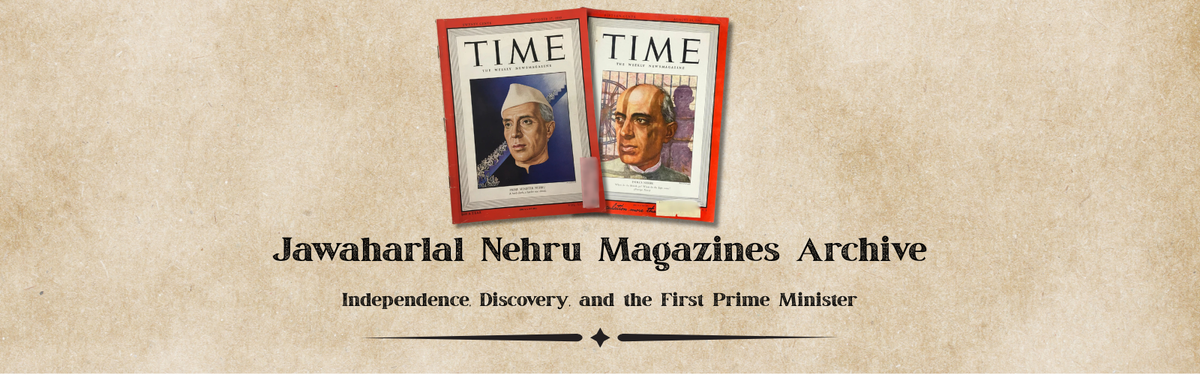
Vintage magazines covered the statesman with a reverence rarely extended to political figures of the era, treating him as much as a cultural icon as a head of state. Life magazine, with its sweeping full-bleed photography, brought his image into American living rooms — capturing the steel-grey temples, the contemplative gaze, and the unmistakable white cap that became synonymous with Indian sovereignty. Picture Post in Britain offered a more intimate, often conflicted editorial lens, documenting the twilight of Empire through the rise of the man who helped dismantle it. Meanwhile, India's own The Illustrated Weekly of India published richly detailed portrait features and policy dispatches that read today as extraordinary primary documents of a nation discovering itself. International coverage frequently balanced political gravitas with a fascination for the personal — the Princeton-educated daughter Indira, the Himalayan retreats, the literary ambitions of a leader who wrote his autobiography in a British prison. Soviet and Eastern European periodicals, too, devoted considerable editorial space to the Indian leader, framing him as proof that decolonization and principled neutrality could coexist on the world stage. Taken together, the breadth of publications that trained their lenses and their prose on this one remarkable figure amounts to a global portrait — a mosaic of perspectives assembled one ink-pressed page at a time.
Curator's Checklist: Highlights Often Include
-
Independence & Partition coverage (1947): Special commemorative issues and news magazines documenting the midnight transfer of power, often featuring dramatic photojournalism of the ceremonies in New Delhi alongside harrowing Partition dispatches — issues that captured, in real time, the birth of the world's largest democracy and the grief that accompanied it
-
Non-Aligned Movement features: Editorial spreads from the mid-1950s onward examining his vision of a "third way" between Washington and Moscow, with coverage intensifying around the 1955 Bandung Conference and the birth of the Global South as a political concept — frequently including rare photographs of him alongside Nasser, Tito, and Sukarno, the fraternity of a new world order assembled in a single frame
-
Sino-Indian War retrospectives (1962): Issues from late 1962 capturing the political and emotional fallout of the border conflict with China — a crisis that visibly aged the Prime Minister and dominated international press coverage in his final years, with editorials reflecting a world grappling with the vulnerability of even the most visionary leadership
-
Portrait and personality profiles: Long-form magazine essays from publications on multiple continents exploring the paradox of a Harrow-and-Cambridge man leading an ancient, newly independent civilization — frequently accompanied by rare studio and candid photography, and often penned by the era's most celebrated journalists and foreign correspondents who recognized they were writing for history as much as for their readership
-
Obituary and legacy editions (1964): Memorial issues from both Indian and international publications marking his death in May 1964 — among the most sought-after pieces in this archive for their historical gravity and editorial depth, their pages filled with tributes from world leaders, retrospective photography, and the kind of elegiac long-form writing that the magazine format, at its finest, did better than any other medium
The Collector's Value
To hold one of these issues is to hold something that no digital archive can replicate — the slight give of aged newsprint beneath your fingertips, the particular amber warmth of ink that has settled into paper over six decades, the half-page advertisements for Ambassador motorcars or Brooke Bond tea that frame the editorial content and transport you, wholly and immediately, into another century. These are not reproductions or facsimiles; they are the very objects through which the world processed one of the twentieth century's most consequential political lives, in real time, without the benefit of hindsight. Each crease in the cover, each slightly faded masthead, each dog-eared page is a testament to the hands that held this very issue before you — the commuter on a Delhi bus in 1947, the diplomat in a London reading room in 1955, the historian who clipped and archived and understood, even then, that something irreplaceable was unfolding. The surrounding advertisements and ephemera are themselves time capsules — windows into the consumer culture, the graphic design sensibilities, and the everyday preoccupations of a world being remade in the postwar image. For collectors of South Asian history, Cold War political ephemera, or postcolonial studies and independence-era memorabilia, these publications offer an irreplaceable primary source — the living texture of history as it was experienced, not as it was later curated. To own one is to participate in the act of preservation; to ensure that the paper record of a pivotal era survives with the dignity and context it deserves. Explore the current available inventory below and discover which pieces of this extraordinary legacy are waiting to find their next guardian.


