📖 About this Collection
J.D. Salinger: The Man Who Vanished Into the Pages
The Legend & The Legacy
Few figures in American literary history command the reverent, almost mythological fascination that Jerome David Salinger has inspired across generations of readers. When The Catcher in the Rye appeared in July 1951, it detonated quietly and then everywhere at once — passed between teenagers in school hallways, debated in university seminars, banned from library shelves, and pressed into the hands of strangers like a secret worth keeping. In an era before social media algorithms or celebrity gossip cycles, the public's relationship with the reclusive author was mediated almost entirely through print: through reviews in broadsheet literary supplements, through rare interviews reproduced in full in glossy monthlies, and through the breathless cultural commentary of magazines that understood they were watching something unprecedented unfold. His subsequent retreat from public life in the late 1950s and 1960s only deepened the obsession — a man who had given the world Holden Caulfield, Franny and Zooey, and the Glass family, and then simply disappeared into the New Hampshire woods, became as compelling a mystery as any character he had ever written.
Inside the Archive
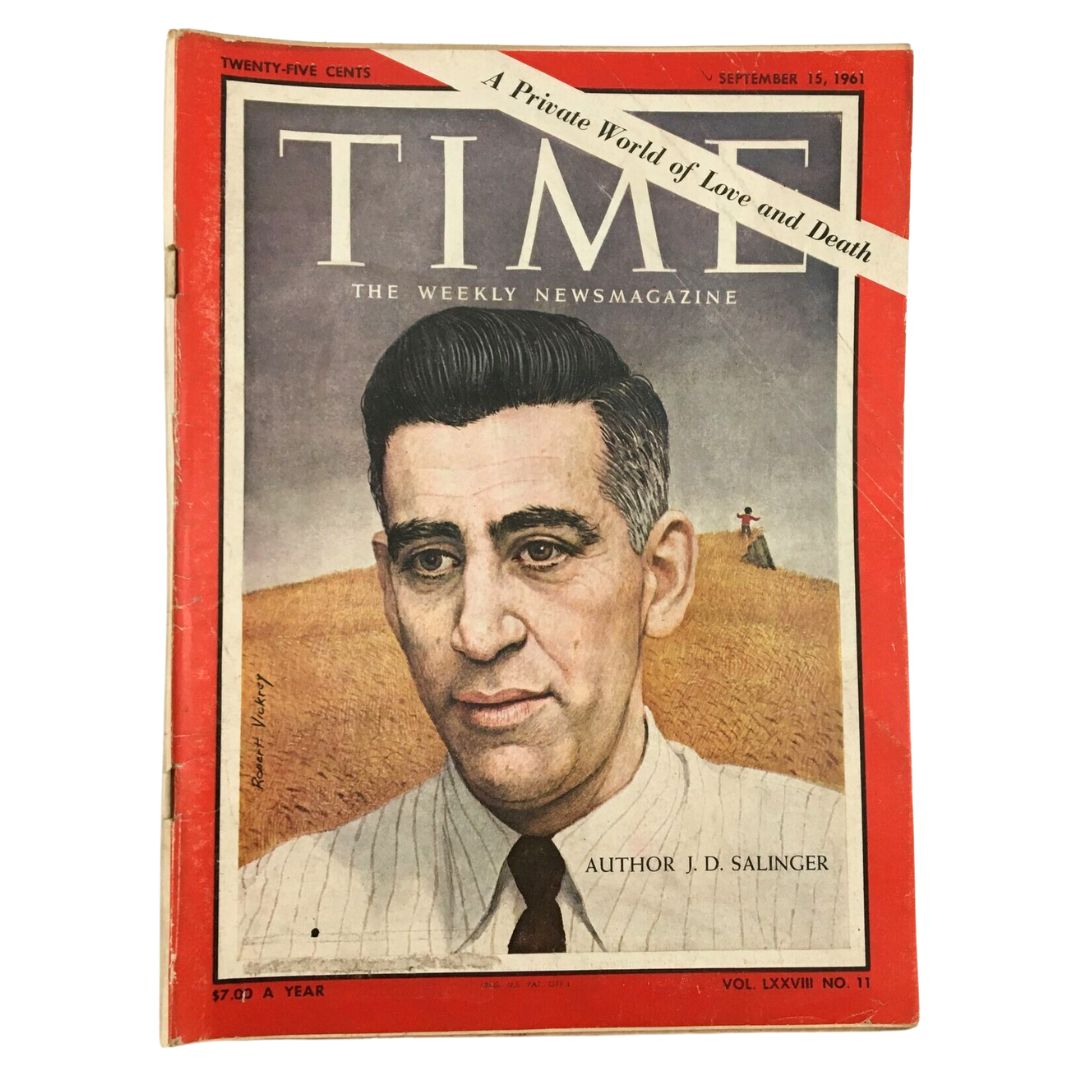
The print coverage surrounding the reclusive master spans several distinct chapters, each with its own editorial character. In the early 1950s, literary magazines and cultural weeklies greeted him with the considered, unhurried prose of a publishing world that still believed in the long review essay — photographs from this period, when they existed at all, tend toward the spare and introspective: a young man at a desk, a half-turned profile, an image that suggests interiority rather than spectacle. The New Yorker, which published his early stories and maintained a spiritual kinship with his sensibility throughout his career, offered readers the most sustained and intimate engagement with his work. Time magazine brought him to a mass American audience with landmark coverage that wrestled seriously with what his fiction meant for postwar culture, often pairing critical analysis with the era's characteristically bold graphic design. Internationally, publications like the Times Literary Supplement and French cultural journals tracked his reception abroad, where L'Attrape-Cœurs — as Catcher was known in France — became its own cultural phenomenon, making his name synonymous with American existential unease in the European literary imagination.
Curator's Checklist: Highlights Often Include
- Early literary debut coverage (late 1940s–early 1950s): Issues of Story magazine and small-circulation literary quarterlies that published his short fiction before Catcher made him a household name — extraordinarily rare primary documents of a writer finding his voice
- The Catcher in the Rye moment (1951–1953): Mainstream weeklies and book review supplements from the months following publication, capturing first-response criticism ranging from reverent to scandalized, often alongside advertisements that place the work vividly in its postwar American context
- The "Nine Stories" and Glass family era (mid-1950s): Cultural magazines grappling with Franny and Zooey and Raise High the Roof Beam, Carpenters, often framing him as both the conscience and the enigma of American letters
- The disappearance narrative (late 1950s–1960s): Feature journalism speculating on his Cornish, New Hampshire retreat, pieces that attempted to interview him or reconstruct his silence — documents of a public fascinated by a man who had chosen invisibility over celebrity
- Retrospective and anniversary coverage (1970s–1990s): Decades-later reassessments in literary and cultural magazines, tracing Catcher's extraordinary influence on successive generations and its recurring place at the center of censorship debates
The Collector's Value
To hold a vintage magazine that covered J.D. Salinger during his active years is to hold a document of cultural bewilderment in the best sense — the record of a society trying to understand a writer who understood it better than it understood itself. These are objects with genuine physical presence: the slightly foxed edges of a 1951 weekly, the dense, cream-weight paper stock of a mid-century literary quarterly, the faint mineral scent of ink that has been setting for seventy years, all of it surrounded by advertisements for Chesterfield cigarettes, DeSoto automobiles, and department store fashions that anchor the prose to its exact moment in time in a way no digital archive can replicate. A first-edition paperback is valuable, but a magazine from the week Catcher was reviewed situates that literary event inside the living, breathing world that received it — the world Holden Caulfield was so desperate to escape. For collectors of mid-century American literature, Beat and postwar cultural history, or the golden age of long-form magazine journalism, these publications offer an irreplaceable window into the conversation that shaped one of the most enduring works of the twentieth century. Explore our current available inventory below and discover which pieces of that conversation are waiting for you today.