📖 About this Collection
Jimmy Hoffa: The Man Who Made Labor Tremble — and Then Vanished
The Legend & The Legacy
Few figures in twentieth-century America commanded the kind of raw, polarizing attention that James Riddle Hoffa did. As the thunderous leader of the International Brotherhood of Teamsters — at its peak, the largest and most powerful labor union in the United States — he was simultaneously lionized by the working class and hunted by the government. His decades-long battle with Robert F. Kennedy, his alleged ties to organized crime, his federal conviction, his presidential pardon by Richard Nixon, and his mysterious disappearance in the summer of 1975 made him one of the most relentlessly covered figures of the postwar American press. In an era before cable news and internet speculation, the American public followed his story exclusively through newspapers and magazines — through dense investigative features, dramatic courtroom photographs, and editorial portraits that made him look alternately like a champion of the blue-collar soul and a man with something very dark to hide. His story was not just labor history; it was American mythology.
Inside the Archive
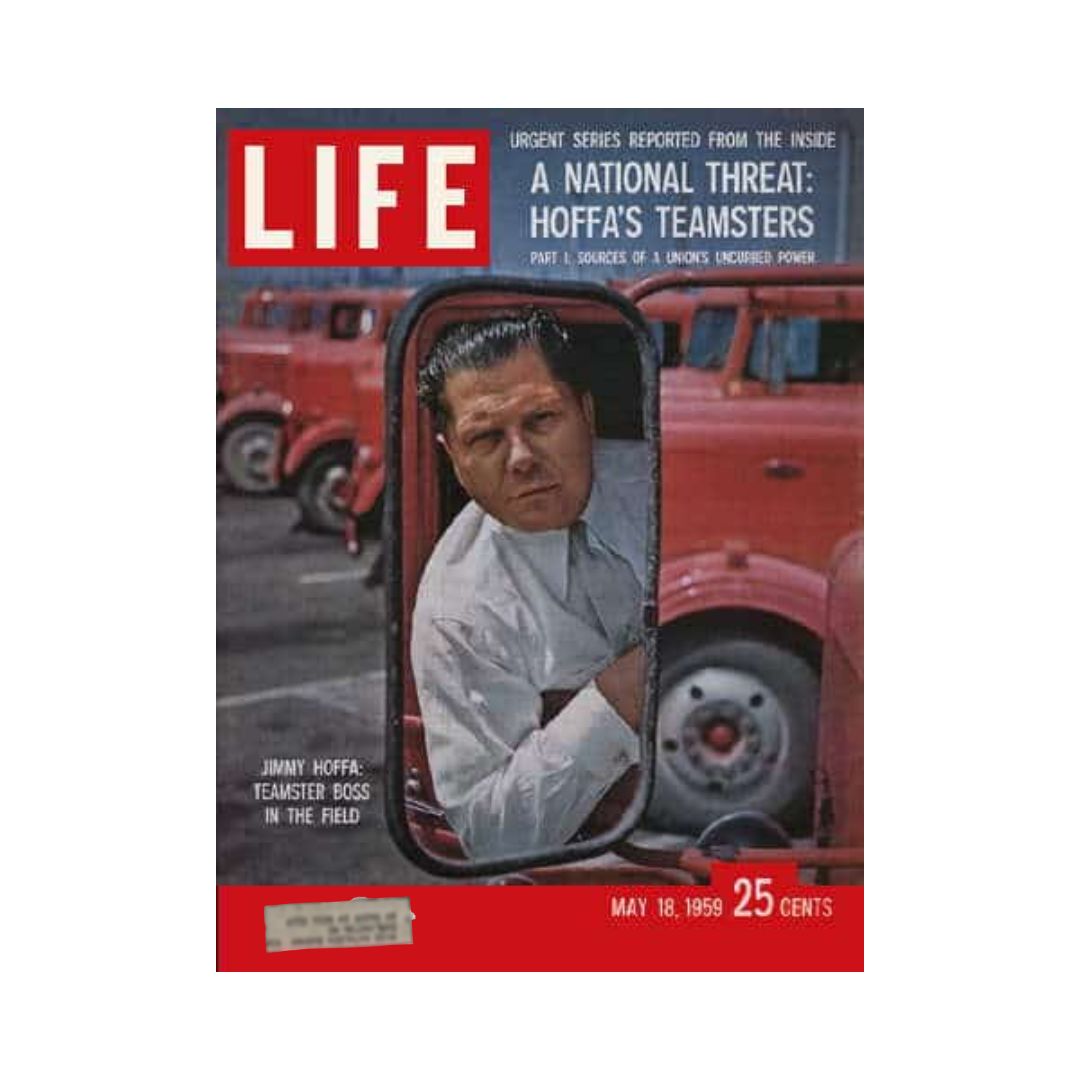
Vintage magazines approached the Teamsters boss with a fascination that bordered on obsession, and the editorial coverage reflected every contradictory dimension of the man. Life magazine — the era's great visual chronicler of American life — ran striking, close-framed portraits that captured the bulldog intensity behind his eyes, often pairing them with sprawling features on union power, Senate hearings, and the strange theater of his legal battles. Time put the labor movement and its most combative face on its covers during the height of the McClellan Committee hearings in the late 1950s, framing him as both a symbol of union might and a question mark over American institutional integrity. Newsweek, meanwhile, offered a more forensic editorial lens — tracking his 1964 jury-tampering conviction, his years at Lewisburg Federal Penitentiary, and later, the chilling open-ended mystery of his final afternoon in a Detroit-area parking lot. Beyond American shores, international publications such as Paris Match and British news weeklies occasionally trained their gaze on him as a uniquely American phenomenon — the gravel-voiced son of a coal miner who had clawed his way to the commanding heights of a nation's economy, and then simply ceased to exist.
Curator's Checklist: Highlights Often Include
- Senate Hearing Coverage (1957–1959): Issues documenting the McClellan Committee investigations, featuring dramatic photography of the adversarial exchanges between the Teamsters chief and a young, sharp-suited Robert F. Kennedy — some of the most electrically charged moments in postwar American political theater
- Trial & Conviction Features (1964): Editorial deep-dives and news magazine covers surrounding his federal prosecution for jury tampering and fraud — a legal saga that consumed front pages and captivated a nation already raw from the Kennedy assassination
- Nixon Pardon & Prison Release (1971): Coverage of his release from Lewisburg following presidential commutation, often accompanied by analysis of the political backchannels and union leverage that surrounded the decision
- Labor Movement Retrospectives: Broader features on Teamsters power during the 1950s–70s, in which the union's dominant personality looms large — offering rich context on postwar working-class America, trucking industry economics, and the complex relationship between organized labor and organized crime
- Disappearance & Aftermath (1975–onward): Perhaps the most sought-after issues among collectors — news weeklies and investigative magazines from the weeks and months following July 30, 1975, brimming with theories, FBI statements, and the eerie silence where an answer should have been
The Collector's Value
To hold one of these original issues is to hold a piece of a mystery that has never officially been solved — and to feel, in the most visceral and physical way, the pulse of a country trying to make sense of one of its most bewildering figures. The paper stock of a 1950s Life or a mid-1960s Time has a weight and texture that no digital scan can replicate: the slight give of coated newsprint, the smell of decades-old ink that carries something of the pressroom urgency with which these stories were rushed to print, the surrounding advertisements for Chevrolets and Lucky Strikes and American Airlines that place you irrevocably inside the era. These are primary source documents — not reprints, not facsimiles — artifacts that sat on American kitchen tables and barbershop counters while the events they described were still unfolding in real time. For collectors of American labor history, mid-century true crime and organized crime ephemera, or Cold War–era political journalism, these publications offer an irreplaceable firsthand window into one of the twentieth century's most enduring unsolved stories. Browse the current selection of available original issues below, and find the piece of history waiting to complete your archive.