📖 About this Collection
John Hinckley Jr.: The Day That Stopped the Nation's Clock
The Legend & The Legacy
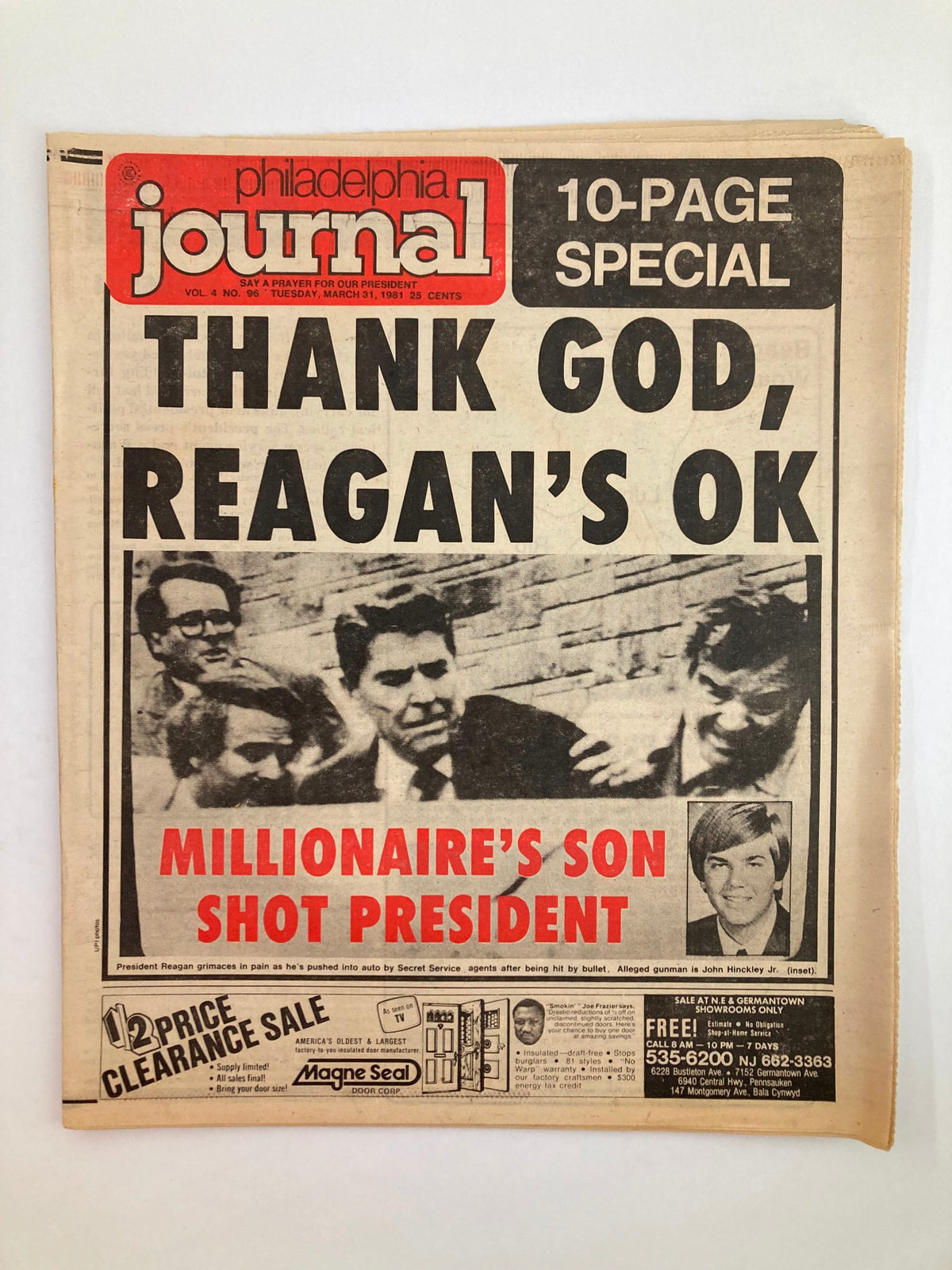
On the afternoon of March 30, 1981, the trajectory of American political history shifted in a single, shattering moment outside the Washington Hilton Hotel. The attempted assassination of President Ronald Reagan by a twenty-five-year-old drifter from Texas thrust an unlikely, deeply troubled young man onto the front pages of every newspaper and magazine in the world. Unlike the assassinations of the 1960s, this event unfolded in the full glare of network television cameras — and yet it was the print media, with its capacity for depth, portraiture, and reflection, that truly excavated the story. The weeks and months that followed produced some of the most psychologically probing magazine journalism of the decade, as editors and writers struggled to answer the question that haunted an entire nation: Who was this man, and how did a society produce him? The trial, the insanity defense, the revelation of his obsessive fixation on actress Jodie Foster and the film Taxi Driver, and his subsequent decades of institutionalization and slow rehabilitation made him one of the most persistently fascinating — and disturbing — figures in the modern American archive.
Inside the Archive
The coverage that followed the shooting was immediate, vast, and remarkably varied in its editorial approach. News weeklies led with dramatic wire photography — the chaos on the sidewalk, the President being shoved into the limousine, press secretary James Brady collapsed on the pavement — images that were reproduced across dozens of issues and have since become defining visual documents of the Reagan era. As the story deepened into courtroom drama and psychiatric testimony, publications shifted toward long-form psychological profiles, illustrated with courtroom sketches and eerie, clinical portrait photography. Time and Newsweek competed aggressively for the definitive cover story throughout 1981 and again during the landmark 1982 trial, producing some of their most compellingly designed issues of the period. People magazine explored the human dimensions of the story — the Hinckley family's anguish, the victims' long recoveries, the culture of celebrity obsession that seemed to lurk at the heart of the case. Internationally, publications such as Paris Match framed the event through the lens of American political fragility, offering a distinctly European perspective on violence, fame, and the peculiar pathologies of modern media culture.
Curator's Checklist: Highlights Often Include
- Immediate aftermath issues (Spring 1981): News weeklies from the days and weeks following March 30th, featuring front-line photography, emergency room reports, and the first attempts to piece together a biographical portrait of the shooter
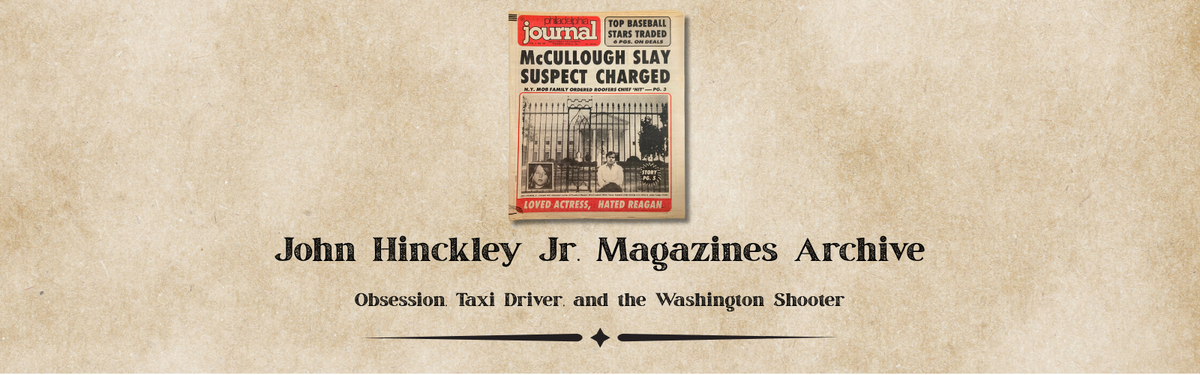
- Trial coverage (1982): Issues documenting the landmark insanity defense proceedings — one of the most consequential and controversial trials in American legal history — including coverage of the Taxi Driver obsession and the letters written to Jodie Foster
- Reagan recovery narratives: Concurrent coverage celebrating the President's survival, offering a fascinating dual portrait of American resilience and vulnerability within the same pages
- Psychological and cultural deep-dives: Feature-length magazine essays from the early-to-mid 1980s examining celebrity obsession, the influence of violent cinema, and the crisis of mental health treatment in America — often using this case as their central lens
- Decades-later retrospectives: Issues from the 1990s through the 2000s revisiting the case during parole hearings and legal milestones, reflecting on how America's understanding of mental illness and criminal responsibility had — or had not — evolved
The Collector's Value
To hold one of these original issues in your hands is to re-enter a moment of profound national suspension — a moment when the world genuinely did not know, for several hours, whether a sitting American president would survive. The paper stock of early 1980s news weeklies carries its own testimony: the slightly rough texture of pages turned under urgency, the dense, saturated ink of cover photographs printed at maximum contrast to convey maximum gravity, the surrounding advertisements for cigarettes, department stores, and American automobiles that root the reader irrevocably in a vanished world. These are not reprints or digital facsimiles; they are primary source documents, artifacts of the precise cultural and emotional temperature of their moment. For collectors of presidential history, true crime and criminal justice ephemera, or Reagan-era Americana, these publications offer something no documentary or podcast ever can — the unmediated, unrevised record of history being processed in real time, by real editors, for a genuinely shocked public. Explore the current available inventory below, and discover which pieces of this extraordinary chapter are waiting to be added to your collection.