📖 About this Collection
Juan Perón: The Strongman, the Spectacle, and the Eternal Return
The Legend & The Legacy
Few figures in twentieth-century history commanded the printed page with the same volcanic intensity as Juan Domingo Perón. From his electrifying rise through Argentina's military ranks to the mass mobilizations that filled the Plaza de Mayo, the general-turned-president was tailor-made for an era when magazines were the world's window onto power. In a time before television dominated the living room and long before the internet collapsed geography, international correspondents and photojournalists raced to Buenos Aires to document the phenomenon unfolding on the southern cone of South America — a populist revolution wrapped in military regalia, animated by the charisma of a leader and the incandescent presence of his wife, Eva. Domestic Argentine publications treated him with the reverence of a national father; foreign press corps viewed him with a mixture of fascination and alarm. His labor reforms, his nationalization of industries, and his doctrine of Justicialismo gave editors and columnists endless ideological terrain to map — and they did so with the breathless urgency that only print, in that era, could sustain. Either way, the presses never stopped running, and the sheer volume of coverage produced across two continents means that the archive of his era is among the richest and most visually compelling of any twentieth-century political figure.
Inside the Archive
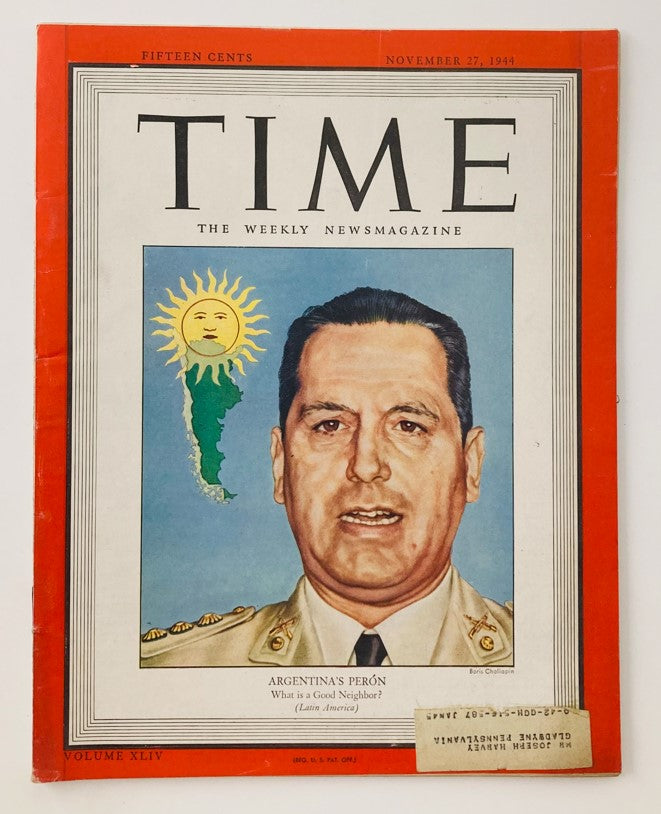
The visual iconography of the Perón era was deliberate and cinematic, and the magazines of the 1940s and 1950s rose to meet it. Photographers captured the General in full dress uniform on the balconies of the Casa Rosada, arms outstretched toward seas of descamisados, his expression sculpted between authority and warmth. Publications such as Life magazine dispatched correspondents to chronicle what American editors framed as a dangerous new strain of Latin authoritarianism, producing sweeping photo essays that are today extraordinary primary documents of Cold War anxiety. Paris Match, with its legendary instinct for drama and portraiture, covered the Peróns as a kind of geopolitical royalty — the power couple of the Southern Hemisphere — while the illustrated Argentine weekly Mariz and the influential Radiolandia fed a domestic readership hungry for every detail of their leader's image and ideology. Time magazine, never shy about placing the hemisphere's most provocative leaders on its iconic cover, engaged with his legacy repeatedly across different decades, framing and reframing the Peronist question as Argentina lurched between democracy and military rule. The editorial tone swings dramatically depending on the publication's origin: inside Argentina, the coverage was often hagiographic and lavishly designed, thick with official portraiture and patriotic color; abroad, it was analytical, cautionary, and frequently riveted by the enigma of the woman standing beside him — a former actress turned political force whose own story threatened to eclipse that of the president himself.
Curator's Checklist: Highlights Often Include
-
Rise to Power Coverage (mid-1940s): Issues documenting his ascent from Secretary of Labor to President in 1946, often featuring dramatic crowd photography from the October 17th mobilization — the founding myth of Peronism — and early editorial portraits projecting military gravitas. Some issues from this window also capture the charged atmosphere of wartime neutrality debates, as Argentina's refusal to align with the Allies made its new strongman a figure of intense international scrutiny.
-
The Evita Years: Coverage in which the First Lady dominates the frame alongside him, reflecting the couple's carefully orchestrated joint image; particularly sought-after are issues from her 1947 European "Rainbow Tour" and the period surrounding her death in 1952. The mourning that swept Argentina after Evita's passing at thirty-three generated some of the most emotionally raw magazine photography of the entire postwar decade, and issues from that period are among the most prized by serious collectors.
-
International Reaction and Cold War Context: Foreign publications — particularly American and European weeklies — often framed the regime within broader anxieties about fascism, neutrality, and hemispheric influence, offering a striking counterpoint to the celebratory tone of domestic Argentine press. Coverage from this angle frequently drew comparisons to European authoritarian models, making these issues fascinating artifacts of how the Western world was struggling to categorize a leader who defied easy political taxonomy.
-
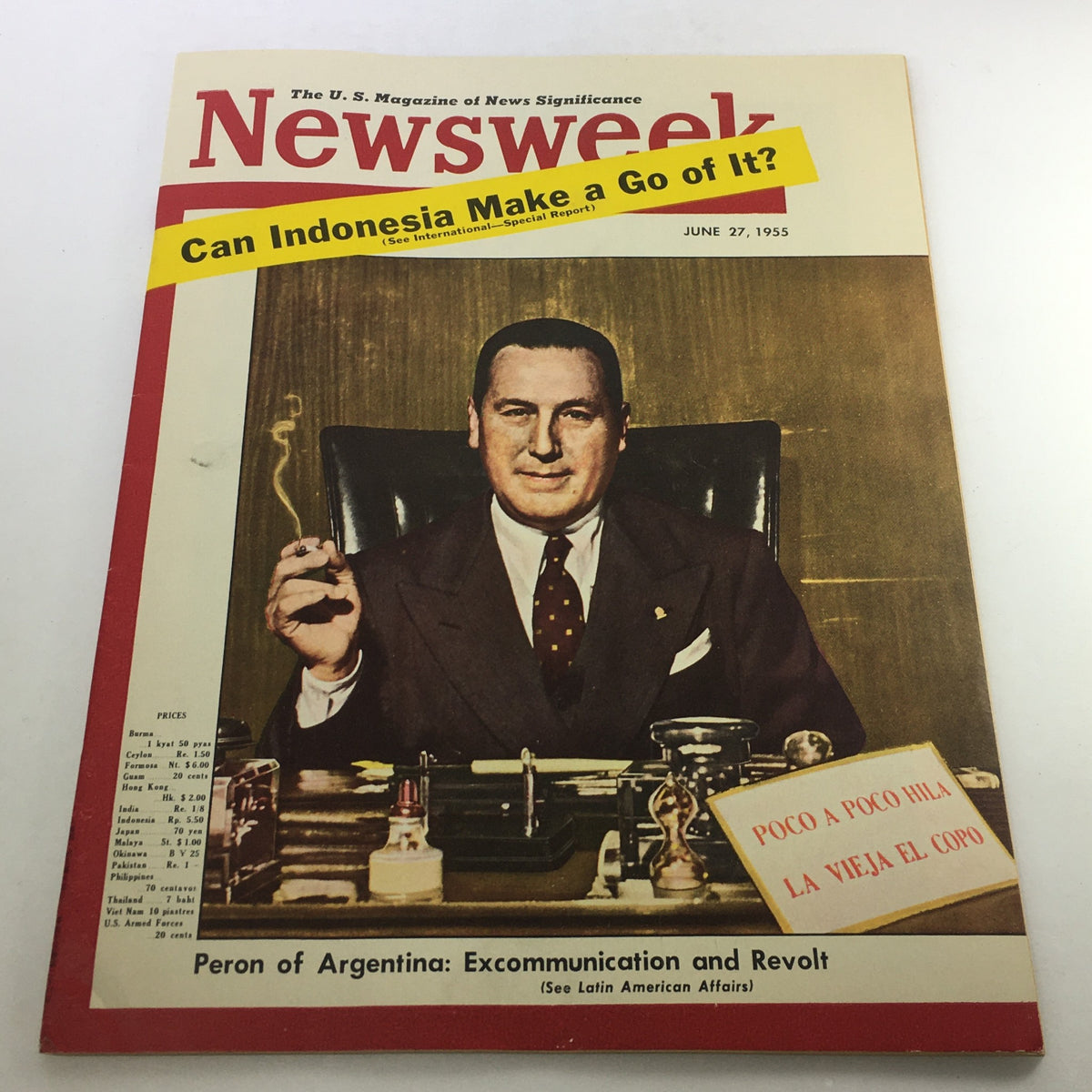
The 1955 Coup and Exile: Issues covering the Revolución Libertadora that ousted him, his flight into exile, and the subsequent banning of his very name inside Argentina — a surreal chapter well-documented by international newsmagazines. The visual contrast between the triumphant leader of earlier issues and the exiled figure photographed in Panama, Venezuela, and eventually Franco's Spain gives a collector's archive of this era a genuinely novelistic arc.
-
The Triumphant Return (1973): Coverage of his return from nearly two decades of exile in Madrid and his re-election to the presidency, an event that drew millions to Ezeiza Airport in one of the most photographed — and tragically violent — homecomings in political history. Publications from this moment grapple with the strange spectacle of an aging caudillo reclaiming power in a country transformed by a generation of upheaval, and the photography from this chapter has a haunted, elegiac quality entirely distinct from the bold confidence of the early years.
The Collector's Value
To hold an original magazine from the Perón era is to hold something that no digitized archive can replicate — the weight of coated mid-century paper stock, the slightly oxidized tang of decades-old ink, the surrounding advertisements for Argentine consumer goods or American automobiles that place you irrevocably inside a specific cultural moment. These are not reprints or facsimiles; they are artifacts that existed in real hands, in real homes, at the very moment history was being made and debated across kitchen tables and café counters from Buenos Aires to Barcelona. The typography, the layout philosophies, the editorial choices about which photograph to run and at what size — all of it speaks volumes about how the world was processing one of the most polarizing leaders of the modern age. To page through a surviving copy of Life or Paris Match from 1952 is to experience the unmediated rhythm of how information arrived in that world — slowly, deliberately, in gorgeous full-bleed photographs and densely argued columns that rewarded sustained attention in a way the modern scroll never can. The very impermanence of these objects — the brittleness of aged newsprint, the fading of covers left too long in sunlight — makes each surviving copy a minor miracle of preservation, a physical vessel carrying six, seven, or eight decades of history on its pages. For collectors of Latin American political history, mid-century photojournalism, or populist and Cold War-era ephemera, these publications offer an irreplaceable primary-source intimacy that no biography or documentary can approach. Browse the current available inventory below and discover which pieces of this extraordinary chapter in world history are waiting to find their next custodian.