📖 About this Collection
Julia Child: The Kitchen Was Her Stage, and the World Pulled Up a Chair
The Legend & The Legacy
Before food television became an empire and celebrity chefs filled primetime slots, there was one woman standing at an oversized stove, laughing at her own mistakes, and utterly transforming the way Americans thought about cooking. Julia Child arrived on public television in 1963 with The French Chef and immediately became something the culture had never quite seen: a towering, unpolished, gloriously authentic presence who treated her audience as intelligent adults worthy of real technique. She did not sell convenience — she sold confidence. In an era when the ideal American housewife was expected to open cans and set timers, Julia was deglazing pans with cognac and deboning whole ducks on afternoon television. Her landmark cookbook, Mastering the Art of French Cooking, co-authored with Louisette Bertholle and Simone Beck, had already seduced the literary world in 1961, but it was print media — the glossy magazines stacked on coffee tables and tucked into kitchen drawers across the country — that carried her face, her philosophy, and her considerable warmth into millions of American homes. Long before a single cable channel existed, readers met her on the page first.
Inside the Archive
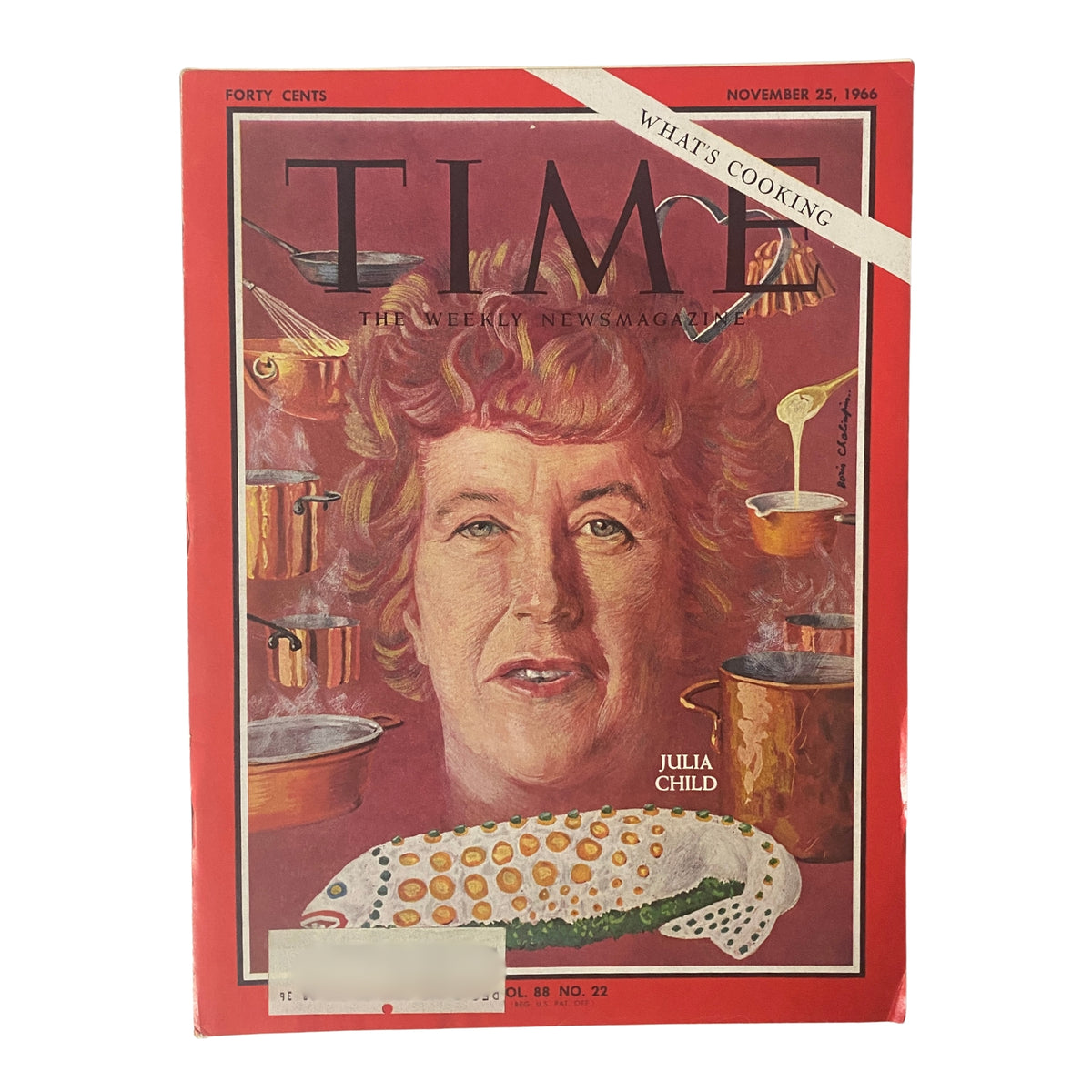
Vintage magazines approached Julia Child with a reverence typically reserved for heads of state or Hollywood royalty, and the photography reflected that. Editorial spreads frequently placed her in her element — apron-clad, mid-gesture, surrounded by copper pots and the beautiful chaos of a working kitchen — conveying an energy that was simultaneously masterful and deeply approachable. Time magazine, recognizing a genuine cultural phenomenon, put her on its cover in 1966 in one of the era's most iconic food-world portraits, cementing her status not merely as a cooking instructor but as an American institution. McCall's and Ladies' Home Journal, the great arbiters of mid-century domestic life, published her recipes, profiled her marriage to the devoted Paul Child, and explored her years in Paris with the swooning editorial warmth those magazines did so well. Food-focused titles and general-interest publications alike found her irresistible copy — her backstory, her late-blooming career beginning only in her late thirties, her wartime OSS service, and her absolute refusal to condescend made for rich, layered storytelling that editors returned to again and again across four decades of coverage.
Curator's Checklist: Highlights Often Include
- Early television era features (1963–1970): Coverage tied to the launch and runaway success of The French Chef on PBS, often exploring the novelty of serious culinary instruction on public television and her immediate, unexpected cultural impact
- Cookbook milestone tributes: Editorial features surrounding the publication of Mastering the Art of French Cooking and its sequels, frequently accompanied by recipe excerpts, kitchen photography, and profiles of her collaborative partnership with her co-authors
- Profile pieces on her Paris years and personal life: Deeply reported features on her time at Le Cordon Bleu, her marriage to diplomat and artist Paul Child, and her unconventional path to culinary authority — a story that resonated powerfully with women readers of every generation
- Holiday and seasonal recipe issues: Major women's service magazines regularly featured her guidance for holiday entertaining throughout the 1970s and 1980s, issues now prized for their period recipes, vintage food styling, and surrounding advertisements for now-defunct American brands
- Later-career retrospectives and cultural legacy pieces: As American food culture matured through the 1980s and 1990s, publications revisited her foundational influence on the culinary world, often in rich anniversary features that read today as primary historical documents of the food revolution she sparked
The Collector's Value
There is something quietly extraordinary about holding a magazine from 1966 that carries Julia Child's face on its cover — the slight give of paper that has absorbed sixty years of atmosphere, the faintly sweet mustiness of ink that predates digital prepress, the surrounding advertisements for Jell-O molds and electric ranges that frame her modernity in delicious historical irony. These are not reprints or facsimiles; they are the precise objects that real readers held in real kitchens, dog-earing pages and clipping recipes that would go on to change how a generation cooked. They capture a woman in the act of becoming legendary, documented in real time by journalists and photographers who sensed, correctly, that something significant was happening. For collectors of culinary history, mid-century Americana, or women's cultural history, these publications offer an irreplaceable primary-source window into the moment American food culture grew up — tactile, beautiful, and wholly authentic. Explore the current available inventory below and find the piece of her story that belongs in your collection.