
📖 About this Collection
Kurt Angle: The Man Who Made the World Tap
The Legend & The Legacy
In an era before streaming platforms and social media feeds dictated public perception, Kurt Angle's rise from blue-collar Pittsburgh wrestler to Olympic gold medalist — and later, professional sports entertainment superstar — was consumed almost entirely through the printed page. His legendary 1996 Atlanta Olympics performance, where he won gold in freestyle wrestling with a broken neck and torn meniscus, was the kind of story that print journalists lived to tell. Sports magazines leaned into the almost mythological dimensions of his achievement: an everyday American kid, grinding through pain with impossible discipline, standing atop the podium with a medal that felt like it had been forged from sheer will. For years after, the wrestling world and mainstream sports press alike tracked his unprecedented crossover into the WWE, where a legitimate Olympic champion brought an entirely new credibility to sports entertainment — a tension that made for irresistible editorial copy throughout the late 1990s and 2000s.
Inside the Archive
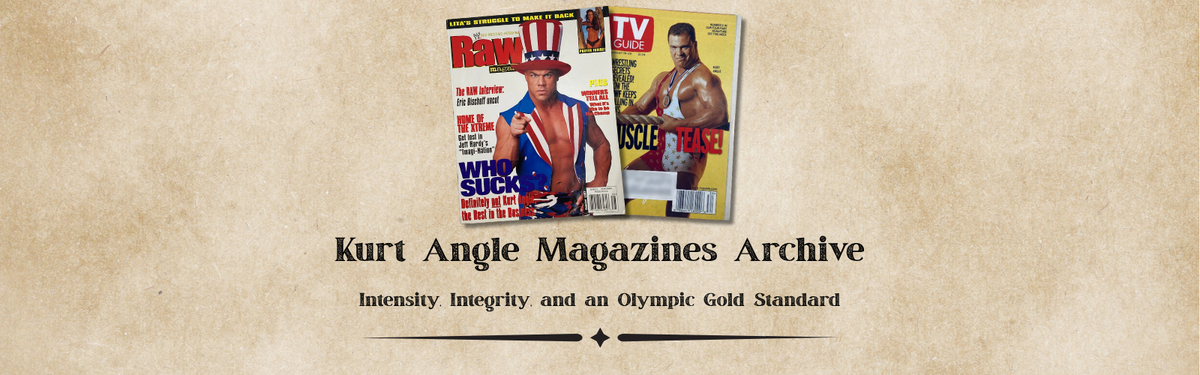
The photography that accompanied Kurt Angle's coverage across print media tells two distinct stories. In the sports press of the mid-1990s, editorial photographers captured him in the unadorned, almost austere aesthetic of amateur athletics — singlets, sweat, and the raw geometry of a wrestling mat — images that communicated sacrifice and national pride above all else. Then came the WWE era, and with it a more theatrical, high-contrast visual language: the gleaming gold medals worn with a showman's knowing grin, the arena pyrotechnics frozen in the background of a carefully staged promotional shot. Sports Illustrated covered his Olympic triumph extensively, framing him within the great American underdog tradition, while Wrestling Observer Newsletter and its print contemporaries became indispensable documents of his professional career, tracking every title reign and creative arc with the seriousness of a trade journal. Mainstream publications such as TV Guide also captured this period, reflecting just how deeply the WWE's late-1990s attitude era — and Angle's central role within it — had penetrated American popular culture beyond the traditional wrestling audience.
Curator's Checklist: Highlights Often Include
- Olympic glory coverage — Feature-length print tributes to his 1996 Atlanta gold medal victory, often accompanied by the iconic podium photography and deeply reported accounts of the broken neck narrative that made the achievement feel almost unbelievable
- WWE debut and attitude era features — Editorial pieces from the turn of the millennium documenting his arrival in professional wrestling, with commentary on the cultural curiosity of an authentic amateur champion entering the scripted spectacle
- Championship reign retrospectives — Coverage of his multiple WWE and ECW title reigns, including the storied feuds with The Rock, Stone Cold Steve Austin, and Shawn Michaels that defined an era
- Crossover mainstream profiles — Pieces from general sports and entertainment publications that grappled with his identity as both a legitimate world-class athlete and a beloved on-screen character, a duality few performers have ever navigated
- TNA/Impact Wrestling era documentation — Collector-relevant print coverage from the mid-to-late 2000s and beyond, chronicling his celebrated run in professional wrestling's most ambitious alternative promotion of that period
The Collector's Value
There is something irreplaceable about holding a magazine from the precise cultural moment it was printed. The slightly rough texture of newsprint beneath your fingertips, the warm amber tinge that only decades of time can give to a page, the faint ghost of ink and paper that rises when you open a cover for the first time in years — these are experiences that no digital archive can replicate, and they are precisely what makes original print issues so deeply coveted. A vintage sports magazine featuring the Olympic hero is not merely a collectible; it is a primary source document, a frozen fragment of how the world felt about a singular athlete in the very moment his story was unfolding. The surrounding advertisements — the sneakers, the energy drinks, the pay-per-view promotions of a bygone era — only deepen the time-capsule quality, situating the subject within the full texture of the cultural moment. For collectors of Olympic sports memorabilia, professional wrestling history, or late-1990s and early-2000s Americana, these publications offer an intimacy and authenticity that framed prints and replica merchandise simply cannot touch. Browse the current available inventory below, and find the issue that belongs in your collection.


