📖 About this Collection
Selena: Queen of Cumbia, Dreamer of Worlds
The Legend & The Legacy
In the years before streaming algorithms and social media feeds decided what the world would love, a young woman from Corpus Christi, Texas captured an entire continent through sheer force of talent, warmth, and an incandescent stage presence that no screen could fully contain. Selena Quintanilla-Pérez became the best-selling Latin artist of the 1990s not through viral moments, but through the slow, profound accumulation of devotion — sold-out arenas, gold records, and a crossover moment that felt, to millions, like a cultural coronation. Her story was one that mainstream America was only beginning to understand when it was suddenly, tragically cut short in March of 1995. In the weeks and months that followed, the press scrambled to tell the world what her fans already knew: that she was not simply a pop star, but a generational figure, a proud Mexican-American icon who had made an entire community feel seen in the pages of publications that had long looked elsewhere. That reckoning played out, in real time, on the printed page — in ink and photography and breathless obituaries that tried, and often failed, to measure the size of what had been lost.
Inside the Archive
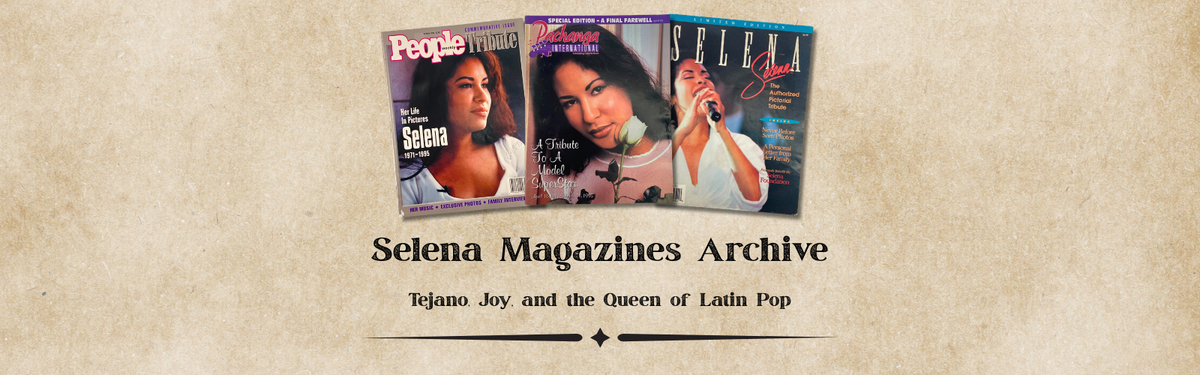
The coverage of Selena in vintage print is a study in contrasts — and in the gradual dawning of mainstream recognition. Spanish-language publications such as People en Español, which launched its inaugural issue with her image on the cover in 1996 as an act of direct tribute, had tracked her ascent for years with the full-throated enthusiasm she deserved, running glossy spreads that celebrated her rhinestone-studded Tejano costumes, her radiant smile, and the sheer theatricality of her performances. Mainstream titles like People and Entertainment Weekly came to her story largely through the prism of tragedy, publishing extensive memorial issues and retrospectives in 1995 that introduced her, posthumously, to an audience that had been slow to pay attention. Billboard magazine, meanwhile, had documented her chart dominance and the historic crossover promise of her English-language album Dreaming of You with the sober authority of the music industry's paper of record. Across all of these publications, the photography shares a common quality: an unguarded luminosity, a subject who commanded the lens without ever seeming to perform for it.
Curator's Checklist: Highlights Often Include
- Memorial and tribute issues from 1995, in which major publications published extended profiles, candid photographs, and reflections from collaborators — among the most emotionally significant documents in any Selena archive
- Spanish-language entertainment weeklies and fan magazines from the early-to-mid 1990s covering her Tejano chart victories, regional tour announcements, and fashion features that documented her signature aesthetic before it became iconic
- Music industry trade publications from 1994–1995 tracking the extraordinary commercial momentum of Amor Prohibido and the anticipation surrounding her English-language debut
- Texas and Southwest regional publications that covered her as a hometown hero and community figure long before the national press arrived — offering an intimate, ground-level portrait unavailable anywhere else
- Post-1997 issues responding to the release of the Jennifer Lopez biographical film, which prompted a second wave of feature coverage, reassessment pieces, and a new generation of collectors encountering her story for the first time in print
The Collector's Value
To hold one of these magazines is to hold a piece of a story that the digital world has flattened into memes and streaming playlists. The weight of a 1995 memorial issue — its slightly oversized pages, the soft give of newsprint against glossy stock, the faint, sweet mustiness of decades-old ink — restores to her story the gravity and texture that time tends to smooth away. The surrounding advertisements are themselves a time capsule: perfume campaigns and fashion spreads that place her image squarely within the cultural moment she inhabited, reminding us that she was not a legend in amber but a living force in a living world. For collectors of Tejano music and Latin pop history, Chicano cultural heritage, or 1990s music memorabilia, these publications offer something no reprint or digital archive can replicate — a primary source, untouched and irreplaceable, that bears witness to a story the world is still learning to fully tell. Explore the current available inventory below and find the piece of history that speaks to you.