📖 About this Collection
Steve Reeves: The Last Olympian in Print
The Legend & The Legacy
Before the age of social media, before fitness influencers and streaming blockbusters, there was a man whose physique and presence seemed almost mythological — a living sculpture who crossed from the competitive bodybuilding stage in York, Pennsylvania, straight onto the grand stages of Cinecittà studios in Rome. Steve Reeves won the Mr. Universe title in 1950 and almost immediately became the international face of a new kind of masculine ideal: powerful yet graceful, heroic yet accessible. When his portrayal of Hercules in the 1958 Italian epic of the same name was dubbed into English and swept across American drive-ins and European cinema houses, millions encountered him not through television interviews or digital clips, but through the glossy, ink-heavy pages of fan magazines, bodybuilding journals, and international film weeklies. In an era when a single photograph in the right publication could define a celebrity's entire public persona for a decade, his chiseled image became one of the most reproduced in both the fitness world and the emerging "sword-and-sandal" peplum genre — a cultural phenomenon that is today deeply and lovingly documented in print.
Inside the Archive
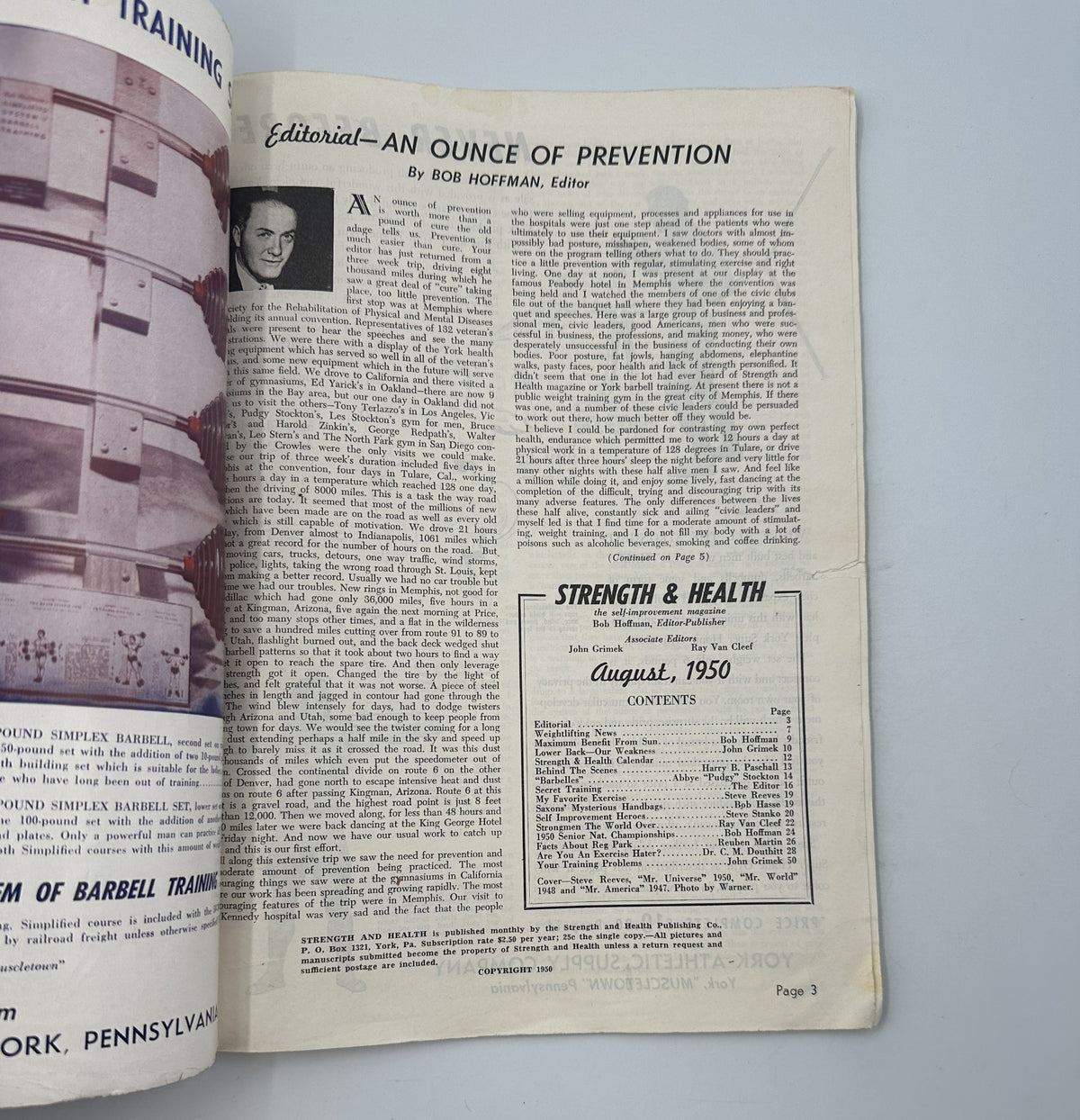
Vintage magazines of the 1950s and 1960s treated Reeves with the reverence one might expect reserved for ancient gods — which was, of course, entirely the point. Bodybuilding publications such as Strength & Health and Muscular Development were among the first to chronicle his rise through amateur competition, publishing dramatic black-and-white photographs that emphasized the extraordinary symmetry of his physique with an almost clinical, sculptural admiration. When Hollywood — or rather, the Italian film industry — transformed him into an international box-office sensation, the coverage expanded dramatically. Movie Life and Screen Stories, the beloved mid-century fan magazines stacked in American beauty parlors and drugstore racks, ran breathless feature profiles and full-color photo spreads, positioning him alongside the conventional studio stars of the era despite his distinctly independent, European-produced filmography. Internationally, publications like Ciné Revue and various Italian fotoromanzo weeklies covered him with a fervor that rivaled the treatment of any Hollywood icon, reflecting just how deeply the Hercules films had penetrated European popular culture. The editorial tone across all of these was consistently reverential — here was not merely an actor, but an ideal made flesh.
Curator's Checklist: Highlights Often Include
- Competition & Physique Features — Early bodybuilding magazine coverage from the late 1940s and early 1950s documenting his amateur career, Mr. America (1947) and Mr. Universe (1950) victories, often accompanied by posed physique photography and training editorial
- Peplum Film Promotions — Movie magazine spreads and studio-adjacent features tied to the release of Hercules (1958), Hercules Unchained (1959), and subsequent sword-and-sandal epics, frequently including on-set photography from Italian productions
- International Fan Magazine Coverage — European publications, particularly Italian and French film weeklies, offering a fascinating contrast to American coverage and reflecting his enormous overseas celebrity
- Crossover Health & Lifestyle Features — Articles in general men's health and physical culture magazines of the late 1950s and early 1960s presenting him as the living embodiment of a healthy, disciplined lifestyle — a proto-wellness icon
- Later Career & Western Era Coverage — Rarer but collectible features from the mid-1960s documenting his transition into Spaghetti Western-adjacent productions and his eventual, deliberate retreat from Hollywood, lending these issues a quietly elegiac quality
The Collector's Value
To hold one of these original issues is to hold a direct artifact of the moment when bodybuilding first became cinema, and cinema first gave the world a modern Hercules. The paper itself tells part of the story — the slightly brittle, yellowed pages of a mid-century fan magazine carry a weight and fragrance that no digital archive can replicate, and the surrounding advertisements for Brylcreem, Kodak cameras, and American automobiles place the subject firmly within the cultural world that produced him, transforming each issue into a complete time capsule rather than a mere celebrity document. The printing techniques of the era, with their slightly saturated color separations and dramatic high-contrast monochrome spreads, render even familiar photographs with a graphic power that modern reproduction simply cannot match. For collectors of classic bodybuilding and physical culture history, golden-age cinema and peplum film memorabilia, or mid-century men's lifestyle and Americana, these publications offer primary source documentation of a figure who shaped the aesthetics of heroism for an entire generation — and whose influence quietly echoes in every superhero film made today. Browse the current available inventory below and discover which pieces of this remarkable legacy are waiting to find their next custodian.