📖 About this Collection
The Notorious B.I.G.: Crown of the Concrete Jungle
The Legend & The Legacy
In the brief, blazing years between 1994 and 1997, Christopher Wallace — born in Brooklyn, destined for mythology — rewrote the grammar of American popular culture. Before streaming algorithms and social media feeds could flatten an artist into content, the Notorious B.I.G. was experienced through something far more deliberate: the physical page. Fans read about him in cover stories passed hand to hand on subway platforms, in barbershops, in college dormitories. His rise from Bed-Stuy's Fulton Street to the commanding heights of Bad Boy Records was chronicled in real time by journalists who understood they were watching history being made. The East Coast-West Coast rivalry, his two landmark albums, his larger-than-life persona, and his devastating murder in March 1997 at the age of 24 — all of it landed on newsstands, unfiltered and immediate, in an era when print still carried the full weight of cultural authority. To hold a magazine from that period is to hold a primary document of one of the most turbulent and creatively fertile chapters in the story of hip-hop.
Inside the Archive
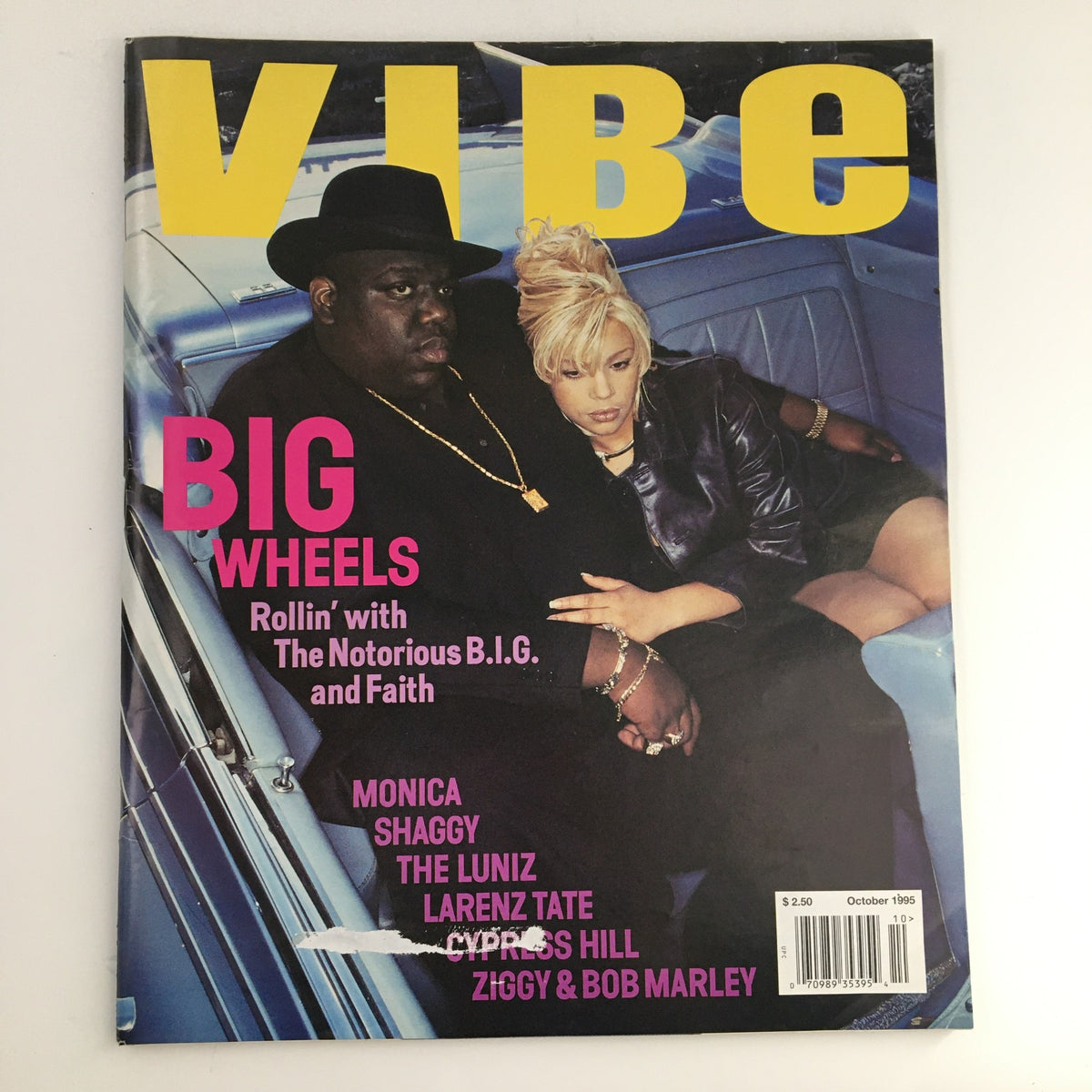
Vintage magazine coverage of the Brooklyn titan reflects the visual and editorial energy of mid-1990s America — a culture simultaneously seduced and unsettled by hip-hop's ascent into the mainstream. Photographers captured him with a commanding, almost cinematic gravity: the crown imagery, the tailored suits, the contradictions of menace and warmth held in a single frame. Editorial voices ranged from celebratory to cautious, often wrestling with how to contextualize a figure of such enormous commercial power who had emerged from poverty and remained unabashedly rooted in it. The Source and Vibe — the twin bibles of hip-hop journalism in that era — produced some of the most iconic coverage, deploying long-form profiles and sprawling photo shoots that treated rap artists with the seriousness previously reserved for rock royalty. Rolling Stone, bridging the gap between mainstream rock culture and the seismic shifts happening in Black music, also devoted significant ink to his story, particularly in the wake of his death and the ensuing cultural reckoning about the costs of the East-West conflict.
Curator's Checklist: Highlights Often Include
- Landmark cover features from Vibe and The Source during the 1994–1997 window, often coinciding with the releases of Ready to Die and Life After Death, representing the peak of his cultural visibility
- Tribute and memorial issues published in the weeks and months following March 1997, in which editors across hip-hop, mainstream music, and general culture press grappled with the magnitude of the loss
- East Coast-West Coast rivalry coverage — feature-length investigations and editorial essays from the mid-1990s that document one of pop culture's most consequential and ultimately tragic feuds
- Crossover mainstream profiles from publications like Rolling Stone reflecting the precise cultural moment hip-hop forced the broader American press to take the genre seriously as an art form and as a commercial force
- Posthumous retrospectives and anniversary editions published in the years following 1997, reassessing his brief catalog and cementing his canonical status alongside the greatest voices in American music
The Collector's Value
There is no digital surrogate for the experience of opening a 1990s hip-hop magazine and finding him there, in his prime, staring back at you from a world still unaware of what was coming. The paper stock of publications from that era has a particular weight and warmth to it — slightly coarser than today's glossy standards, the ink carrying that faintly mineral, decades-old scent that signals authentic ephemera rather than reproduction. Surrounding the editorial features are the advertisements, the fashion spreads, the letters pages and chart listings: a complete, preserved cross-section of a cultural moment that cannot be reconstructed, only recovered. These are not nostalgia pieces. They are primary sources — journalism produced in real time about an artist whose influence on language, fashion, production, and storytelling continues to compound thirty years after his death. For collectors of hip-hop history, 1990s New York culture, or African-American music and media heritage, these publications offer something no playlist or documentary can replicate: the sensation of being present, of reading the story as it was first told. Explore our current rotating inventory below and discover which pieces of that irreplaceable era are available today.