


Description
Collector's Note – Why This Issue Matters
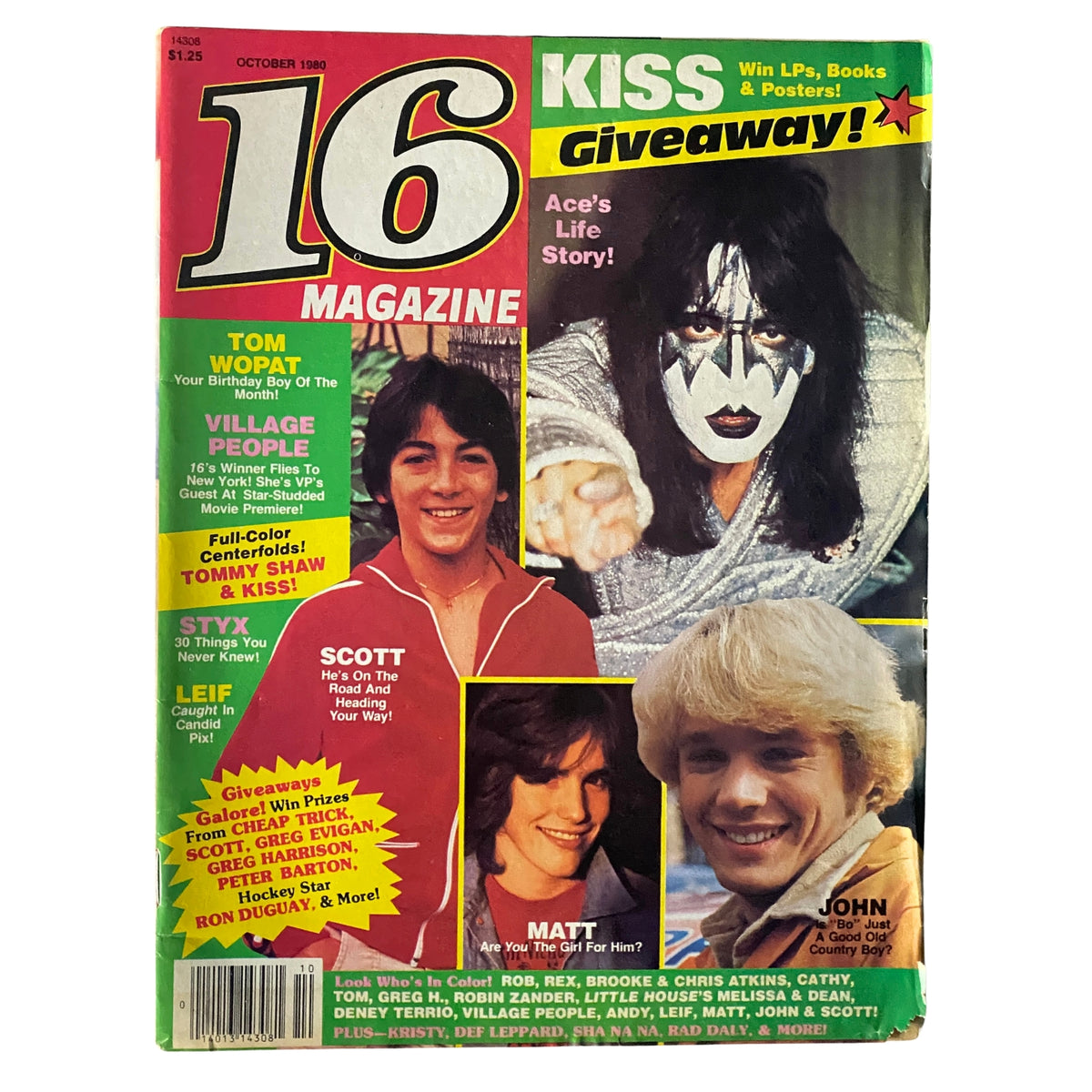
October 1980 captures a specific and significant crossroads in the careers of both Scott Baio and Ace Frehley. Baio was at the height of his Chachi Arcola fame on Happy Days, which was still drawing enormous ratings in its eighth season, and his teen idol status was arguably at its absolute peak — the kind of cultural saturation that made a 16 Magazine cover placement not just expected but almost obligatory. Frehley, meanwhile, was navigating a more complicated moment. KISS had released Unmasked in June 1980, their first album without Peter Criss on drums, and the band's commercial momentum in the United States was showing the first signs of the erosion that would define their early-1980s struggles. An Ace Frehley cover feature in October 1980 therefore documents him in the final sustained period of his original KISS tenure — still fully within the band's public identity, but at a moment when that identity was under more pressure than it had ever been. 16 Magazine's run across the late 1970s and early 1980s is one of the most concentrated documentary records of the teen idol and rock celebrity culture of the period, and this issue's dual focus on television and rock royalty is characteristic of the magazine at its editorial best.
The centerfold content documented in this issue adds substantial collector value. Full-color centerfolds of KISS and Tommy Shaw of Styx — alongside a KISS LP and memorabilia giveaway — place this issue at the intersection of the hard rock and glam rock fandoms that were central to 16's early-1980s readership. Tommy Shaw's inclusion is a precise period marker: Styx had released Cornerstone in late 1979 and were in the middle of the commercial peak that would culminate with Paradise Theatre in January 1981, making fall 1980 the exact moment of their maximum mainstream visibility. A Leif Garrett interview rounds out the editorial mix — Garrett's teen idol career was past its 1978–1979 peak by October 1980, but he remained a fixture in the fan press, and his presence here alongside harder rock content reflects the broad demographic net that 16 cast across its readership. The broader magazine landscape of 1980 captures a pop culture at a genuine transition point, with the MTV era less than a year away from changing everything about how music celebrities were made and marketed.
About the Publication
16 Magazine, founded in 1957 and published through the 1990s, was one of the defining teen fan magazines of the twentieth century. Its format combined celebrity profiles, pin-ups, centerfold posters, contests, and reader correspondence into a package aimed specifically at the teenage audience that drove pop music and television fan culture. By 1980 it was operating alongside Tiger Beat and Teen Beat in a competitive market, each tracking overlapping celebrity rosters through slightly different editorial lenses. The magazine's centerfold and poster content was central to its value proposition, making the presence and condition of those pages the primary consideration for contemporary collectors evaluating surviving issues.
Key Highlights Inside
- Scott Baio and Ace Frehley cover. A pairing that maps the precise intersection of television teen idol culture and hard rock celebrity that defined 16 Magazine's early-1980s editorial identity — Baio at his Happy Days peak alongside Frehley in his final sustained period as a KISS member.
- Full-color KISS centerfold. A significant collector item for the KISS fanbase, produced during the Unmasked era and representing the band's continued dominance of the teen magazine market even as their U.S. commercial fortunes were beginning to shift.
- Full-color Tommy Shaw (Styx) centerfold. Coverage of Styx's lead guitarist and co-vocalist at the exact moment of the band's maximum commercial visibility — between Cornerstone and the release of Paradise Theatre — making this a precise document of their cultural peak.
- Scott Baio interview. An in-depth feature on the Happy Days star at the height of his teen idol status, representing the television celebrity dimension of 16's dual rock-and-TV editorial formula.
- Leif Garrett interview. Coverage of Garrett in the post-peak phase of his teen idol career, reflecting 16's practice of maintaining continuity with established fan favorites even as new subjects emerged.
- KISS LP and memorabilia giveaway. A contest feature that is itself a period document of the KISS merchandise ecosystem and the fan engagement mechanics of early-1980s teen magazines.
Condition & Rarity
The listing describes this issue as in good condition with light wear typical for its age, no address label, and centerfold posters included. For 16 Magazine from October 1980, the no-label status is a meaningful positive — subscription copies, which carried address labels, are considerably more common in the surviving market than clean newsstand examples. The presence of the KISS and Tommy Shaw centerfolds is a critical condition factor for collectors: these pages were the most actively used and most frequently removed from teen fan magazines of this format, and surviving copies with intact centerfolds command significantly more collector interest than those without. The good overall condition with light age-appropriate wear represents a solid example of what the market for early-1980s 16 Magazine offers. Collectors should verify the centerfold pages against the physical magazine to confirm their completeness and condition, as these are the issue's primary collectible assets.
Looking for More Issues Like This?
An October 1980 issue of 16 Magazine with both KISS and Tommy Shaw centerfolds intact, in clean no-label condition, is a specific and desirable find for collectors of early-1980s rock and teen pop culture ephemera. The 16 Magazine collection at OriginalMagazines.com is the most comprehensive place to browse for other issues spanning the magazine's run, including additional early-1980s editions with rock and television celebrity coverage. For collectors building a picture of the broader pop culture landscape this issue inhabits, the 1980 magazine collection covers publications across music, television, and entertainment from across that transitional year.