




Description
Collector's Note – Why This Issue Matters
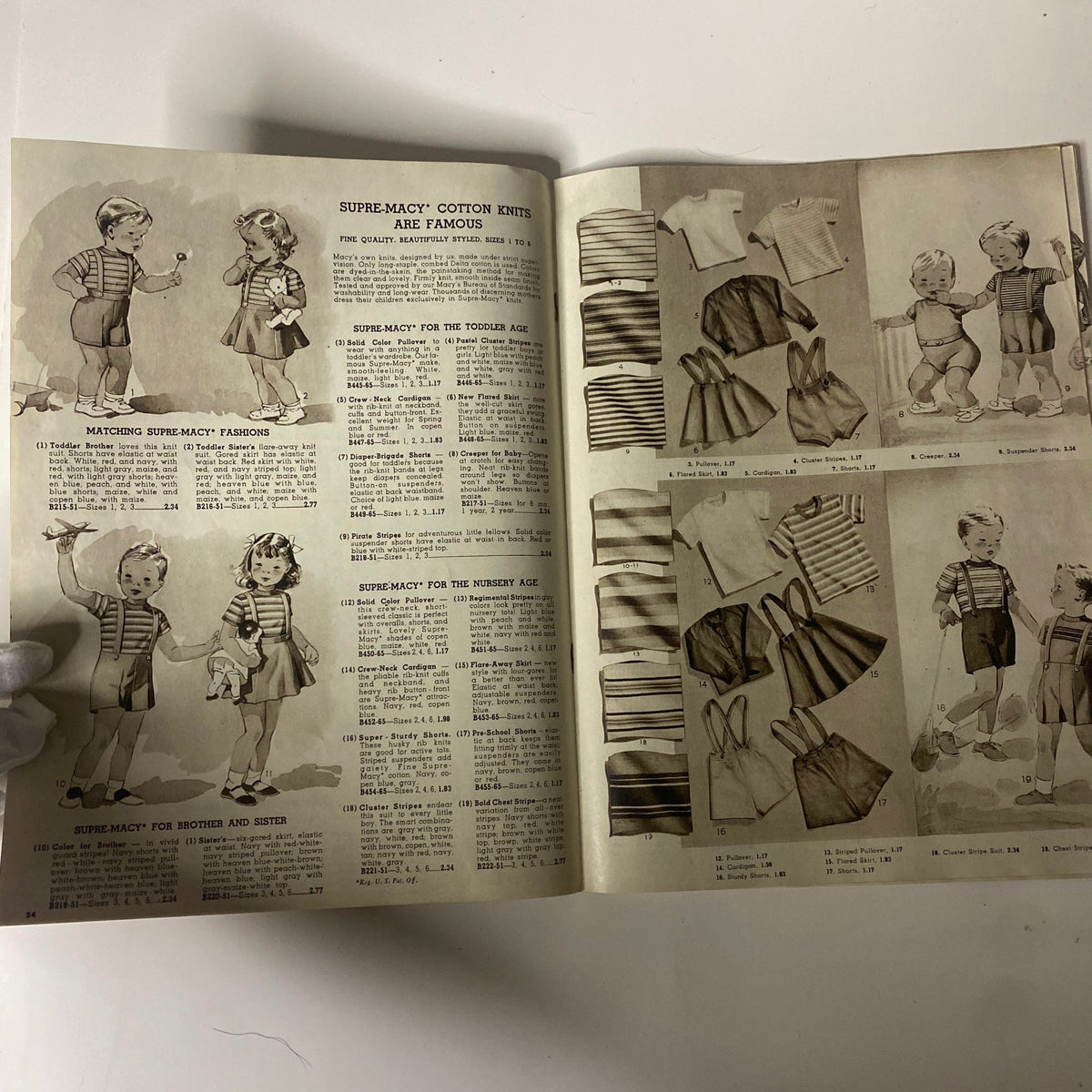
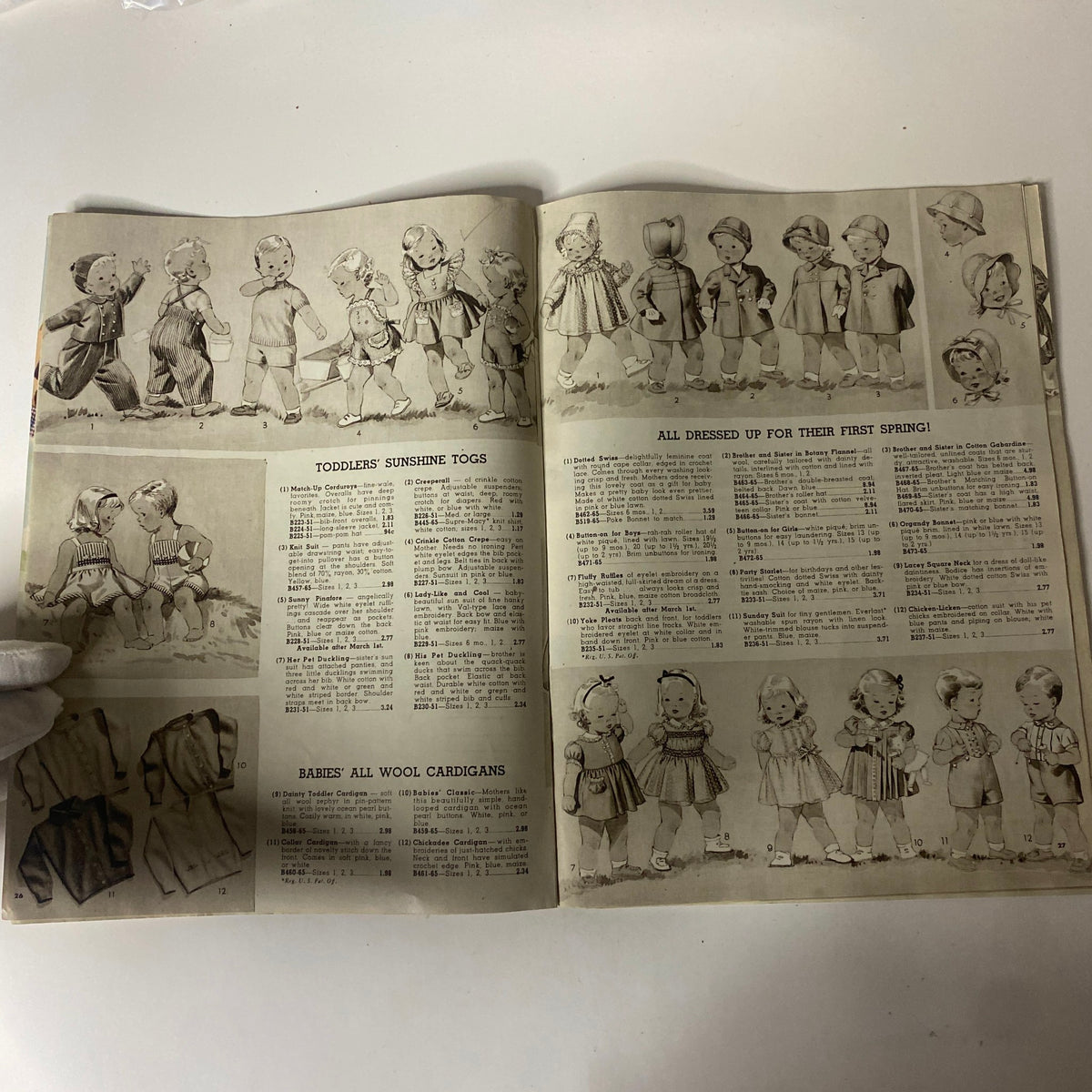
The 1945 Macy's Spring and Summer Catalog is a primary document of American consumer culture at one of the most historically charged moments of the twentieth century — the final spring and summer of the Second World War. The spring-summer season of 1945 encompassed the war's European conclusion in May with Germany's surrender, the atomic bombings of Hiroshima and Nagasaki in August, and Japan's surrender ending the conflict entirely. A Macy's catalog covering this season was produced and distributed while the war was still fully operational and was being used by American families navigating the specific consumer constraints of total wartime mobilization: rationing of fabrics and leather, the L-85 regulations that restricted the amount of cloth used in civilian garments, the wholesale redirection of industrial production toward military needs, and the particular emotional and psychological atmosphere of a country waiting for a war that had consumed its sons, husbands, and brothers to finally end. The specific items confirmed in this catalog's listing — Brother's bib-top overall at $1.13, Big Sister's sunsuit at $0.87, Big Sister's overall at $2.00, Little Sister's overall at $1.13 — are primary commercial documentation of wartime children's clothing at its most practically oriented and most price-conscious, garments designed for durability and affordability in the context of fabric conservation and family economies stretched by wartime conditions. The price points themselves are historical documents: $0.87 for a child's sunsuit in 1945 tells a precise story about the cost of consumer goods at the end of the wartime economy, before the postwar inflation and prosperity that would transform American consumer pricing within a few years. For collectors building a documentary archive of American retail history and wartime domestic life, the Macy's catalog collection at OriginalMagazines.com provides essential depth across the retailer's historical publishing record, with the wartime editions representing a category of primary source documentation that is both historically significant and genuinely uncommon in well-preserved form.
Macy's specifically — as distinct from a generic wartime retailer — gives this catalog an additional dimension of historical significance. R.H. Macy & Co. was by 1945 one of the most symbolically important retail institutions in American commercial culture, its Herald Square flagship in New York being one of the largest department stores in the world and its identity closely bound to the specific aspirational character of American middle-class consumer life. The fact that even Macy's was offering children's bib-top overalls at $1.13 and sunsuits at $0.87 — practical, durable, affordably priced workwear-adjacent garments rather than the fashionable children's clothing that peacetime prosperity would soon make the norm — is itself primary evidence of how thoroughly the wartime consumer constraints had reshaped even the most aspirational mainstream retail. The "emphasis on durable, family-friendly fashion" noted in the listing description is not simply a marketing choice but a reflection of material reality: fabric rationing under the War Production Board's L-85 regulations had made the specific construction and material choices visible in these garments economically and legally constrained, and the simple, practical silhouettes of children's overalls and sunsuits were in part a response to those constraints. A Macy's catalog from the spring-summer of 1945 is therefore primary documentation of the wartime consumer economy at its most mainstream and most prestigious institutional level, capturing the specific material culture of American family clothing at the moment before victory and postwar prosperity transformed it almost beyond recognition. The full range of 1945 magazines and publications from this extraordinary year documents the end of the Second World War from multiple perspectives and across multiple publication types, and this Macy's catalog sits within that body of material as a primary document of everyday domestic consumer life rather than of the war's dramatic public events.
The children's clothing focus confirmed by the listing's specific items adds a secondary collecting dimension that extends beyond general wartime Americana into the specific niche of mid-century children's fashion and retail documentation. The bib-top overall, the sunsuit, and the children's overall were the iconic garments of American childhood in the 1940s — practical, washable, durable constructions that spoke to the specific domestic economy of the era's family life. Their documentation in a Macy's catalog with specific pricing and the implied product photography of a major department store catalog gives them a primary commercial context that makes them primary research material for anyone studying the history of children's clothing, the wartime consumer economy, or the specific retail culture of 1940s American department store publishing. The combination of Macy's institutional prestige, the wartime pricing constraints, the specific garment types, and the spring-summer 1945 date makes this catalog a uniquely specific primary source for multiple overlapping research communities.
About the Publication
The Macy's Spring and Summer Catalog was a seasonal retail publication produced by R.H. Macy & Co. for distribution to its customer base, covering the company's spring and summer merchandise offering across the full range of its clothing, household, and seasonal goods. Macy's catalogs of the wartime period served the company's extensive customer base beyond its physical store locations, providing a shopping channel for the households that could not easily access the flagship Herald Square store and its regional counterparts. The 1945 edition's documented emphasis on practical, affordably priced children's clothing reflects the specific wartime consumer environment — fabric rationing, War Production Board regulations, and the family economic pressures of wartime — within which Macy's was operating, producing a catalog whose content was shaped by the constraints of total war mobilization as much as by the preferences of its peacetime customer demographic. As a wartime publication from one of America's most symbolically important retail institutions, this catalog is a primary document of how the country's most prestigious mainstream consumer culture was navigating the specific material constraints and cultural atmosphere of the war's final year.
Key Highlights Inside
- Confirmed wartime children's clothing with specific pricing — primary commercial documentation — The Brother's bib-top overall at $1.13, Big Sister's sunsuit at $0.87, Big Sister's overall at $2.00, and Little Sister's overall at $1.13 constitute confirmed primary commercial documentation of wartime children's clothing pricing at one of America's most prestigious retail institutions in the spring-summer of 1945, preserving the specific cost structure of children's consumer goods under wartime rationing and economic conditions.
- Wartime fabric-conserving garment design — L-85 era construction documentation — The practical, durable, simply constructed children's garments confirmed in this catalog are primary evidence of wartime clothing design under the War Production Board's L-85 fabric conservation regulations, documenting the specific aesthetic and construction vocabulary of American children's fashion during the conflict's final year.
- Macy's institutional voice during wartime — prestige retail in a constrained economy — As a catalog from one of America's most symbolically significant retail institutions, this publication documents how Macy's was presenting its wartime merchandise offering to its customer base — the specific product vocabulary, pricing language, and retail framing through which a major American department store was navigating the specific commercial and cultural constraints of the war's final spring and summer.
- Spring-summer 1945 apparel and household goods across the full catalog — Beyond the confirmed children's clothing items, the listing references an assortment of spring and summer apparel along with household essentials, suggesting a comprehensive wartime seasonal offering that extended across multiple consumer categories — primary documentation of the full breadth of American household consumer life at the war's conclusion.
- Note: Specific additional product categories, the full range of apparel and household goods beyond the confirmed children's clothing items, and the complete catalog contents have not been independently verified beyond the listing description. The highlights above reflect what is documentable from the listing and the well-established historical context of Macy's wartime retail operations and the specific consumer environment of the spring-summer 1945 season.
Condition & Rarity
This catalog is described as being in good condition, protected by a plastic covering, with the listing confirming that the photographed item is exactly what will be received and directing detailed condition assessment to the accompanying photographs — the appropriate approach for an eighty-year-old publication where the visual record provides the precision that verbal description cannot replicate. For a consumer catalog now eight decades old that was produced for practical use during wartime conditions rather than archival preservation, good condition represents an unusually well-maintained survivor of a publication category that the passage of eighty years has treated with particular attrition. Wartime publications are subject to specific deterioration patterns that differ from peacetime equivalents: the wartime paper conservation measures that reduced paper quality across all American publishing in this period — the lower-grade paper stock mandated to conserve raw materials for the war effort — makes surviving wartime catalogs more susceptible to brittleness and toning than their prewar counterparts, giving any surviving copy in good condition a proportionally higher preservation achievement relative to what was originally produced. The plastic protective covering indicates intentional long-term preservation care that has stabilized the catalog against further deterioration. The confirmed specific pricing in the listing suggests that the interior pricing pages remain legible and accessible, which is a meaningful positive for collectors approaching this catalog as a primary source for wartime retail economics rather than solely as a visual artifact. Macy's wartime catalog publications from the early-to-mid-1940s are genuinely uncommon in the collector and research market, their survival rates limited by the combination of wartime paper quality, eighty years of storage attrition, and the absence of any systematic institutional preservation effort for consumer retail publications of this type.
Looking for More Issues Like This?
Macy's wartime catalog publications from the mid-1940s are among the more historically significant and actively sought items in American retail ephemera collecting — primary documents of one of America's most iconic department stores navigating the specific constraints and consumer culture of total war mobilization, preserved in the specific form of a practical shopping guide rather than as retrospective historical documentation. If this spring-summer 1945 catalog is no longer available, the Macy's catalog collection at OriginalMagazines.com is the most focused resource for exploring what else has surfaced from the retailer's historical publishing record across its full span of catalog production. For collectors building a broader documentary record of American consumer life, wartime culture, and retail history during the war's final and most historically consequential year, the 1945 magazines collection brings together a wide range of primary source material from that extraordinary year in American and world history.