



Description
Collector's Note – Why This Issue Matters
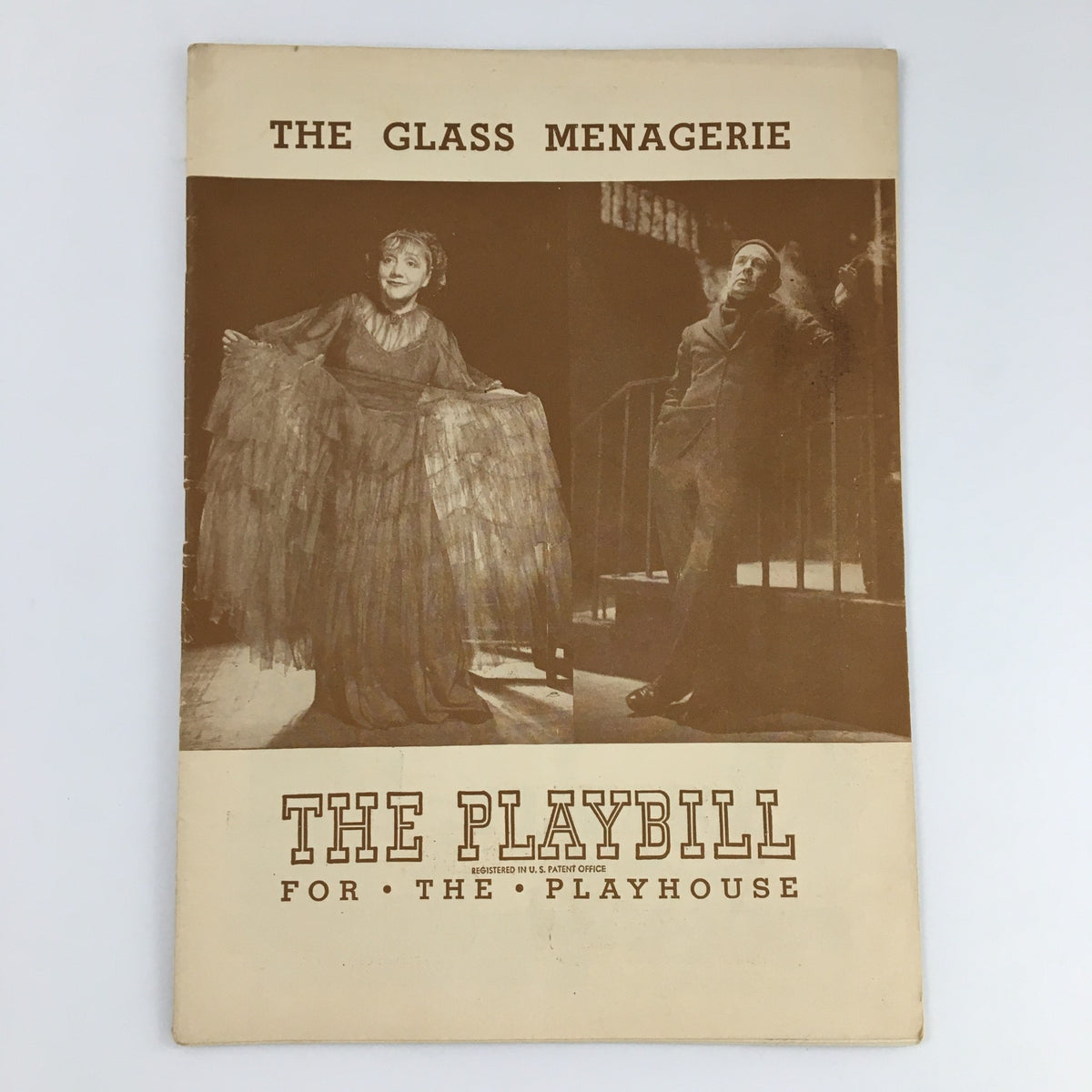
The 1945 Playbill for The Glass Menagerie at The Playhouse, featuring Laurette Taylor and Eddie Dowling, is among the most historically significant theatrical programs in the history of American drama. Tennessee Williams's The Glass Menagerie had its Broadway premiere in 1945 — following a tryout in Chicago that had generated extraordinary word-of-mouth — and its arrival on the New York stage marked the emergence of the most important American playwright of the postwar generation. The play introduced audiences to Williams's distinctive theatrical voice: the fragile lyricism, the autobiographical emotional intensity, the use of memory as dramatic structure, and the compassion for characters trapped by circumstance and desire that would define his subsequent body of work. It was not simply a successful new play — it was a redefinition of what American drama could be, arriving at a moment when the theater was hungry for exactly the kind of personal, poetic honesty that Williams brought to it. A Playbill from the original 1945 Broadway production is a primary document of that premiere moment, produced when the play's historical importance was not yet established but was being recognized in real time by the critics and audiences who were among the first to encounter it. Collectors building a serious archive of American theatrical history will find the Playbill collection an essential resource for the primary documents of the American stage's most significant productions across its modern history.
Laurette Taylor's performance as Amanda Wingfield in the original production is considered by theatrical historians to be among the greatest performances in the history of American acting. Taylor had been one of the most celebrated stage actresses of the early twentieth century before a prolonged personal crisis and struggle with alcoholism had effectively ended her career for more than a decade. Her return to the stage in The Glass Menagerie — at the age of sixty, after years of absence — was itself a theatrical event, and her performance as the faded Southern belle clinging to memories and dreams while her family disintegrates around her was described by critics with a reverence that rarely attaches to theatrical performances. She died just two years after the Broadway opening, making this 1945 Playbill among the very limited primary documentation of her final and greatest stage performance. The presence of Eddie Dowling, who co-directed and played Tom Wingfield, adds further historical texture — he was a significant figure in the American theater of the period whose involvement with The Glass Menagerie represents one of the most important production decisions in the play's history. Collectors focused on the intersection of American theatrical history and the origins of the postwar American drama will find that 1945 Playbill and magazine issues document a year of extraordinary cultural significance, with The Glass Menagerie's premiere among its most enduring contributions to the American artistic record.
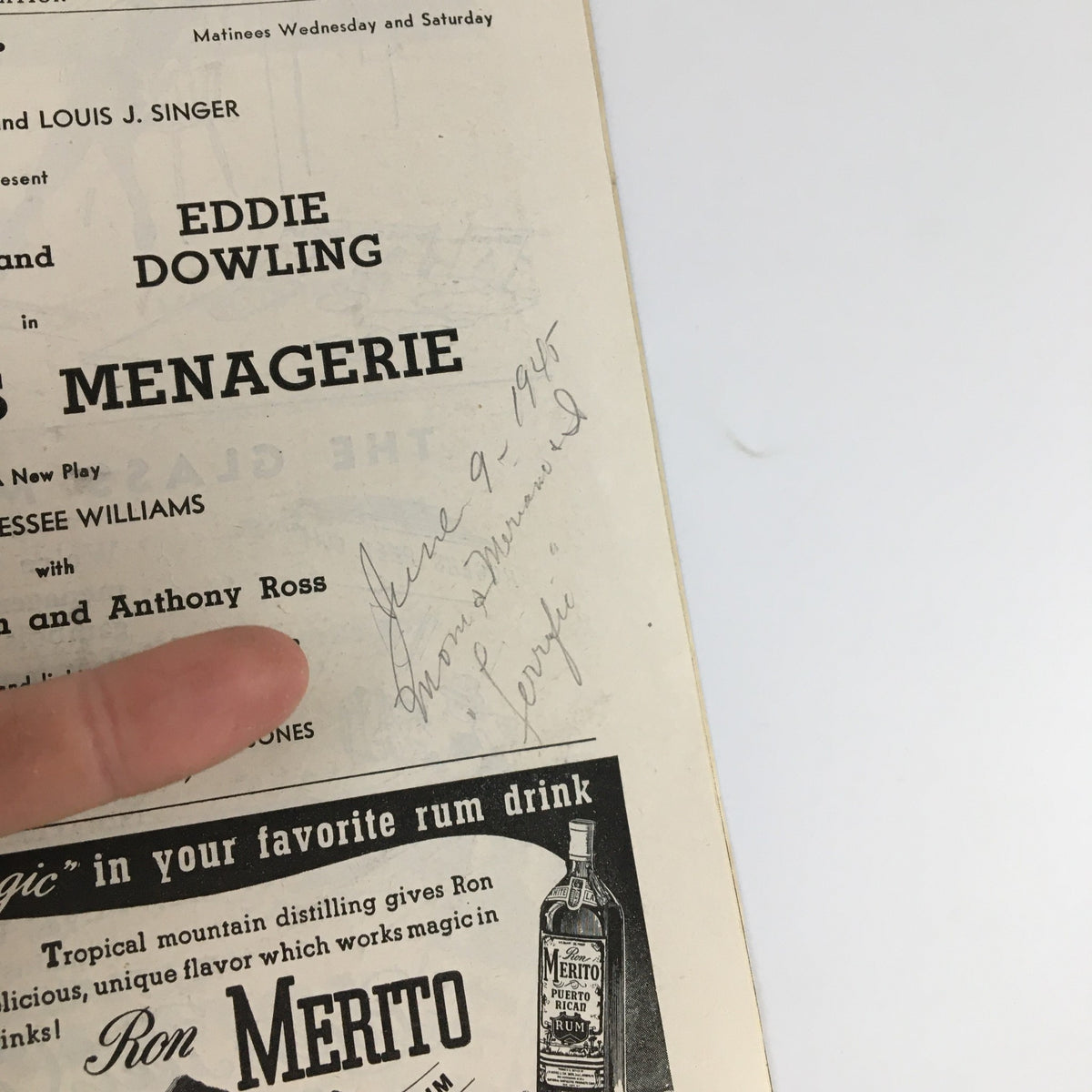
The Glass Menagerie occupies a position in American literary and theatrical history that very few plays share — it is taught in virtually every serious dramatic literature curriculum, performed continuously in regional and community theaters around the world, and studied as the foundational document of a playwright whose subsequent works would include A Streetcar Named Desire and Cat on a Hot Tin Roof. The 1945 Broadway premiere Playbill is the original documentary artifact of a work that has become part of the permanent canon of American drama, produced at the moment when that canonical status was being established rather than retrospectively recognized. The writing noted in the listing as potentially present adds a further dimension of personal history — a program that was carried into the theater, handled during the performance, and perhaps annotated by someone present at one of the most important theatrical events in American cultural history. For collectors of theatrical primary documents, this is as foundational as the category gets.
About the Publication
Playbill is the official program publication distributed to audiences at Broadway and major theater productions across the United States, with a history stretching back to 1884 and a continuous presence at every significant Broadway production throughout the twentieth century. Its format combines cast and creative team biographies, production notes, scene and act listings, and advertising in a standardized package that makes each individual Playbill a primary document of a specific production at a specific moment in theatrical history. The 1945 format differed somewhat from the modern Playbill in its physical specifications and editorial layout, reflecting the production design conventions of mid-century Broadway publishing, and issues from this era are distinguished from later Playbills by their period typography, advertising content, and the documentation style of their cast biographies. A Playbill from a 1945 Broadway premiere carries the specific authority of a document produced for and distributed at the production's actual performances — it is the program that audiences held in their hands during the evenings when one of the greatest performances in American theatrical history was unfolding on the stage in front of them.
Key Highlights Inside
- Laurette Taylor documented as Amanda Wingfield — a primary record of what theatrical historians consider one of the greatest individual stage performances in American theater history, produced during the final years of a career that had been dormant for more than a decade before this triumphant and definitive return to the stage.
- Eddie Dowling documented as Tom Wingfield and co-director — capturing the specific creative configuration of the original Broadway production, including the director whose staging choices shaped how the play's memory-narrative structure was first presented to a New York audience and subsequently influenced the play's entire performance history.
- Tennessee Williams's Broadway premiere documented at its original moment — a Playbill from the production that introduced the most significant American playwright of the postwar generation to the New York theatrical establishment, before his canonical status had been confirmed by subsequent works and before his historical importance had been retrospectively recognized.
- Scene and act listings consistent with the 1945 Playbill format — providing the production's original structural organization as presented to its premiere audiences, which may differ in specific details from the published script that subsequently became the standard reading text.
- The Playhouse theater documentation — grounding the Playbill in the specific venue that hosted the original Broadway production, adding a layer of physical and historical specificity that connects the document to a particular location in New York theatrical geography.
- Writing noted as potentially present — an additional dimension of personal provenance that connects the program to a specific individual who attended the original production, adding character and historical texture that program-only copies do not possess.
Condition & Rarity
Good condition with minor wear typical for age and some possible writing present is an honest and appropriate assessment for a Playbill from 1945 that has survived eighty years. The condition evaluation for theatrical programs from this era must account for their physical vulnerability — they were produced on paper stock of modest quality, carried into theaters, handled during performances, and stored across eight decades without the benefit of the archival materials and climate-controlled storage that modern collectors apply to significant artifacts. Good condition for a 1945 Broadway Playbill accurately describes a program that retains its structural integrity, legible cast and production information, and overall completeness despite the expected yellowing, edge wear, and minor physical deterioration that paper of this age inevitably shows. The possible writing noted in the listing is a condition attribute that deserves careful evaluation from the provided photographs — handwriting from an original audience member is a provenance detail that some collectors value as evidence of the program's authentic theatrical use, while others prefer unmarked copies for display purposes. A protective plastic covering indicates deliberate preservation intent that is particularly meaningful for a paper artifact approaching its centennial, providing ongoing protection for materials that are genuinely fragile at this age and that represent an irreplaceable category of primary theatrical documentation.
Looking for More Issues Like This?
Original Playbills from the 1945 Broadway premiere of The Glass Menagerie are among the rarest and most historically significant theatrical programs in the American stage's primary document record — they are the original artifacts of a production that is now recognized as one of the most important premieres in the history of American drama, and surviving copies in any condition represent genuinely extraordinary finds for serious collectors of theatrical history. The broader Playbill collection is the most reliable starting point for finding other significant programs from across Broadway's history, including other productions from the 1940s that document the American stage at one of its most historically rich and creatively fertile periods. Collectors building a focused archive of 1945 as a year of American cultural history will find the complete 1945 Playbill and magazine collection an invaluable resource for locating other documents from this extraordinary year in which the end of the war and the emergence of a new American dramatic voice coincided to make the cultural record uncommonly rich.