


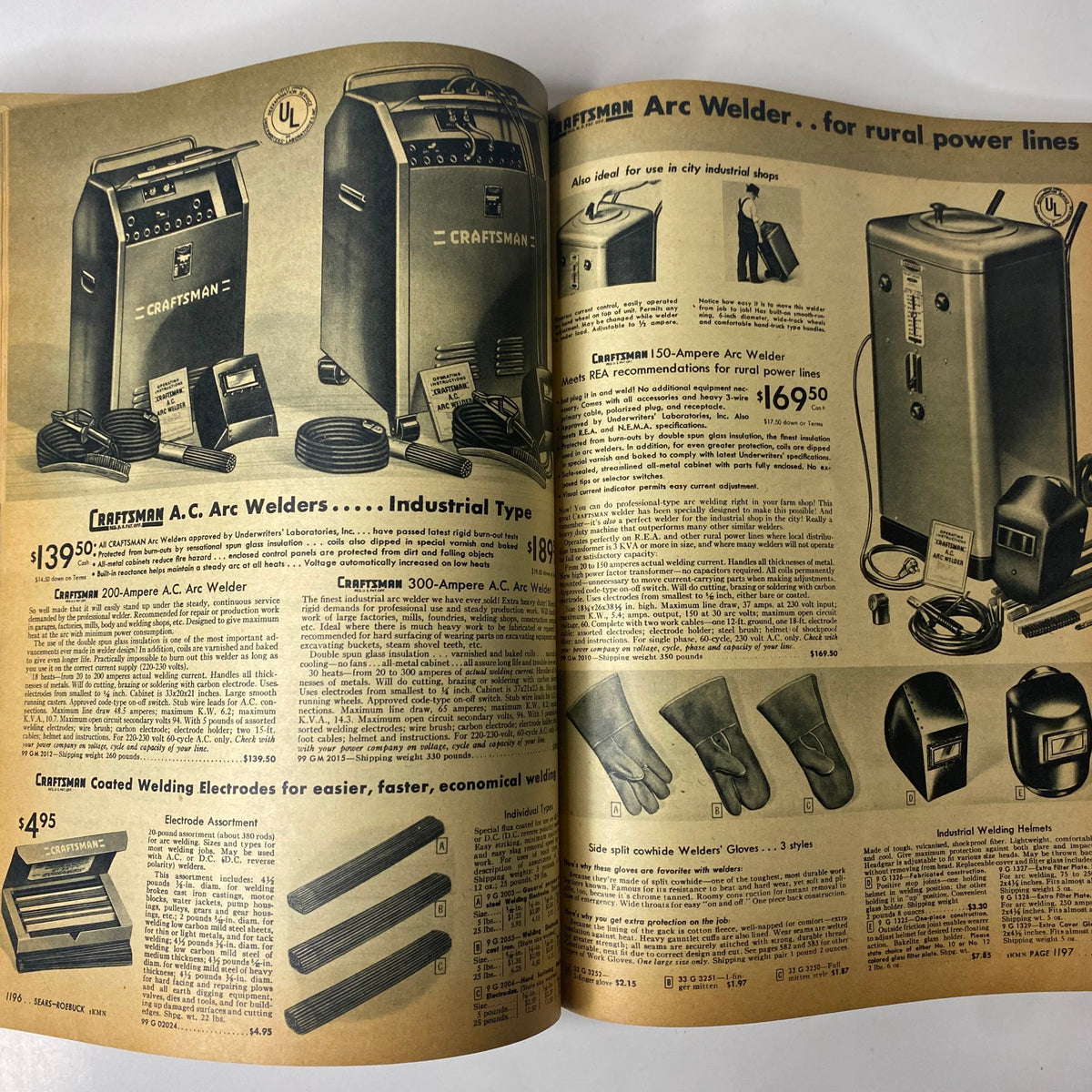


Description
Collector's Note – Why This Issue Matters
The 1946–1947 Sears, Roebuck and Co. Fall and Winter Catalog is a primary document of one of the most consequential transitions in American consumer history — the immediate postwar reconversion from wartime austerity to civilian abundance, documented with the comprehensive specificity that only a mass-market general merchandise catalog can provide. The timing is precise and historically significant: the Fall and Winter 1946 catalog would have been prepared and distributed in the late summer and early fall of 1946, just one year after V-J Day and in the midst of the most rapid demobilization in American military history. The wartime restrictions on fabric yardage, appliance manufacturing, and consumer goods production that had shaped American domestic life since 1942 had been lifted, and the Sears catalog was among the first large-scale commercial vehicles through which ordinary American households could see and order the consumer goods that wartime production had deferred. For collectors building archives of vintage Sears catalogs documenting the arc of American consumer culture, the 1946–1947 Fall and Winter edition occupies a position of unusual historical importance — the catalog that documented the opening of the postwar consumer era rather than its mature expression.
The confirmed content categories give this catalog its specific documentary weight. The women's coats, men's suits, and children's winter outerwear documented here reflect the immediate postwar return to fuller silhouettes, richer fabrics, and the stylistic conventions that wartime restrictions had suppressed — the New Look was still a year away when Christian Dior would formally launch it in February 1947, but the directional shift toward longer skirts, more generous fabric use, and unapologetic femininity that Dior would codify was already present in American ready-to-wear in the fall of 1946. A Sears catalog from this specific season documents that shift at the mass-market level, showing how the reconversion from wartime to civilian fashion was translating into the actual garments available to ordinary American consumers rather than the fashion press's aspirational coverage. The confirmed Kenmore appliance content adds a parallel dimension: the postwar appliance boom — the washing machines, refrigerators, and kitchen equipment that would define the suburban domestic ideal of the 1950s — was just beginning its acceleration in 1946, and Sears's Kenmore line was one of its primary vehicles. Collectors focused on 1946 publications as documents of American material culture will find this catalog providing primary source specificity that no other single document from the year offers.
The 1946–1947 dual-year designation reflects the catalog's intended use across the fall and winter selling season that bridged two calendar years — a standard Sears catalog practice that gives this edition a specific temporal span covering the Christmas of 1946 and the winter months running into early 1947. That span places it across the precise threshold of the first full postwar holiday season, when American consumer spending on gifts, clothing, and household goods resumed at levels not seen since before Pearl Harbor. The catalog's role as the primary shopping reference for millions of American households during that specific first postwar Christmas gives it a cultural resonance that goes well beyond its function as a merchandise guide.
About the Publication
Sears, Roebuck and Co. seasonal mail-order catalogs were large-format illustrated publications issued twice yearly in Spring/Summer and Fall/Winter editions and distributed to tens of millions of American households, making them among the most widely circulated publications in the country across the mid-twentieth century. The Fall and Winter edition was the most commercially significant of the year, covering the back-to-school, holiday, and winter seasons in a single comprehensive volume that families consulted for months. By 1946, Sears was the largest retailer in the United States, and its catalog was the primary retail interface for American consumers in smaller cities, towns, and rural communities where department store access was limited. The catalog's format combined fashion illustration and photography with detailed merchandise descriptions, fabric specifications, sizing information, and pricing — providing a level of consumer documentation that editorial publications of the era did not attempt.
Key Highlights Inside
- Women's coats and postwar fashion reconversion — confirmed content — Primary retail documentation of the immediate postwar return to fuller silhouettes and richer fabrics, capturing the mass-market expression of the stylistic shift that Dior would formally codify as the New Look in February 1947 — documented here at the consumer level one season earlier.
- Men's suits — confirmed content — Postwar men's tailoring documented at the specific moment of reconversion from wartime fabric restrictions, reflecting the return to civilian dress conventions for the millions of veterans re-entering the workforce and civilian social life in 1946.
- Children's winter outerwear — confirmed content — Documentation of the postwar baby boom's first major consumer season, as families that had deferred purchases during wartime began equipping growing children with the winter clothing that wartime austerity had constrained.
- Sears Kenmore appliances — confirmed content — Early documentation of the postwar appliance boom that would define mid-century American domestic life, with the Kenmore line represented at the opening of the consumer demand surge that wartime manufacturing deferrals had built up across four years.
- 1946–1947 — first postwar Christmas season catalog — The comprehensive merchandise reference for the first full postwar holiday season, documenting American consumer aspiration at the precise moment of transition from wartime austerity to the abundance that would characterize the following decade.
Condition & Rarity
Good condition with minor wear and plastic protective covering represents a meaningful assessment for a nearly 80-year-old large-format retail catalog designed for sustained household use across an entire selling season. Minor wear on a publication of this age is an expected characteristic of survival rather than a deficiency — the relevant attributes for a 1946 Sears catalog are cover integrity, spine condition across what would have been a substantial page count, and interior page legibility, all of which good condition implies. The plastic protective covering indicates deliberate preservation at some point in the catalog's post-use history, limiting further deterioration. The listing does not specify label status; the photographs are the authoritative reference for whether the cover carries an address label and whether the full cover imagery is unobstructed — a meaningful distinction for display-oriented collectors given the historical significance of a catalog cover from the first postwar holiday season. Fall and Winter Sears catalogs from 1946 survive in smaller numbers than their original distribution volume suggests: these were working household documents that most families used until deterioration, and the fraction that survived in good condition did so through deliberate preservation across eight decades rather than casual storage.
Looking for More Issues Like This?
Sears Fall and Winter catalogs from the immediate postwar years — particularly those in good condition that document the 1946 consumer reconversion with the cover and interior content intact — are among the most historically specific and difficult to locate editions in the entire Sears catalog archive, and the 1946–1947 edition's position at the precise opening of the postwar consumer era gives it a documentary significance that later catalogs from the more settled 1950s do not carry. The Sears catalog archive at OriginalMagazines.com is the most direct resource for collectors researching other seasonal editions spanning the postwar decades, from the reconversion years of the late 1940s through the mature consumer culture of the 1950s and beyond. For collectors building a broader picture of American material life in 1946 specifically, the complete 1946 publications collection covers magazines and periodicals from the first full year of American peace after four years of wartime.