

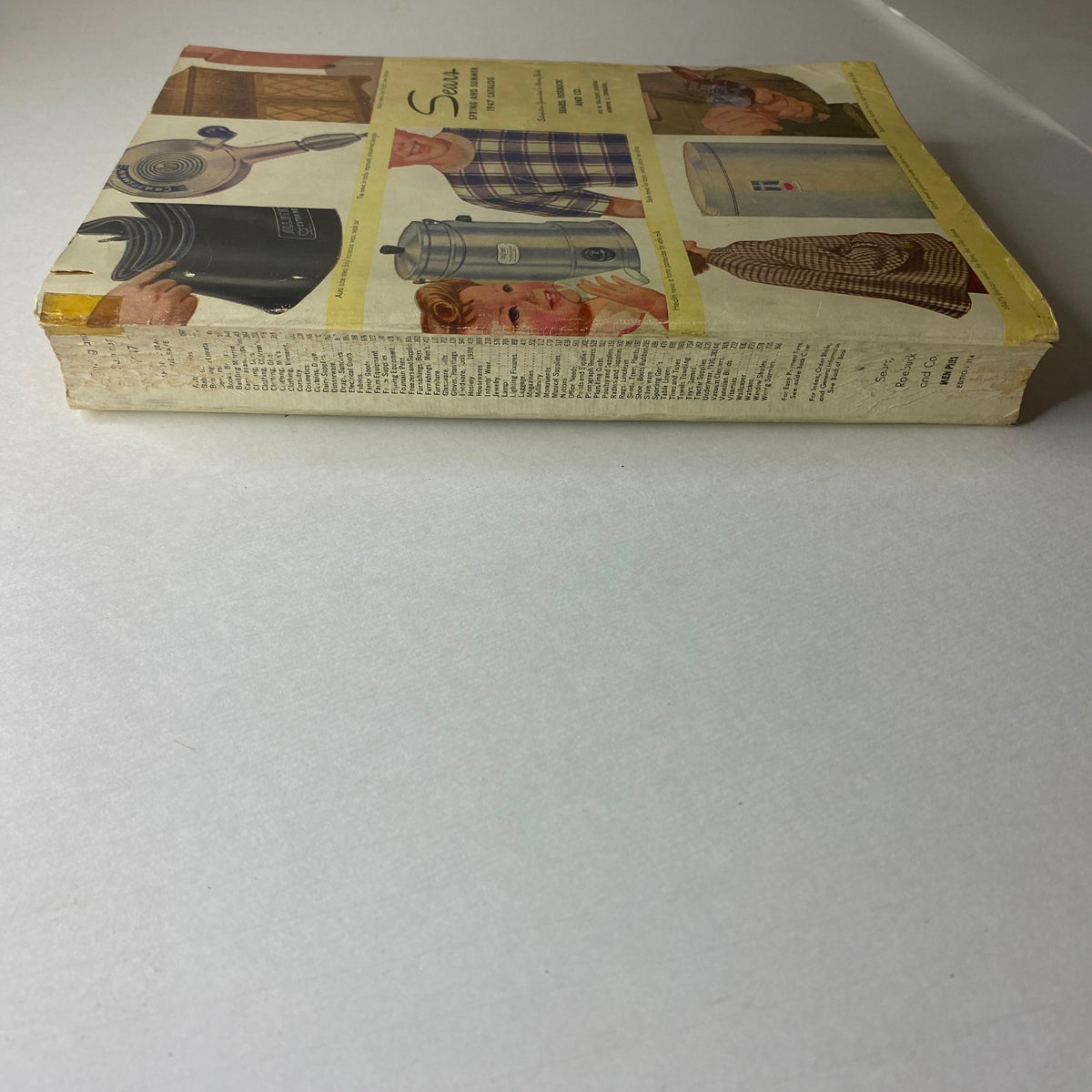


Description
Collector's Note – Why This Issue Matters
The 1947 Sears, Roebuck and Co. Spring and Summer Catalog is a primary document of American consumer culture at one of its most psychologically and economically charged moments. The war had ended less than two years before this catalog's publication, and the pent-up demand for civilian goods that had been suppressed by wartime rationing and production restrictions was now being released into a market eager to furnish, clothe, and equip itself for peacetime life. Sears was positioned at the center of that release. The spring and summer catalog — one of the two flagship annual publications in Sears' catalog calendar — would have arrived in American households as both a practical shopping tool and a tangible expression of postwar possibility. The fashion content described in the listing reflects this directly: tailored suits, flared skirts, and feminine silhouettes were the deliberate aesthetic counterstatement to the utilitarian, fabric-rationed clothing of the war years. For collectors building an archive of Sears catalog issues across the twentieth century, a 1947 spring and summer edition captures the company at the precise opening of the postwar consumer boom that would define American domestic life for the next two decades.
The catalog's breadth — confirmed in the listing as spanning fashion, children's clothing, household goods, home décor, farm equipment, and garden tools — is characteristic of the flagship Sears seasonal catalog at its most comprehensive. This was not a sale supplement or a specialty edition but the full expression of what Sears offered American households in the spring of 1947: a complete domestic universe available through the mail. That comprehensiveness is precisely what makes these catalogs so valuable as historical research documents. A single 1947 Sears spring catalog contains more granular information about what American families wore, used, planted, cooked with, and decorated their homes with than almost any other single publication of the era — with price points, brand names, and product illustrations that no magazine or newspaper advertisement provides in comparable depth. Publications from 1947 more broadly capture America in the first full year of peacetime normality, and the Sears spring catalog is the most domestically comprehensive document that year produced.
The farm and garden tools section noted in the listing adds a dimension that the fashion content alone would not convey. In 1947, America was still substantially a rural and semi-rural nation, and Sears' catalog served farm households as directly as it served urban and suburban ones. The postwar home gardening trend referenced in the listing reflected both the lingering habits of wartime Victory Gardens and the early expressions of suburban domestic pride that would accelerate through the 1950s. A spring catalog covering this range — from summer dresses to farm equipment — documents a cross-section of American economic and domestic life that no urban-focused publication of the era could match.
About the Publication
Sears, Roebuck and Co. had been issuing its general catalog since 1888, and by 1947 the spring and summer edition was one of the most widely distributed publications in the United States — reaching rural, suburban, and urban households across the country through a mail-order system that Sears had refined over six decades. The flagship seasonal catalogs, typically several hundred pages in length, covered the full range of Sears merchandise and served simultaneously as shopping reference, price guide, and aspirational document for millions of American households. The catalog's reach into rural America was particularly significant in the postwar period, when many households still lacked convenient access to department stores or specialty retailers and depended on mail order for a substantial portion of their consumer purchasing.
Key Highlights Inside
- Women's fashion coverage featuring tailored suits, flared skirts, and feminine silhouettes in postwar styles — a direct reflection of the aesthetic reaction to wartime fabric rationing and utility clothing restrictions.
- Summer fabric emphasis on lightweight cotton and linen, with illustrated fashion spreads documenting the specific silhouettes and materials that defined American women's dress in the spring and summer of 1947.
- Children's clothing section featuring summer dresses and playwear — a primary source for mid-century children's fashion research and period costume recreation.
- Household goods and home décor coverage reflecting mid-century domestic design in the first full postwar year, with period-specific price points and product illustrations.
- Farm equipment and garden tools section — documenting Sears' service to rural and semi-rural households during a period when American agriculture and home gardening were both significant aspects of domestic life.
Condition & Rarity
The absence of an address label on this catalog is a favorable attribute. Sears flagship seasonal catalogs were distributed both through mail subscription and through retail pickup at Sears stores and catalog offices, and label-free examples may represent either retail pickup copies or mail copies whose labels were cleanly removed — both configurations are preferable to labeled examples for display purposes. Good condition for a publication now nearly eighty years old is an honest and meaningful assessment. The primary condition risks for surviving copies of large-format Sears catalogs from this era are spine separation — the binding on several-hundred-page catalogs of this period is susceptible to cracking and detachment over decades — page completeness, since catalog pages were frequently clipped for reference use, and toning or brittleness in the paper stock, which varies significantly depending on storage conditions. When evaluating any surviving copy of this catalog, completeness of interior pages is the most critical factor, as the research and reference value of the document depends entirely on what remains intact.
Looking for More Issues Like This?
An intact, label-free 1947 Sears spring and summer catalog in good condition is a genuinely useful find for collectors, researchers, costume designers, and historians — these comprehensive postwar editions are among the most information-dense domestic documents the era produced, and complete surviving copies are encountered less frequently than their original distribution numbers would suggest. If this one has already found a home, the full archive of Sears catalog issues spans multiple decades of American retail and consumer history and is worth exploring in depth. The broader 1947 publication collection offers additional context for this pivotal first full year of postwar American life across multiple publication types.