




Description
Collector's Note – Why This Issue Matters
The 1955 Sears Roebuck and Co. Fall and Winter Catalog is a primary document of mid-century American consumer culture — not a magazine in the editorial sense, but something arguably more historically revealing. Sears catalogs of this era were the dominant retail interface for millions of American households, particularly in rural and suburban communities where department stores were inaccessible. The Fall and Winter edition was the largest and most anticipated of the two annual issues, arriving in homes each year as a comprehensive survey of what American manufacturers were producing and what American families were expected to want. In 1955, that meant the full flowering of postwar prosperity: affordable synthetic and blended fabrics, coordinated sportswear, and the kind of practical-yet-fashionable ready-to-wear clothing that defined how ordinary Americans dressed during the Eisenhower era. Collectors building a material record of 1950s domestic life will find the Sears catalog archive an indispensable resource for tracing how mass retail shaped American taste decade by decade.
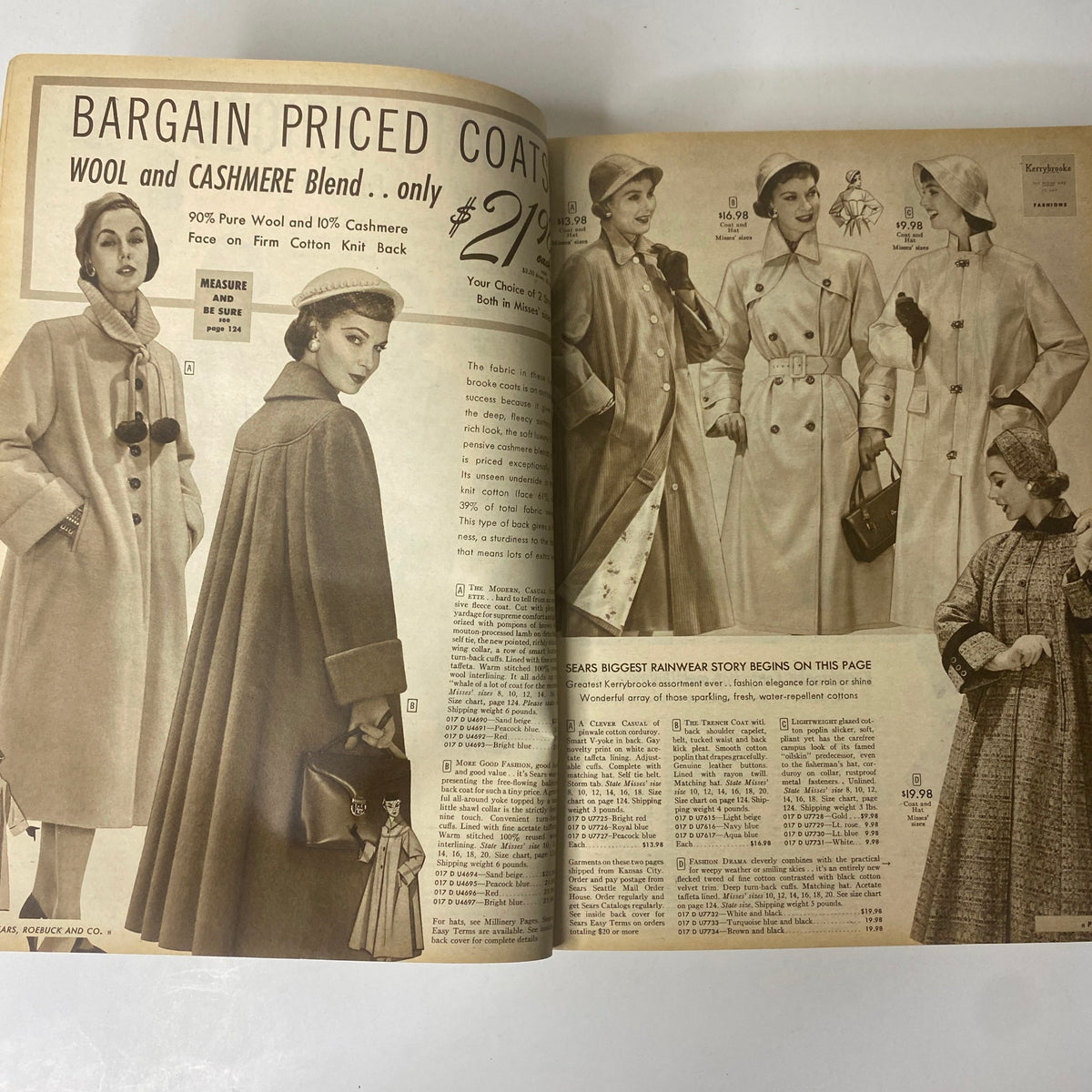
The specific focus of this catalog's featured fashion — colorful corduroy coordinates, structured jackets, coordinated two-piece sets, and versatile skirts and blouses — speaks directly to one of the defining textile stories of the mid-1950s. Corduroy had transitioned from a utilitarian workwear fabric into a fashionable, washable, and colorful choice for everyday American clothing. Its appearance in force in a 1955 Sears catalog signals its mainstream acceptance, precisely the kind of cultural timestamp that fashion historians value. Sears catalogs did not lead fashion trends — they confirmed them, translating what was happening in higher-end retail into affordable, mass-produced versions for the broadest possible American audience. A catalog page from 1955 is therefore a more reliable record of what most Americans actually wore than any fashion magazine of the period. The broader landscape of 1955 publications provides essential context for understanding what the catalog sat alongside — a year of rock and roll's emergence, television's rapid expansion, and a consumer economy running at full confidence.
Sears Fall and Winter catalogs from the 1950s are among the most actively collected of all American retail ephemera. They survive in reasonable numbers but rarely in strong condition — these were working documents, consulted repeatedly over months, used to fill out order forms, and passed between family members. A well-preserved example with intact pages and no label damage represents genuine scarcity in the collector market, particularly for a year as culturally central as 1955.
About the Publication
Sears, Roebuck and Co. issued its general merchandise catalog biannually — Spring/Summer and Fall/Winter — from 1888 through the catalog's eventual discontinuation in 1993. At its mid-century peak, the Fall and Winter edition ran to hundreds of pages and covered clothing, appliances, tools, toys, furniture, and farm equipment, functioning as a complete retail universe for American households. The catalog had no editorial voice in the journalistic sense; its authority was commercial and practical. But for historians, sociologists, and collectors, it serves as an unmatched archive of American material culture — what things looked like, what they cost, and what a mass-market audience was expected to aspire to in any given year.
Key Highlights Inside
- Extensive coverage of mid-century corduroy fashion, with colorful coordinated ensembles including structured jackets, two-piece sets, skirts, and blouses — reflecting the mainstream arrival of washable, fashionable corduroy in everyday American wardrobes.
- Over 100 pages of color fashion content documenting the styles, silhouettes, and color palettes that defined American ready-to-wear clothing in the fall and winter of 1955.
- Practical retail pricing and product descriptions consistent with Sears' positioning as the primary affordable clothier for middle-class and rural American families in the postwar period.
- Note: Specific additional sections, product categories, and interior page details beyond what is documented in the listing have not been independently confirmed. The above reflects what is verifiable from the listing description and well-documented knowledge of this catalog format and era.
Condition & Rarity
Sears catalogs from the 1950s present a particular conservation challenge for collectors: they were produced on uncoated paper stock with spiral or saddle-stitch binding, designed for heavy practical use rather than preservation. Pages are prone to tanning, edge brittleness, and binding loosening after seven decades. A surviving example rated in good condition, with no label (Sears catalogs were mailed directly to households and frequently bear address labels on the cover, making label-free copies meaningfully preferable for display purposes), and protected by a plastic sleeve represents a well-preserved example by realistic standards for this format. When evaluating any surviving copy of this catalog, the priority condition factors are binding integrity — whether pages remain fully attached and the spine has not split — cover brightness, and the absence of significant moisture damage or heavy soiling, both common in household catalogs that were stored in utility spaces. The plastic protective covering limits ongoing oxidation and physical wear, which matters considerably for paper this age.
Looking for More Issues Like This?
Well-preserved Sears Fall and Winter catalogs from the 1950s are genuinely difficult to find at collector grade, and the 1955 edition in particular draws strong interest from both fashion historians and mid-century Americana collectors. The Sears catalog collection at OriginalMagazines.com is the best place to search for other editions spanning the full run of this iconic American retail institution. For collectors interested in the broader material culture of the mid-1950s, the 1955 magazine collection offers a wide range of period publications that capture the same confident, colorful postwar America this catalog so vividly documents.