


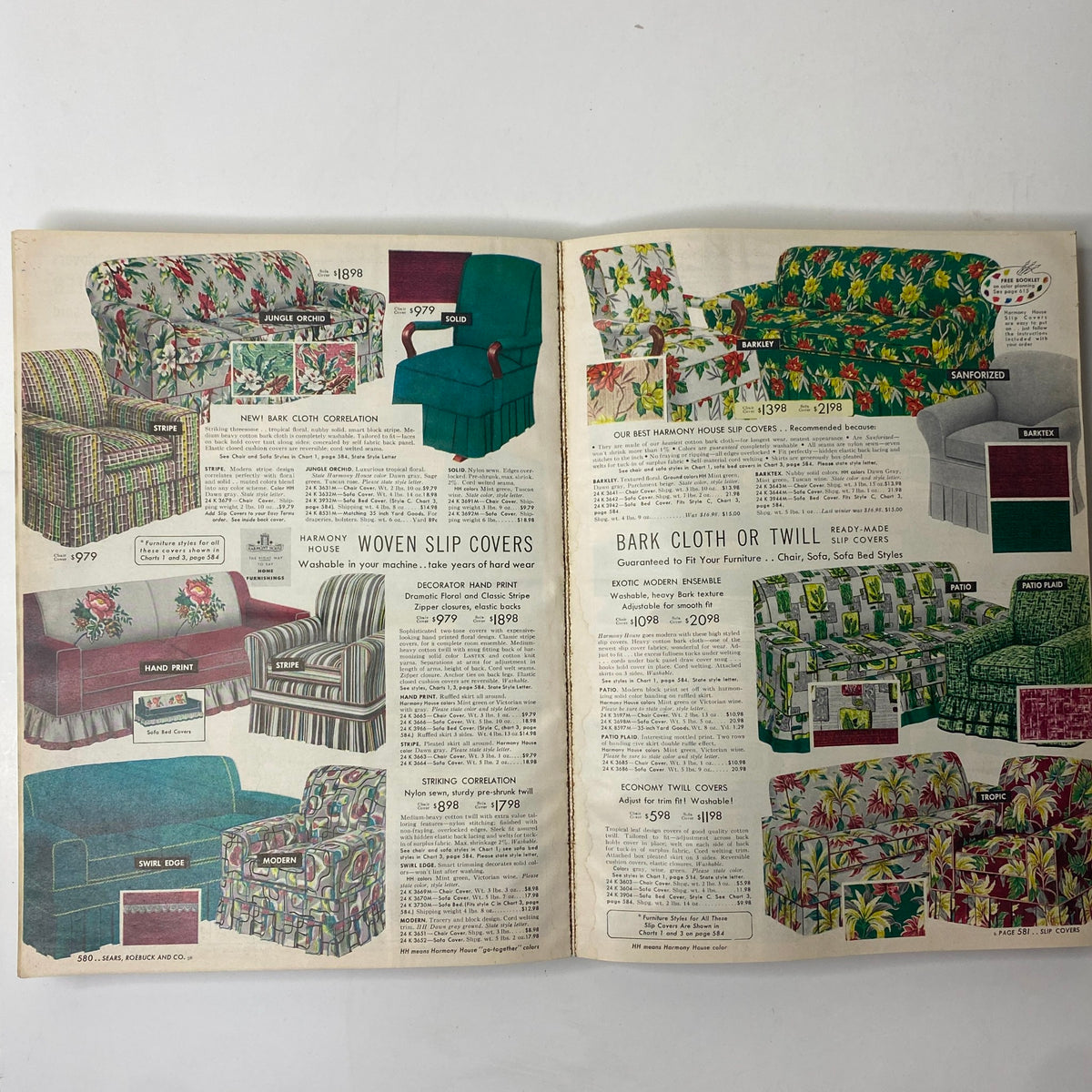


Description
Collector's Note – Why This Issue Matters
The 1955 Sears Roebuck and Co. Spring and Summer Catalog is a primary document of American consumer fashion and domestic aspiration at one of the most culturally confident and visually distinctive moments in the twentieth century. The spring-summer season of 1955 was occurring at the absolute apex of Eisenhower-era prosperity and postwar domestic optimism — a moment when the combination of rising real wages, suburban expansion, the television-driven democratization of aspiration, and the country's genuine belief in its own material progress was producing a consumer culture of unusual energy and visual richness. The catalog's featured content — California-inspired designs, bold-print dresses with feminine silhouettes, Western influences, easy-to-wear summer fashions — documents the specific aesthetic vocabulary of American mass-market fashion at this mid-decade peak, a visual language that was simultaneously distinctive to its moment and enormously influential on the broader cultural identity of 1950s America that subsequent generations have tried to recover and understand. The California and Western influences specifically noted in the listing reflect the decade's intense fascination with the American West and with California as a projection screen for postwar American lifestyle aspiration — the ease, the sunshine, the informality, the optimism that California represented in the national imagination of 1955, and that translated directly into the specific silhouettes and print vocabularies of the summer fashions featured in this catalog. For collectors building a serious archive of Sears catalog history and mid-century American fashion documentation, the Sears catalog collection at OriginalMagazines.com provides essential depth across the company's full publishing history, with the mid-1950s editions representing the catalog at its most aesthetically coherent and culturally resonant.
The 1955 date gives this spring-summer catalog a specific historical position within the arc of postwar American consumer culture that rewards close attention. This was the year of Disneyland's opening, of the introduction of the Chevrolet Bel Air's most celebrated design iteration, of the mass popularization of television as a household fixture, and of the first full season of rock and roll's mainstream cultural emergence. The American consumer economy of 1955 was operating at a level of confidence and expansiveness that it had not previously experienced in the twentieth century, and the Sears spring-summer catalog was one of the primary vehicles through which that confidence was translated into the specific visual and material terms of middle-class domestic life. The easy-to-wear dresses with bold prints and feminine silhouettes that this catalog featured were not merely fashion items — they were expressions of a specific cultural ideal about how American women should look, move, and present themselves in the prosperity of the postwar decade, an ideal that the catalog both reflected and actively promoted to its enormous mass-market readership. The label-free condition confirmed in the listing is a meaningful positive for collector evaluation, indicating that this catalog avoided the direct-mail labeling that characterizes most surviving copies from this distribution channel and that the cover surface has been preserved without the disruption that address blocks create on labeled examples. The full range of 1955 magazines and publications documents this peak-prosperity year from multiple angles and across multiple publication types, and the Sears spring-summer catalog sits within that body of material as one of the most comprehensive single-volume records of what mainstream American consumer fashion aspiration looked like at this specific and historically distinctive moment.
The Western influences documented in this catalog's featured content reflect a specific and historically interesting strain of mid-1950s American fashion culture that deserves direct engagement. The postwar popularity of Western aesthetics in American consumer goods — from clothing to home furnishings to automobile design — was part of the same broad cultural project that produced the suburban ranch house, the Westerns that dominated American television and cinema throughout the decade, and the general romanticization of frontier values that permeated 1950s American popular culture. In women's fashion, Western influences typically manifested in specific decorative elements — embroidery, denim fabrics, bandana prints, yoke detailing — that combined the decade's love of casual ease with the specific visual vocabulary of the American West. Their presence in a Sears spring-summer catalog confirms that these influences had by 1955 fully penetrated the mass-market mainstream and were being offered to the broadest possible American consumer audience, not merely to regional Western markets. That documentation — of a specific fashion aesthetic at the precise moment of its mass-market mainstreaming — is the kind of primary evidence that fashion historians find most valuable in surviving catalog material, because it captures the moment when a style moved from subculture to mainstream with a specificity that retrospective accounts cannot replicate.
About the Publication
The Sears Roebuck and Co. Spring and Summer Catalog was the warm-weather companion to the company's flagship fall-winter edition, distributed annually to millions of American households through the direct-mail program that had been central to Sears' retail dominance since the company's founding in 1886. By 1955, the spring-summer catalog had been a fundamental institution in American consumer culture for nearly seven decades, its arrival marking the seasonal transition and serving as the primary retail reference for millions of households — particularly in rural and small-town America — that lacked convenient access to department store shopping. The catalog's format combined comprehensive merchandise coverage across clothing, home goods, appliances, and the full range of consumer categories with the visual production values that Sears' dominant market position enabled, producing a publication that simultaneously served as practical shopping guide, comprehensive fashion reference, and visual projection of American consumer aspiration in any given season. The 1955 edition's emphasis on California-inspired and Western-influenced summer fashions reflects both the specific aesthetic trends of the mid-decade and the catalog's accurate reading of what its enormous, geographically diverse readership most wanted to see and buy in the spring and summer of the decade's most prosperous year.
Key Highlights Inside
- California-inspired summer fashion documentation — The confirmed California-inspired designs in this catalog document the specific aesthetic influence that the West Coast was exerting on mainstream American fashion in 1955, capturing the moment when California's specific vision of easy, sun-oriented, informally elegant living had fully penetrated the mass-market catalog at the level of featured fashion content. For fashion historians researching the California influence on mid-century American style, this catalog provides primary commercial documentation from within the trend's mainstream moment.
- Western-influenced designs — bold prints and feminine silhouettes — The Western influences and bold-print summer dress vocabulary documented in this catalog are primary evidence of the mid-1950s mass-market fashion aesthetic at its most characteristic and most specific, preserving the visual language of easy-to-wear American summer fashion at a historically distinctive moment in its development.
- No address label — clean cover presentation — The confirmed absence of a mailing label is a meaningful positive condition attribute for a Sears catalog from this era, as direct-mail distribution typically resulted in labeled covers being the norm among survivors. A label-free cover preserves the full visual integrity of the 1955 catalog's cover design and imagery without address block disruption.
- Mid-1955 consumer pricing documentation — Retail pricing across the spring-summer fashion offering of a 1955 Sears catalog provides primary economic data for historians researching consumer goods pricing at the height of Eisenhower-era prosperity — a specific and historically well-defined moment in the arc of mid-century American consumer economics.
- Water damage — authentic provenance character — The water damage noted in the listing's condition description adds a specific provenance dimension to this catalog, documenting its physical survival history in ways that affect the collector's assessment of specific content areas. Collectors evaluating any surviving copy should assess the extent and placement of water damage relative to the fashion content pages that constitute the catalog's primary documentary value.
- Note: Specific additional product categories, the full range of merchandise beyond the confirmed California and Western-influenced fashion content, and the complete catalog contents have not been independently verified beyond the listing description. The highlights above reflect what is documentable from the listing and the well-established historical context of Sears' 1955 spring-summer catalog format and the specific fashion trends it featured.
Condition & Rarity
This catalog is described as being in good condition with some water damage and no address label, protected by a plastic covering — a condition profile that requires honest evaluation for collectors weighing its suitability for specific purposes. The water damage is the primary condition consideration and the most variable: its significance depends entirely on its extent, placement, and whether it affects the catalog's cover presentation, the fashion content pages that constitute its primary documentary value, or is confined to less critical areas such as outer margins or back sections. Water damage on publications of this era typically manifests as tide lines, paper cockle, color staining, or in severe cases as mold or paper deterioration, and the listing's characterization of "some" water damage with an overall good condition grade suggests damage that is present but not catastrophic — potentially confined to margins or specific sections rather than pervasive throughout the catalog. The listing directs condition assessment to accompanying photographs, which is the appropriate approach for a condition attribute of this type that requires visual verification rather than verbal description. The absence of an address label is a genuine positive, preserving the cover surface without the disruption that direct-mail labels create on most surviving copies from this distribution channel. The plastic protective covering indicates preservation care that has stabilized the catalog against further deterioration. Collectors evaluating surviving copies of this catalog for research purposes should prioritize the completeness and condition of the California-inspired and Western-influenced fashion pages as the primary documentary content, while display-grade collectors should assess the water damage's visual impact on the cover and opening pages before making acquisition decisions.
Looking for More Issues Like This?
Sears spring and summer catalogs from the mid-1950s — and particularly label-free examples that preserve the full cover presentation despite the honest wear of their decades of survival — are actively sought by fashion historians, consumer culture scholars, costume designers, and retail ephemera collectors who recognize these publications as irreplaceable primary documents of American mass-market fashion at its most visually distinctive and culturally confident mid-century moment. If this 1955 edition is no longer available, the Sears catalog collection at OriginalMagazines.com is the most comprehensive resource for exploring what else has surfaced from this foundational American retail publishing tradition across its full span of production years. For collectors building a broader documentary picture of American consumer life and fashion culture at the Eisenhower era's most prosperous and culturally confident moment, the 1955 magazines collection brings together a wide range of primary source material from that landmark year in American popular and consumer culture history.