


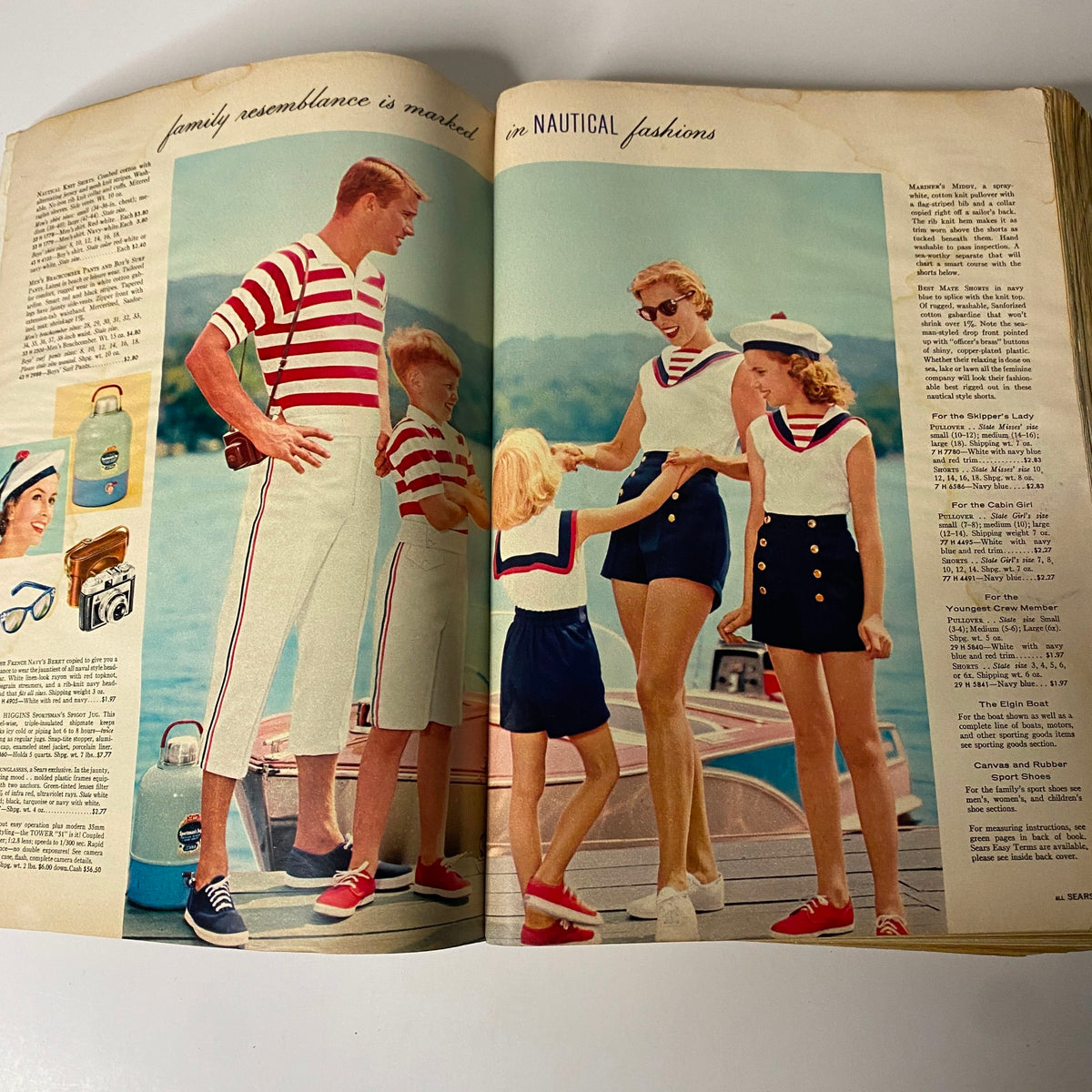


Description
Collector's Note – Why This Issue Matters
The 1958 Sears, Roebuck and Co. Spring and Summer Catalog documents one of the most discussed fashion transitions of the entire postwar decade. The Chemise look — a loose, unfitted dress silhouette that fell straight from the shoulders without a defined waist — had arrived in American fashion in 1957 and 1958 as a direct challenge to the nipped-waist, full-skirt silhouette that Christian Dior's New Look had established as the dominant postwar aesthetic. The Chemise provoked an unusually intense public reaction: praised by fashion editors as the next great evolution in women's dress and rejected by many American consumers and retailers as unflattering and unwearable, it became a genuine cultural controversy that played out in newspapers, department store sales figures, and — crucially — in the mass-market retail catalogs that served the broadest cross-section of American women's fashion consumption. Sears featuring the Chemise look in its 1958 Spring and Summer Catalog is a primary document of how the most significant American retailer navigated that controversy, making editorial and commercial choices about which fashion directions to present to its enormous customer base at a moment of genuine industry uncertainty. Collectors building a comprehensive record of Sears' mid-century catalog publishing will find related volumes in the Sears catalog archive at OriginalMagazines.com.
The framing of Sears' 1958 spring fashion content around Paris — "Paris fashions" and "The Chemise Look" as confirmed cover and interior themes — reflects a specific and historically significant commercial strategy. Sears in the late 1950s was actively working to position its fashion offerings within the vocabulary of haute couture aspiration, translating Parisian design concepts into accessible, mass-market versions for the American middle class that constituted its customer base. This democratization of fashion direction — taking a silhouette debated in the pages of Vogue and presenting it in a format designed for the household mailboxes of suburban and rural America — is one of the defining mechanisms of mid-century American fashion culture, and a 1958 Sears catalog featuring the Chemise is a primary document of that mechanism at a specific and contested moment. The accessories coverage — shoes, jewelry, and hats — adds additional period specificity, documenting the complete styling vocabulary of the late-1950s Sears customer as the catalog's editors understood and presented it. Those researching the fashion and consumer culture of this period will find the 1958 magazines collection at OriginalMagazines.com valuable for context across publications from this pivotal fashion year.
The 1958 Spring and Summer Catalog also occupies a specific position within Sears' annual publishing calendar as one of the company's major seasonal volumes — distinct from the general catalog in its focused fashion and outdoor orientation, and issued at the moment when American consumer attention was turning toward warm-weather purchasing across clothing, home goods, and leisure equipment. The combination of fashion direction controversy, Paris-inspired content, and the characteristic visual language of late-1950s American commercial illustration makes this volume a genuinely rich primary source for researchers of retail history, fashion history, and mid-century American consumer culture.
About the Publication
Sears, Roebuck and Co. began publishing mail-order catalogs in 1888 and by the mid-twentieth century had established its general and seasonal specialty catalogs as among the most widely distributed publications in American history. The Spring and Summer Catalog was one of the company's major annual volumes, combining fashion — women's, men's, and children's — with home goods, outdoor equipment, and appliances in a comprehensive seasonal offering designed for both mail-order and in-store customers. By 1958 Sears was the largest retailer in the United States, and its catalogs reached into virtually every demographic and geographic category of American household, making their editorial and commercial choices about fashion direction significant not just as retail documents but as evidence of how design trends moved from the runway to the mass market. The catalogs were produced with full-color photography and illustration at a quality that reflected the company's commercial scale and its investment in presenting its merchandise as desirable and current.
Key Highlights Inside
- The Chemise Look — confirmed coverage of the most contested fashion silhouette of the 1957–58 season, presented in a mass-market retail context at the precise moment when the American fashion industry was debating whether the unfitted dress would succeed or fail with mainstream consumers.
- Paris fashions framing — Sears' deliberate positioning of its spring 1958 fashion content within the vocabulary of Parisian haute couture, reflecting the retailer's strategy of making aspirational fashion direction accessible to its broad middle-class customer base.
- Accessories coverage — confirmed features on shoes, jewelry, and hats as complements to the season's clothing, documenting the complete styling vocabulary of the late-1950s Sears customer in period-specific commercial language.
- Spring and Summer 1958 seasonal scope — a major Sears seasonal catalog covering the full range of warm-weather consumer goods, providing a comprehensive commercial inventory of what was available and at what price in the American mass market during the final year of the Eisenhower decade's first half.
- Note: Specific page counts, additional product categories beyond those confirmed in the listing, and detailed interior content have not been independently verified for this catalog. The highlights above reflect confirmed content references and well-documented historical context for Sears' 1958 catalog format and the fashion moment it documents.
Condition & Rarity
The noted condition describes an acceptable copy with good interior, front cover creases and wear, and a plastic protective sleeve. The condition distinction between cover and interior is the most meaningful attribute for collector evaluation: the front cover wear and creases affect the catalog's display presentation but do not compromise the interior fashion content, product listings, and period illustration that constitute its primary research and reference value. Good interior condition on a publication now sixty-seven years old indicates pages that remain legible and intact — the essential requirement for a catalog used as a fashion history or retail history resource. Cover creases should be assessed in listing photographs for their extent and placement; creases concentrated at corners or spine edges are considerably less significant than those running across the central cover illustration. The plastic sleeve confirms deliberate protective storage. Spring and Summer Sears catalogs from 1958 are less systematically preserved than the company's general catalogs, and the Chemise controversy that makes this volume particularly significant also makes it a more specifically sought configuration within the broader Sears catalog collector community.
Looking for More Issues Like This?
A 1958 Sears Spring and Summer Catalog featuring the Chemise look is a specific and historically layered find for collectors of mid-century fashion history, retail Americana, and period commercial design — the fashion controversy it documents gives it an editorial significance that most seasonal catalogs don't carry. If this issue has already been claimed, the Sears catalog collection at OriginalMagazines.com is the best place to search for other volumes across the company's publishing history. Collectors drawn to the specific fashion and cultural atmosphere of the late 1950s will find the 1958 magazines collection worth exploring for period publications across fashion, retail, and popular culture from this pivotal transitional year.