




Description
Collector's Note – Why This Issue Matters
The 1959 Montgomery Ward Fall and Winter Catalog is a primary document of mid-century American consumer culture at one of its most confident and fully realized moments — the final year of the 1950s, when the postwar consumer economy had matured into a sophisticated retail ecosystem and the mass-market catalog had reached the peak of its influence as the primary shopping mechanism for millions of American households outside major urban centers. Montgomery Ward, founded in 1872 as the first American mail-order company, had by 1959 been sending seasonal catalogs into American homes for nearly nine decades, and the Fall and Winter edition was the most commercially significant issue of the year — the catalog that covered back-to-school, Halloween, Thanksgiving, and Christmas in a single massive reference volume that families consulted for months. A surviving 1959 Fall and Winter catalog documents the specific aesthetic, pricing, and consumer aspiration of the moment with a completeness and specificity that no other single document from the period provides. For collectors focused on 1959 magazines and publications as documents of American material culture, a Ward's seasonal catalog is primary source material of the first order.
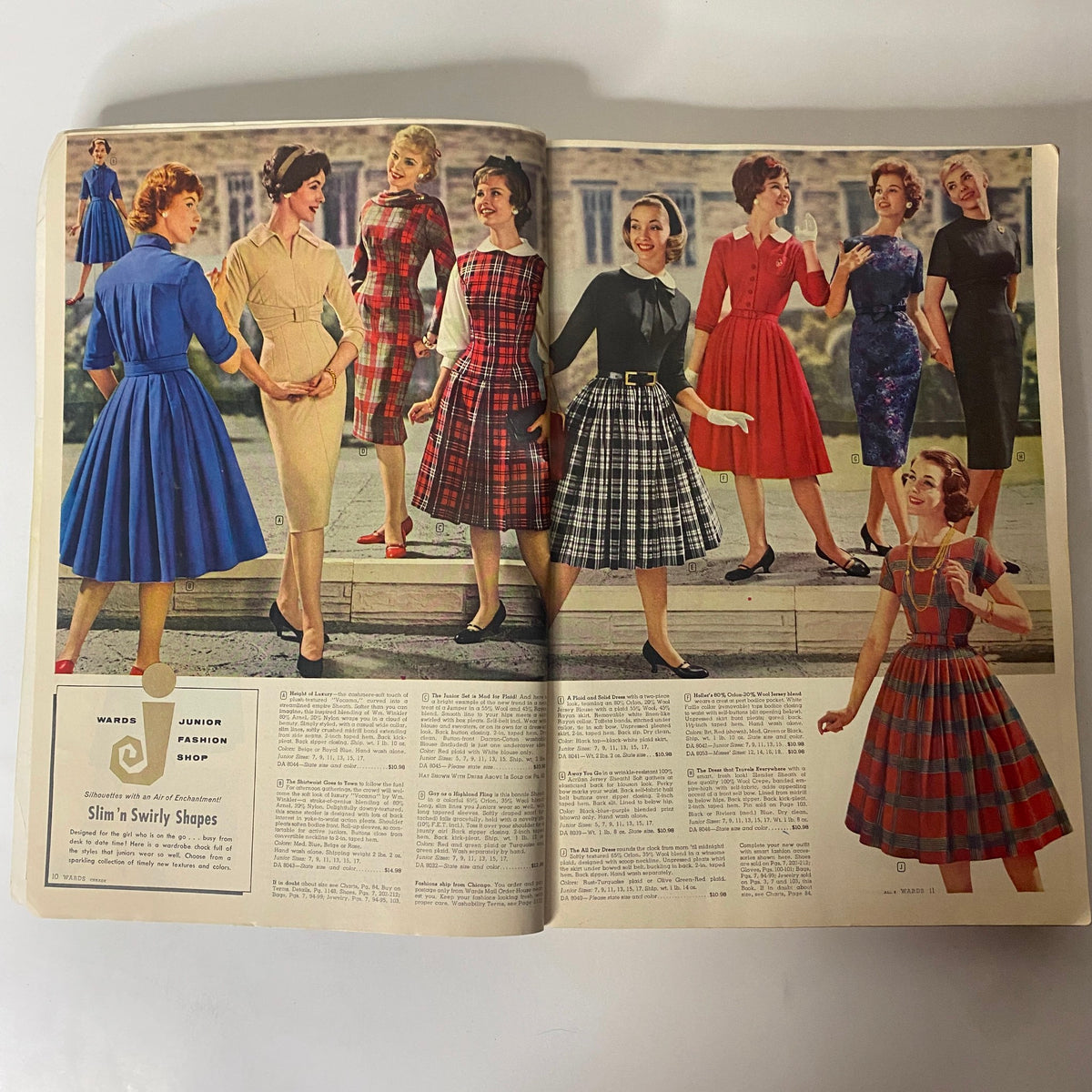
The confirmed focus on junior misses cold-weather fashion — knitwear, coats, pants, and winter accessories — situates this catalog within a specific and well-documented strand of late-1950s American fashion history. By 1959, the postwar teenage consumer had been established as a distinct market category for over a decade, and junior sizing was the retail industry's primary mechanism for addressing that category with fashion-forward rather than simply scaled-down adult styling. The cold-weather junior fashions documented in a 1959 Ward's catalog reflect the specific silhouettes, color palettes, and styling conventions of the late Eisenhower era — the fitted coats, the coordinated knitwear sets, the functional-yet-stylish winterwear that defined how American teenage girls and young women were expected to dress as the decade closed. This is fashion history documentation without the editorial mediation of a fashion magazine: the catalog shows what was actually manufactured, priced, and sold to real American consumers, not what a fashion editor thought they should want. The specificity of that record — sizes, prices, fabrics, color names, style numbers — makes it invaluable primary material for costume historians, fashion researchers, and collectors of mid-century Americana.
The 1959 date carries additional resonance as a threshold moment in American retail history. Montgomery Ward and its primary competitor Sears were at the peak of their catalog dominance in the late 1950s, before the suburban shopping mall expansion of the 1960s began to shift American retail habits away from mail-order toward in-person browsing. A 1959 Fall and Winter catalog therefore documents the catalog retail format at nearly its maximum cultural and commercial influence — the moment just before the structural changes in American retail geography that would gradually erode the catalog's centrality to American consumer life over the following two decades.
About the Publication
Montgomery Ward's seasonal mail-order catalogs were not magazines in the conventional editorial sense but functioned as the primary retail interface between the company and its customers — large-format, extensively illustrated publications issued twice yearly in Spring/Summer and Fall/Winter editions, supplemented by specialty catalogs for Christmas and other seasons. By 1959, the Fall and Winter catalog was a substantial publication running to several hundred pages and covering clothing, footwear, housewares, appliances, toys, sporting goods, and seasonal merchandise across every demographic category the company served. Its audience was the broad American household market, with particular strength in rural and small-town communities where department store access was limited and mail-order remained the primary mechanism for purchasing branded consumer goods. The catalogs were designed to be kept and consulted across the season rather than read once and discarded, which accounts for the survival of copies in usable condition more than six decades after publication.
Key Highlights Inside
- Junior misses cold-weather fashion — confirmed featured content — A documented showcase of late-1950s winterwear for junior sizes including knitwear, coats, pants, and accessories, representing primary retail documentation of the specific silhouettes and styling conventions of 1959 American fashion for the teenage and young women's market.
- 1959 Fall and Winter — peak catalog retail era documentation — Published at the moment of maximum cultural and commercial influence for the American mail-order catalog format, before the suburban mall expansion of the 1960s began to shift retail habits away from catalog purchasing.
- Montgomery Ward — founding American mail-order institution — A catalog from the company that invented American mail-order retail in 1872, documented in its 87th year of operation and at the peak of its mid-century consumer reach.
Note: Specific page counts, additional department content, and interior details beyond the confirmed junior misses cold-weather fashion focus have not been provided in the available listing. Fall and Winter catalogs of this era typically covered a comprehensive range of merchandise categories beyond clothing, but specific confirmed departments for this issue should be verified from available photographs rather than assumed from general catalog conventions.
Condition & Rarity
Good condition with no label and plastic protective covering represents a solid assessment for a 65-year-old large-format retail catalog — a publication format designed for sustained household use across an entire season rather than single reading, and one that consequently survived in far smaller numbers than its original distribution volume might suggest. The no-label status is a straightforward positive attribute: Ward's catalogs were mailed directly to customer households with address labels on the cover, and surviving copies without labels either represent display copies, extras, or copies from which labels have been cleanly removed — in any case preserving the full cover imagery without obstruction. The plastic protective covering indicates deliberate preservation at some point in the catalog's post-use history. Good condition in a publication of this age and format means the cover retains its imagery, the spine is intact despite the substantial page count typical of Fall and Winter editions, and interior pages are readable and structurally sound — characteristics that represent genuine preservation for a consumer publication designed for practical use rather than archival storage. The specific wear characteristics should be assessed from available photographs for any surviving copy being considered for research or display purposes.
Looking for More Issues Like This?
Late-1950s Montgomery Ward seasonal catalogs in good condition with intact covers are considerably less common than their original distribution numbers might suggest — these were working documents that most households used until they fell apart, and deliberate preservation was the exception rather than the rule. For collectors building a broader picture of American consumer culture and material life at the close of the 1950s, the complete 1959 publications collection at OriginalMagazines.com covers magazines, catalogs, and periodicals from the final year of the decade and regularly surfaces material that serious researchers of mid-century Americana will find directly relevant to the consumer culture this catalog documents.