



Description
Collector's Note – Why This Issue Matters
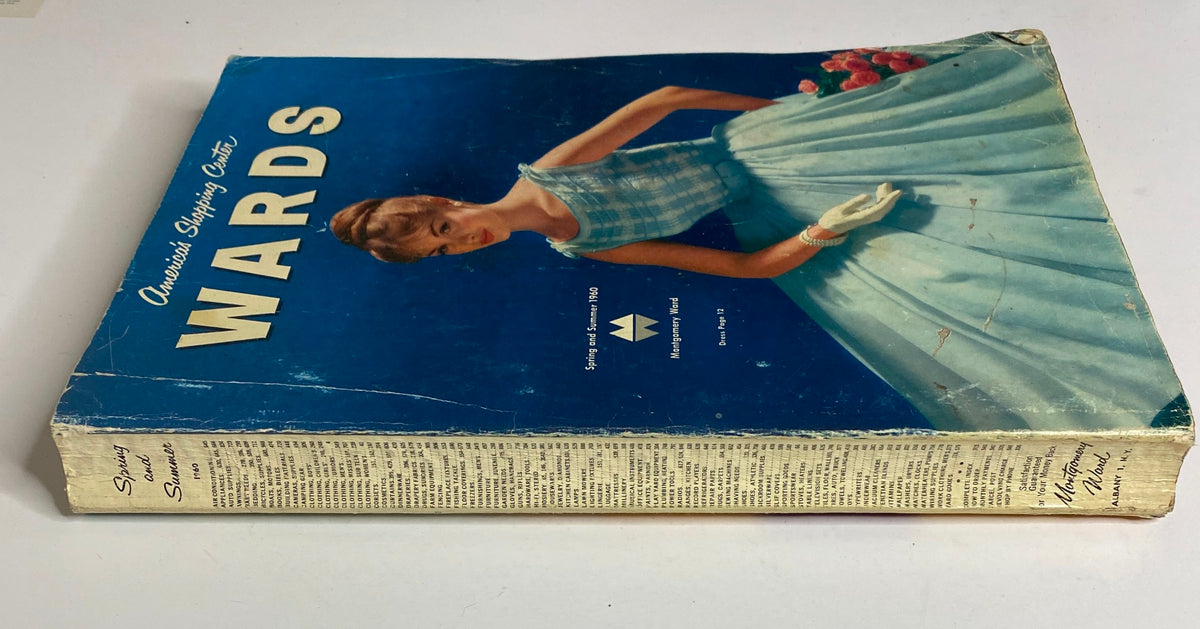
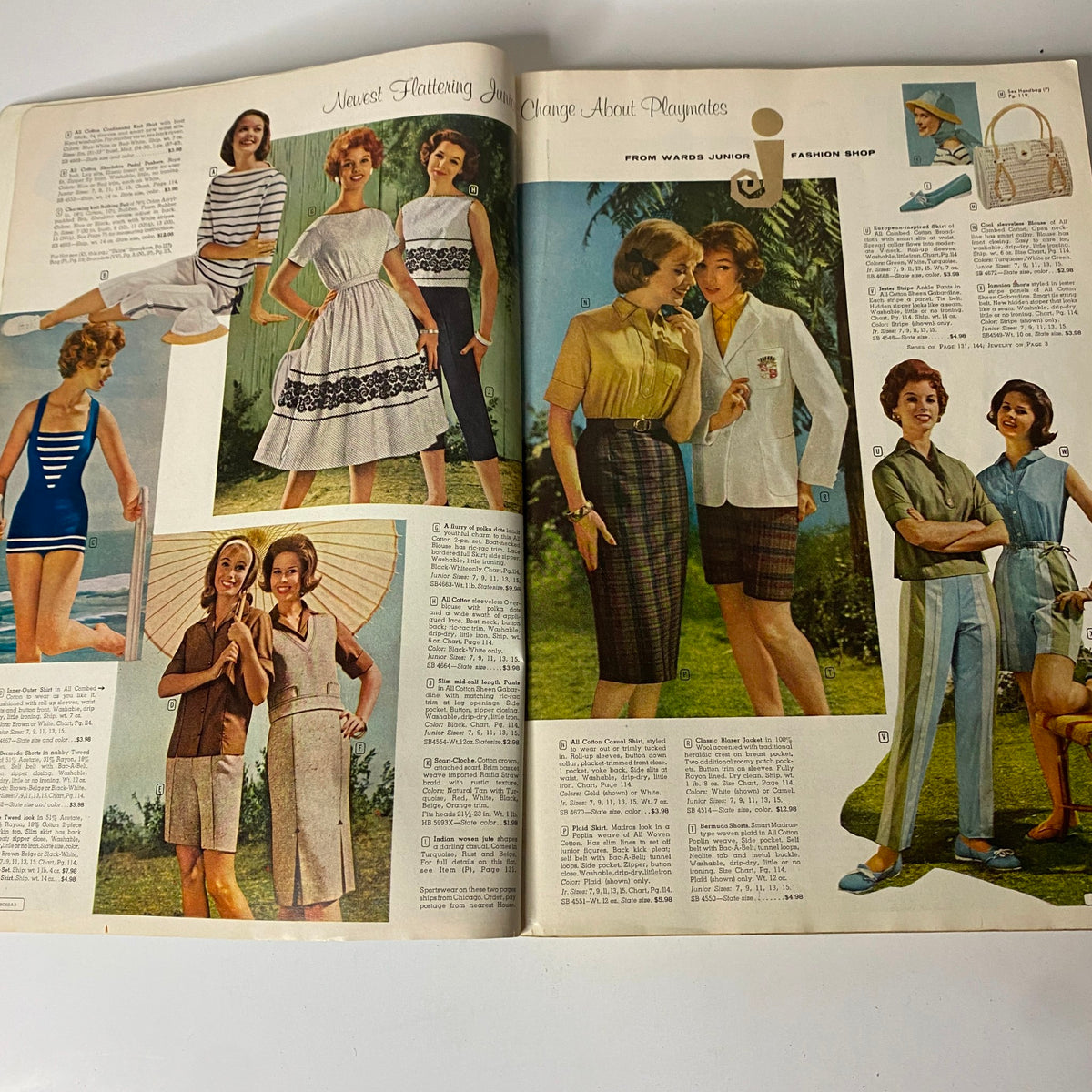
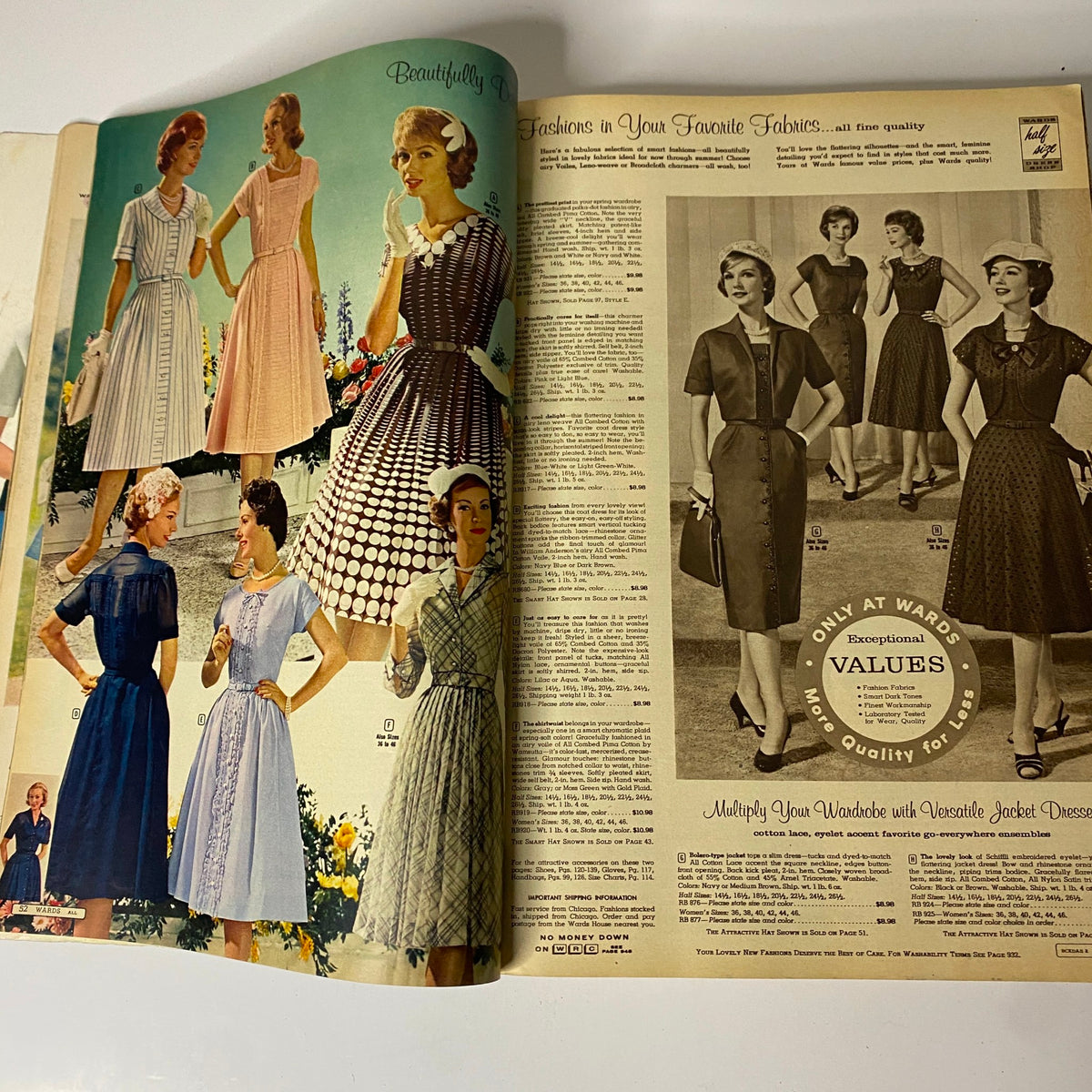
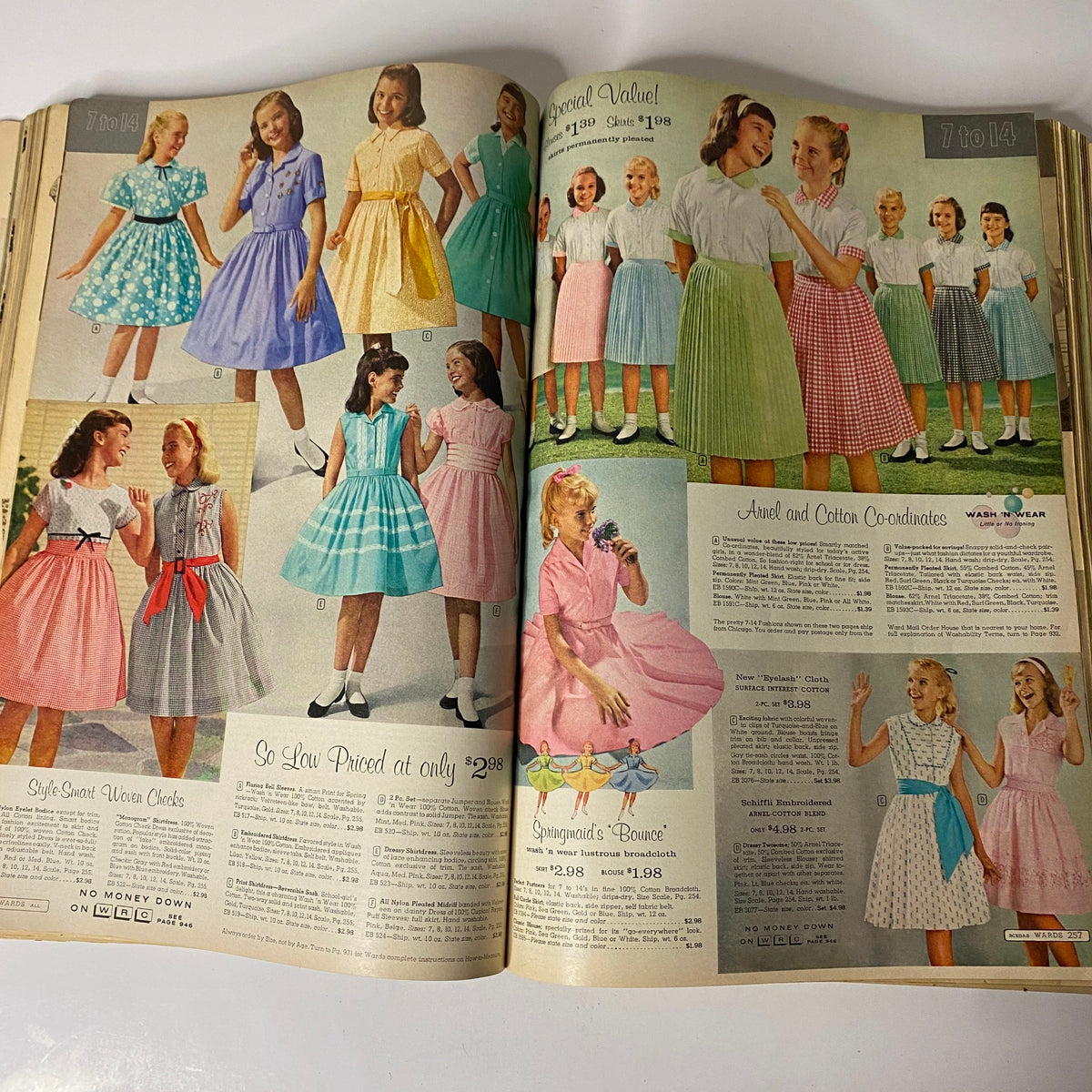
The 1960 Montgomery Ward Spring and Summer Catalog — specifically the confirmed "Newest Flattering Junior Styles — Change About Playmates" section from the Wards Junior Fashion Shop — is a primary document of American junior fashion at the precise opening moment of one of the most consequential decades in the history of how young women dressed and how that dressing was commercially understood and marketed. The spring-summer season of 1960 was the last before the Beatles, the last before the Kennedy assassination reshaped the national mood, the last before the first stirrings of the youth-culture revolution had fully reached the mainstream catalog retail market. The specific garments documented here — the all-cotton casual shirt in turquoise, red, white, black, beige, and orange; the Jamaica shorts in cotton sheen gabardine with stripe panel styling; the slim ankle-length pants in black; the Bermuda shorts in Madras-style plaid; the Indian woven poplin dress with kick pleat — are primary commercial evidence of what the American junior fashion market looked like at the last moment of its pre-revolutionary innocence. The Madras look appearing twice in this section — in the Bermuda shorts and the Indian woven poplin dress — is historically specific: Madras plaid was the specific American preppy summer classic that the Ivy League aesthetic had made fashionable in the late 1950s, and its presence as a junior fashion category in a 1960 Montgomery Ward catalog documents the precise moment when that aesthetic had moved from collegiate to mass-market accessibility. The pricing — $2.98 for shorts, $3.98 for a casual shirt, $8.98 for a dress, $12.98 for a 100% wool blazer — constitutes primary commercial documentation of junior fashion's specific consumer economics at the opening of the Kennedy era. For collectors building a documentary archive of American junior fashion and mid-century retail history, the full range of 1960 magazines and publications from this year provides essential primary source context for understanding the consumer landscape this catalog inhabited.
The specific construction details confirmed in the catalog's full product descriptions — roll-up sleeves and inverted back pleat for the casual shirt; ticket pocket trim and rayon lining for the 100% wool blazer; hidden zipper and side tie belt for the Jamaica shorts; ric-rac trim on the boat-neck blouse; kick pleat for ease of movement in the Indian woven poplin dress; self-belt with Bac-A-Belt design — constitute a level of primary fashion construction documentation that is rarely available in this form outside of original period commercial publications. These specifics are exactly what fashion historians, costume designers, and vintage clothing researchers find most valuable in surviving catalog material: the precise construction vocabulary, fabric specifications, and design details that document not just what the garments looked like but how they were made, what materials were used, and what functional and aesthetic priorities governed their design. The "washable, drip-dry, little ironing required" care instruction appearing repeatedly across multiple confirmed garments is itself primary evidence of the easy-care aesthetic that was one of the most commercially significant trends in early-1960s junior fashion — the synthetic-era aspiration toward low-maintenance clothing that was reshaping consumer preferences and manufacturer priorities simultaneously. The full color range documented for the casual shirt — turquoise, red, white, black, beige, orange with trim — is primary evidence of the specific color vocabulary of early-1960s American junior fashion at the mass-market level, the exact shades that a major catalog retailer was stocking and promoting in the spring-summer of 1960.
The 100% wool classic blazer with heraldic crest at $12.98 — the most expensive item confirmed in this section — deserves particular attention as a primary document of the specific aspirational aesthetic being offered to junior women shoppers in 1960. The heraldic crest, the ticket pocket, the rayon lining, and the gold-or-white color options are all elements of the traditional Ivy League and British collegiate aesthetic that was defining American aspirational fashion for young women at the end of the 1950s and the opening of the 1960s. Its presence in a Montgomery Ward catalog — the nation's first mail-order retailer, serving a broad middle-class and rural customer base rather than the Ivy League demographic it aesthetically referenced — documents the specific moment when that aesthetic had fully crossed from exclusive to accessible, from campus to catalog, in the spring-summer season that would prove to be among the last of the preppy aesthetic's undisputed cultural dominance before the decade's more radical fashion energies began to displace it.
About the Publication
The Montgomery Ward Spring and Summer Catalog was the warm-weather companion to the company's flagship fall-winter edition, distributed annually to millions of American households through the direct-mail program that had been central to Ward's retail dominance since the company's founding in 1872 as the first major mail-order catalog retailer in the United States. By 1960, the spring-summer catalog had been a fundamental institution in American consumer culture for nearly ninety years. The confirmed Ward's Junior Fashion Shop section reflects the company's specific acknowledgment of the junior fashion market as a distinct consumer category requiring its own curated editorial presentation — a recognition that the young American woman of 1960 had her own fashion identity and her own purchasing aspirations that were distinct from those of her mother's generation and that deserved dedicated catalog real estate. The Chicago shipping origin confirmed in the product listings reflects Ward's operational infrastructure, with the catalog serving as the interface between its centralized distribution network and its geographically dispersed customer base.
Key Highlights Inside
- Complete "Change About Playmates" junior coordinates system with specific pricing and construction details — The confirmed seven-piece junior wardrobe system — casual shirt ($3.98), wool blazer ($12.98), Jamaica shorts ($2.98), slim ankle pants ($2.98), two-piece cotton set ($9.98), Bermuda shorts ($4.98), Indian woven poplin dress ($8.98) — provides primary commercial documentation of junior fashion's specific price architecture and construction vocabulary in the spring-summer of 1960, with confirmed fiber contents, care instructions, color options, and SKU numbers that make this one of the most technically detailed confirmed catalog sections in the Montgomery Ward archive.
- Madras plaid documentation — Ivy League aesthetic at mass-market accessibility — The confirmed Madras-style Bermuda shorts and Indian woven poplin dress document the specific moment when the Ivy League preppy aesthetic's signature fabric had crossed from collegiate exclusivity to Montgomery Ward catalog availability, preserving primary evidence of that aesthetic's mass-market commercialization in the spring-summer of 1960.
- 100% wool heraldic blazer — aspirational Ivy League aesthetic confirmed — The confirmed wool blazer with heraldic crest, ticket pocket, and rayon lining at $12.98 documents the specific aspirational aesthetic ceiling of junior fashion in a major catalog retailer's 1960 spring-summer offering, with full construction and care specifications preserved in primary commercial form.
- "Washable, drip-dry, little ironing required" — easy-care aesthetic documented across multiple garments — The confirmed care instruction appearing on multiple garments is primary evidence of the easy-care trend's commercial penetration of the junior fashion market in 1960, documenting the specific marketing priority that synthetic-era performance values were receiving in mainstream catalog retail at this moment.
- Color range documentation — turquoise, red, white, black, beige, orange with trim — The confirmed six-color range for the casual shirt is primary evidence of the specific color vocabulary being offered to junior fashion consumers in spring-summer 1960, preserving the exact palette that Montgomery Ward was stocking and promoting at the opening of the decade.
- Junior sizes 7 through 15 with Chicago distribution origin confirmed — The confirmed sizing range and shipping origin preserve primary institutional documentation of Ward's junior fashion operation's specific commercial parameters — the size range being offered, the distribution infrastructure being used, and the mail-order purchasing framework being promoted to its early-1960s customer base.
Condition & Rarity
This catalog is described as being in good condition, protected by a plastic covering, with the listing confirming that the photographed item is exactly what will be received and directing detailed condition assessment to the accompanying photographs — the appropriate approach for a vintage retail publication where the visual record provides precision unavailable from verbal description alone. For a catalog now over sixty-five years old produced as a practical shopping reference, good condition represents a well-maintained survivor of a publication category that most original recipients actively used throughout the season and eventually discarded. The confirmed full product descriptions with pricing, SKU numbers, construction specifications, and color options visible in this listing suggest that the specific Ward's Junior Fashion Shop pages are intact and fully legible — a meaningful positive for fashion historians and researchers approaching this catalog as a technical primary source rather than simply as a visual artifact. The plastic protective covering indicates intentional preservation care, correlating with better overall physical stability than unprotected copies. The listing does not specify whether a mailing address label is present on the cover, which is worth verifying from the photographs — Ward's distributed this catalog through direct mail, and labeled copies are the norm, with label-free examples presenting with cleaner cover surfaces.
Looking for More Issues Like This?
Montgomery Ward spring and summer catalogs from 1960 — particularly editions with confirmed detailed junior fashion documentation like the "Change About Playmates" section's complete construction specifications, pricing, and color ranges — are sought by fashion historians, vintage clothing researchers, retail ephemera collectors, and mid-century Americana enthusiasts who recognize these publications as irreplaceable primary documents of American junior fashion at the opening moment of its most consequential decade. If this 1960 spring-summer catalog is no longer available, the 1960 magazines collection at OriginalMagazines.com brings together a wide range of primary source material from that pivotal opening year of the decade, collectively documenting the full sweep of American consumer life, fashion, and popular culture at the last moment before the 1960s fully became the 1960s.