

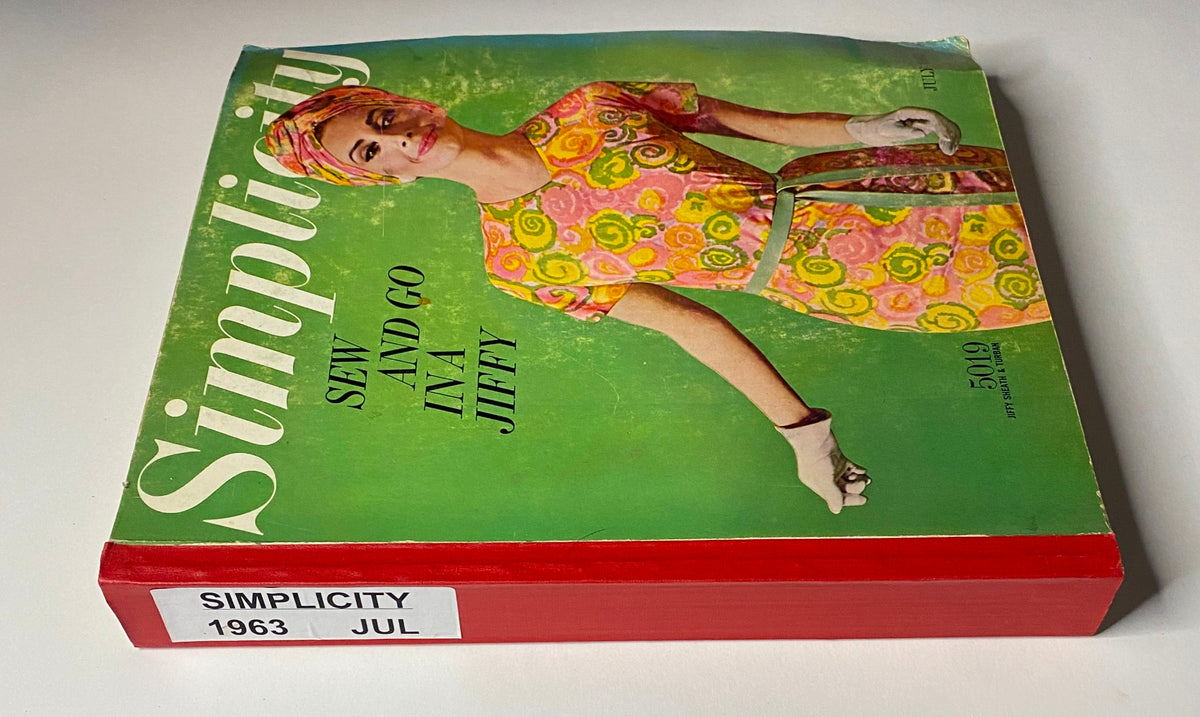


Description
Collector's Note – Why This Issue Matters
July 1963 sits in a particular sweet spot of American fashion history — deep enough into the Kennedy era that its aesthetic had fully crystallized, but just months before the national trauma of November 1963 that would mark the psychological end of that moment. The early 1960s silhouette that Simplicity was documenting in this catalog — clean lines, tailored fits, polished casual coordinates — was the domesticated version of what Jacqueline Kennedy had elevated to a national style ideal. By the summer of 1963, that aesthetic had fully migrated from the pages of Vogue into the fabric stores of middle America, and a July Simplicity catalog is precisely the kind of document that records that migration in practical, pattern-by-pattern detail. For fashion historians and collectors, the Simplicity pattern catalog archive captures this translation process — from runway and first lady to home sewing counter — with a fidelity that no magazine of the period can quite replicate.
The summer timing of this particular edition adds another layer of historical specificity. A July catalog addressed the warm-weather wardrobe at its peak, which in 1963 meant the full vocabulary of early 60s casual dressing: light coordinates, summer suits, transitional pieces that could carry a woman from a daytime errand to an evening occasion without sacrificing the era's standard of polish. The inclusion of pantdresses — a category that would become increasingly prominent as the decade progressed — is a detail worth noting. In July 1963, the pantdress was still a relatively fresh silhouette, not yet the ubiquitous garment it would become by mid-decade. Its presence in this catalog marks the precise moment when a trend was transitioning from fashion-forward to mainstream accessible. Collectors assembling a comprehensive picture of this transitional period will find the catalog complements other magazines from 1963 that document the same cultural moment from different editorial perspectives.
The children's patterns and playwear sections deserve specific mention as historical documents in their own right. Early 1960s children's fashion followed the adult aesthetic far more closely than children's wear would after the mid-decade youth culture explosion began loosening the rules for all ages. The girls' patterns in a July 1963 Simplicity catalog reflect a world in which children were dressed as smaller, simplified versions of their mothers — a relationship between adult and children's fashion that was already beginning to shift and would look almost unrecognizable within five years. That specificity makes this catalog a useful fixed point for anyone studying the arc of American children's fashion through the decade.
About the Publication
Simplicity Pattern Co., founded in 1927 with a mission to democratize home dressmaking through affordable, accessible patterns, had by the early 1960s established itself as one of the central institutions of American domestic life. The large-format counter catalogs distributed to fabric retailers and department store notions departments were the primary interface between the company's design output and its customers — browsed at the counter before individual pattern envelopes were selected from the flat storage drawers that defined the fabric store experience for generations of American women. The "Sew" branding used in the 1963 edition reflects Simplicity's ongoing effort to position home sewing as an active, modern creative practice rather than a merely economical necessity, a distinction that carried real meaning in a postwar consumer culture increasingly oriented toward ready-to-wear. A July issue served the peak summer sewing season, when warm-weather wardrobe construction was the primary focus of the home sewist's calendar.
Key Highlights Inside
- Misses' and Junior Dresses, Pantdresses, Skirts, and Blouses: The catalog's core women's categories, reflecting the full early-60s wardrobe vocabulary — with the pantdress inclusion marking a specific transitional moment in silhouette evolution.
- Casual Coordinates, Light Jackets, and Summer Suits: Warm-weather separates and suiting appropriate to the era's standard of polished casual dressing, designed for the range of occasions that defined middle-class American summer life in 1963.
- Children's Patterns, Playwear, and Basic Accessories: Girls' and children's patterns reflecting the early-60s convention of dressing children as scaled-down versions of adult fashion — a relationship between generations of clothing that the decade would substantially revise within a few years.
- Sizing for Misses, Half-Sizes, Juniors, and Girls: The multi-range structure confirms Simplicity's systematic approach to serving the full spectrum of the female consumer market, from young teens through adult women of varying proportions, within a single catalog edition.
Condition & Rarity
Counter catalogs from the early 1960s face a steeper survival challenge than those from later in the decade, simply because more time has elapsed and the retail objects of that era were discarded with particular efficiency once their seasonal utility ended. A July 1963 Simplicity catalog described as being in good condition, with the catalog pictured confirmed as the actual item, represents a meaningful survivor from a format that was never intended for preservation. In evaluating any copy of this issue, the condition attributes most relevant to collector-grade assessment are binding integrity across the full page count, clarity of the interior pattern illustrations — which were the functional core of the catalog and the section most subject to handling wear — and cover condition, which absorbed the most direct retail counter exposure. Interior pages free from tracing marks, annotation, cutting, or moisture damage define the upper end of the collectible range for this material. Protective plastic covering in surviving examples indicates deliberate storage care that generally correlates with better overall preservation of both covers and interior pages.
Looking for More Issues Like This?
A summer catalog from 1963 in collectible condition is a genuinely uncommon find — these working retail documents had a short useful life and a long subsequent neglect, and the early 60s editions have had more decades to disappear than their later counterparts. If this issue is no longer available, the Simplicity catalog collection at OriginalMagazines.com is the most reliable place to search for other seasonal and themed editions from across the company's history. For collectors focused specifically on the Kennedy-era moment, the 1963 magazine archive offers a wide range of publications from this historically charged year worth exploring.