


Description
Collector's Note – Why This Issue Matters
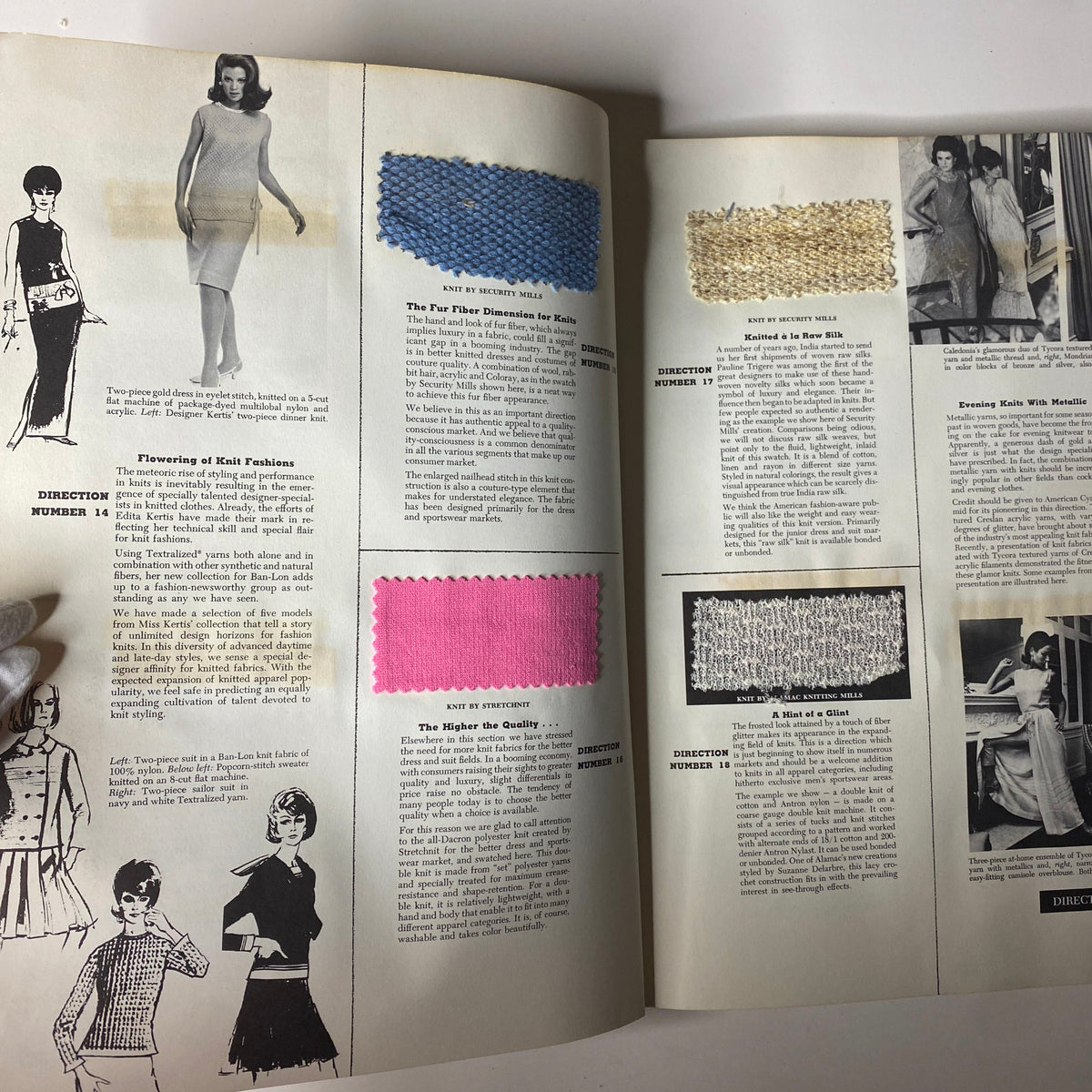
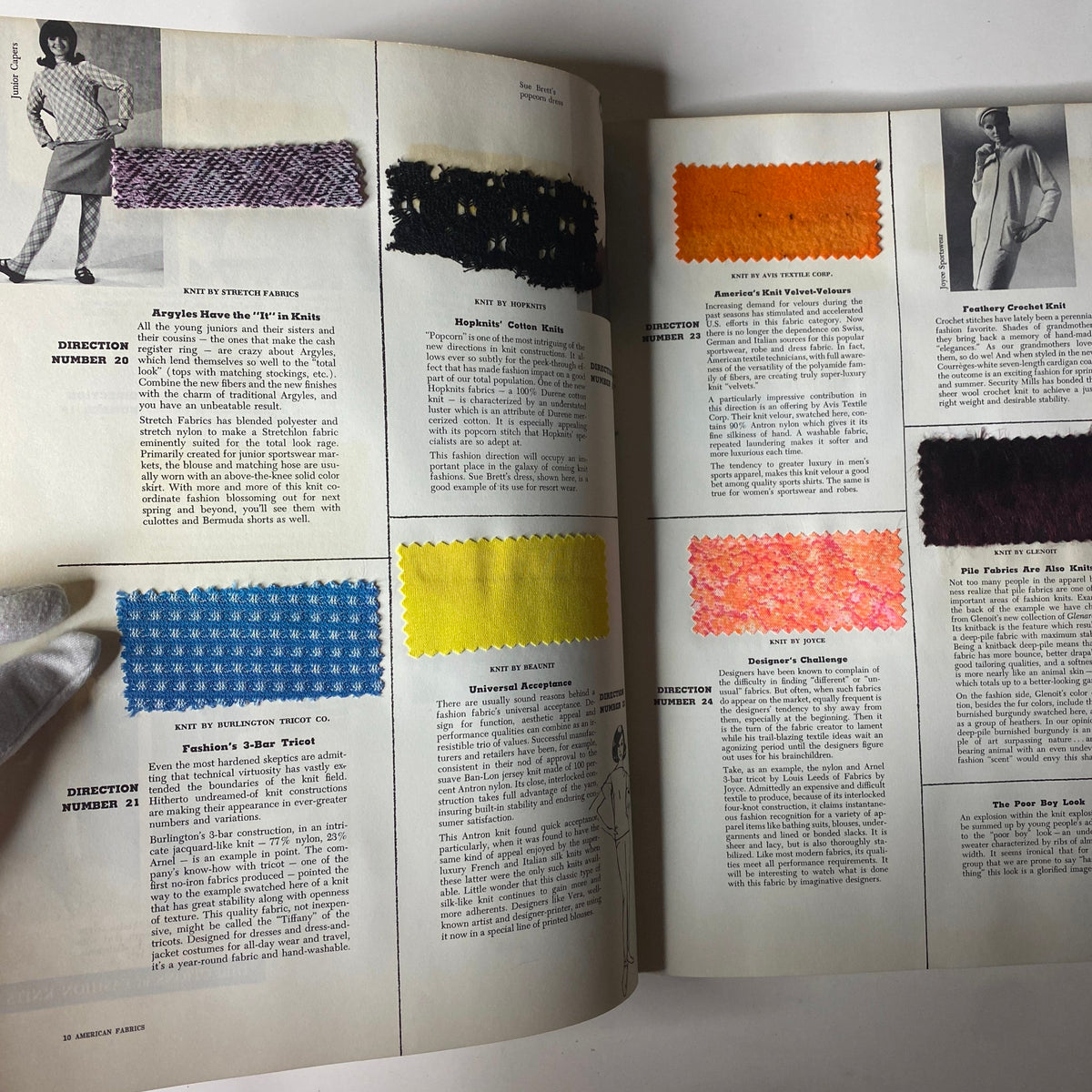
The 1965-1966 American Fabrics No. 70 Winter Catalog is a primary document of the American knitwear industry at the precise moment of its transformation from a significant clothing category into a dominant commercial force, and its confirmed thirty-six-page editorial portfolio on "The Expanding World of Knits" — the largest confirmed feature in any of the mid-1960s issues of this publication — reflects the editorial judgment that this was the most consequential story in American textiles at the time of its publication. The $3 billion-plus knitting sector documentation confirmed on pages 46 through 48, with its data visualizations and ten key growth factors, constitutes a primary commercial and economic document of an industry at its moment of maximum acceleration — the specific numbers, trends, and structural factors that were driving the knit fabric market's displacement of woven fabrics across multiple apparel categories, preserved in the original trade press language rather than in retrospective analysis. The evening knits, metallic knits, textured double knits, and printed knits documented in the "Knit Directions in Fabric and Fashion" trend report on page 3 map the full range of applications through which knitwear was colonizing fashion categories that had previously belonged exclusively to woven fabrics — from casual sportswear to formal evening wear — in a single comprehensive seasonal overview. For collectors and researchers building a documentary archive of American textile history, the American Fabrics catalog collection at OriginalMagazines.com provides essential depth across the publication's full run, with this winter 1965-66 edition representing one of the most historically comprehensive single issues in the publication's coverage of the knitwear revolution.
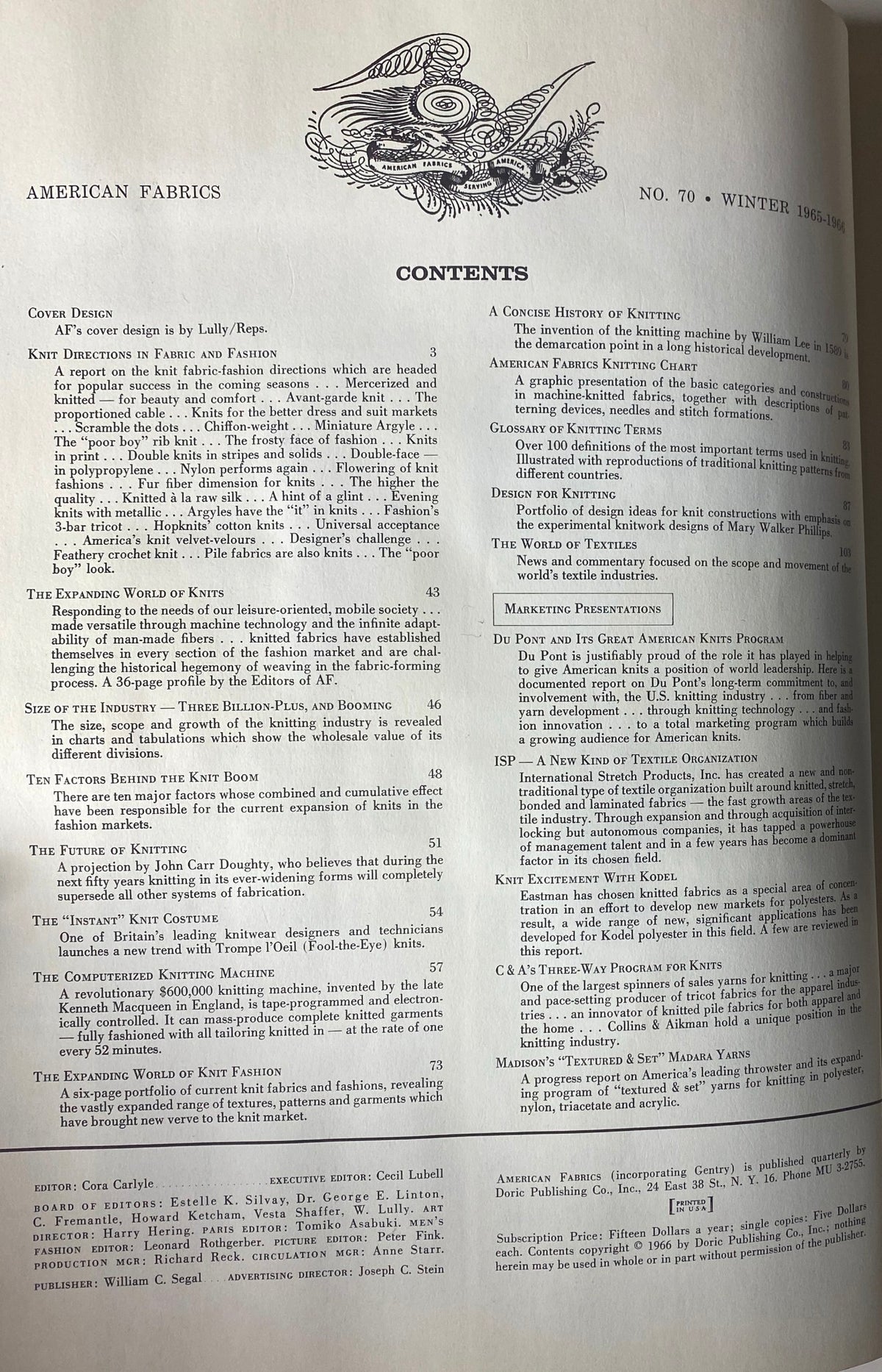
The Kenneth Macqueen computerized knitting machine feature — confirmed on page 56, documenting a $600,000 machine capable of producing complete garments with tailored finishes in under an hour — is primary documentation of a specific and historically significant moment in the automation of textile production. Computer-controlled knitting machinery was in the mid-1960s at the cutting edge of industrial textile automation, and the specific machine described here — with its price point and its claimed production capability — is primary evidence of what the most advanced automated knitwear production technology looked like in 1965-66, before the full computerization of textile manufacturing had become widespread. The price point alone — $600,000 in 1965-66 dollars, equivalent to several million dollars in contemporary purchasing power — documents the extraordinary capital investment that advanced knitwear automation required, and the implied productivity claim — complete tailored garments in under an hour — documents the specific competitive advantage being offered to manufacturers willing to make that investment. This feature is primary industrial history documentation of the technology that was driving the knit industry's economic expansion at exactly the moment when the $3 billion sector data confirms that expansion was at its most dramatic. The educational infrastructure confirmed in this catalog — a one-hundred-plus-definition knitting glossary, a fabric construction chart, a history of knitting from origins through William Lee's 1589 frame, and an experimental design portfolio — reveals an editorial team committed to building the conceptual vocabulary of its industry's most important growth story rather than simply reporting on it. The full range of 1965 magazines and publications from this year documents American fashion, industry, and culture during one of the most consequential transitional periods in twentieth-century textile history, and this catalog sits within that body of material as its single most comprehensive knitwear primary source.
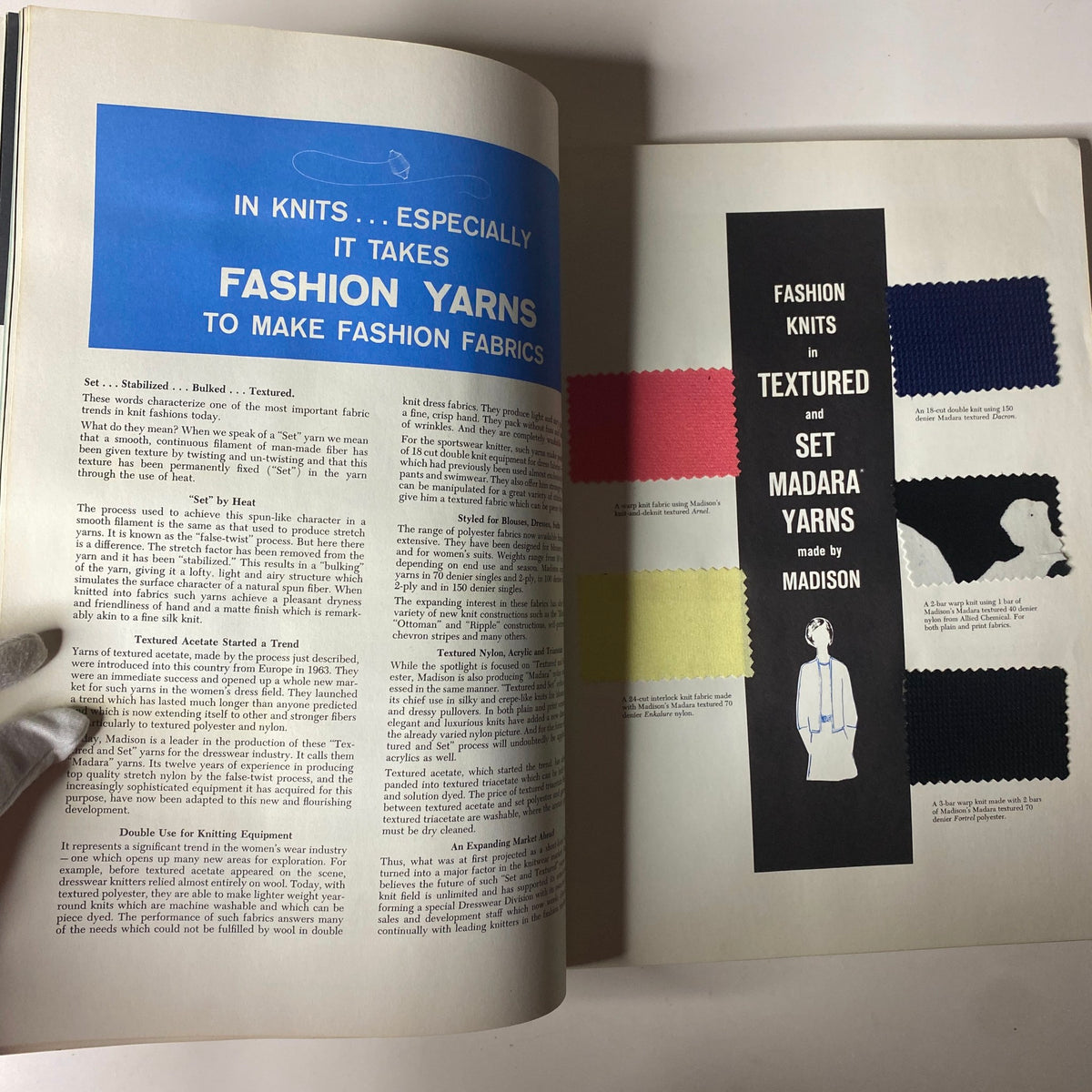
The brand and corporate documentation confirmed in this catalog's marketing spotlights provides a secondary layer of industrial history that is as valuable as the editorial features for researchers studying the specific competitive dynamics of the mid-1960s American textile industry. Du Pont's role in American knits innovation — in the context of a catalog being published immediately after the stretch feature issues that chronicled Du Pont's Lycra development — places the company's knitwear contribution alongside its fiber innovation leadership as a continuous corporate narrative across multiple American Fabrics editions. Eastman Chemical's development of Kodel polyester, Collins & Aikman's tricot and pile fabric leadership, ISP's emergence as a new textile force, and Madison's textured Madara yarn development collectively document the specific competitive landscape of the American fiber and knitting industry in winter 1965-66 — which companies were leading, which were emerging, and which specific product innovations were driving the competitive dynamics of a $3 billion market. That corporate competitive landscape, preserved in the original trade press voice at a specific historical moment, is exactly the kind of primary documentation that industrial historians and business researchers find irreplaceable in trade publications of this type.
About the Publication
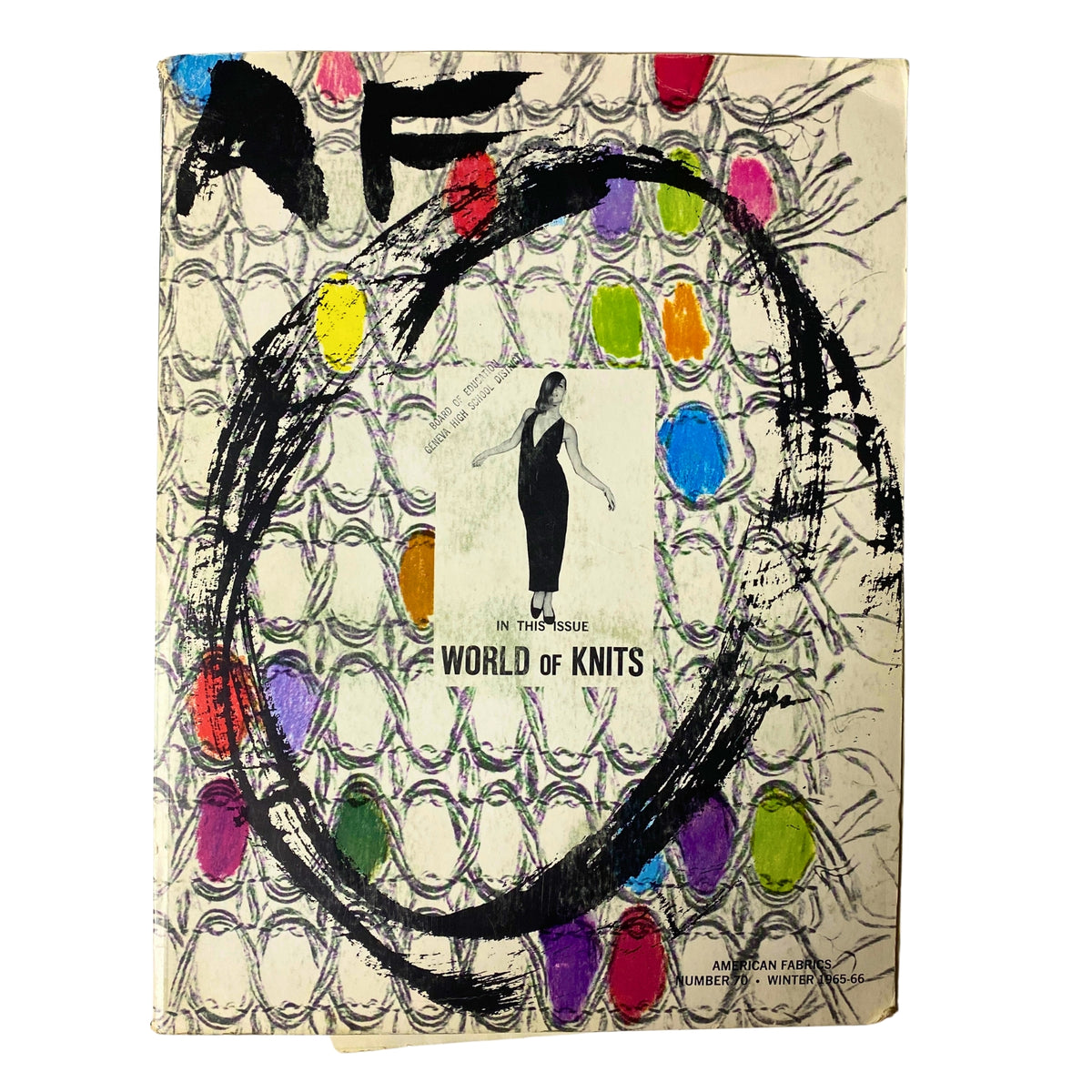
American Fabrics was a trade publication serving the American textile and fashion manufacturing industry, providing manufacturers, designers, buyers, and retailers with documentation of new fabric developments, technical innovations, seasonal trend information, and the market intelligence that professional fashion industry participants needed to make informed production and purchasing decisions. By Number 70 in the winter of 1965-66, the publication had established the distinctive editorial identity visible throughout this issue's confirmed contents — a combination of technical rigor, genuine fashion analysis, educational depth, and the long-form industry commentary that distinguished it from more narrowly commercial trade publications. The cover design credit to Lully/Reps — an evolution of the W. Lully credit confirmed for other mid-1960s editions — reflects the publication's consistent investment in editorial visual quality. Its audience encompassed the full professional range of the American textile industry, and the thirty-six-page knit feature and its supporting educational materials reflect a publication genuinely committed to building its industry's conceptual and technical vocabulary rather than simply documenting its commercial offerings.
Key Highlights Inside
- "The Expanding World of Knits" — 36-page editorial portfolio (p. 43) — The confirmed thirty-six-page feature is the largest single-subject editorial investment confirmed in any mid-1960s edition of this publication, documenting the American knitwear industry's challenge to woven fabrics across multiple market categories in the context of a leisure-oriented lifestyle shift — primary evidence of the trade press's recognition that knitwear's commercial expansion was the defining story in American textiles in the winter of 1965-66.
- "The Booming Knit Industry" with $3 billion sector data and ten growth factors (pp. 46–48) — The confirmed data visualizations and commercial commentary documenting the $3 billion-plus knitting sector's expansion provide primary economic documentation of the American knitwear industry at a specific and historically significant moment in its commercial trajectory, preserving the specific scale, growth factors, and market dynamics in the original trade press voice.
- Kenneth Macqueen $600,000 computerized knitting machine (p. 56) — The confirmed documentation of a specific automated knitting machine — its capital cost, its production capability, and the implications for garment manufacturing — is primary industrial history evidence of the automation technology that was driving the knitwear industry's economic expansion in 1965-66, preserved with the specific technical and commercial detail that only contemporaneous trade press documentation provides.
- Knitting Glossary (100+ definitions), Chart, History, and Design Portfolio (pp. 15–23) — The confirmed educational apparatus accompanying the commercial and technical features documents an editorial commitment to building the conceptual vocabulary of the knitwear industry rather than simply reporting on it, providing primary evidence of how the American textile trade press understood its educational responsibilities to its professional readership in the mid-1960s.
- Du Pont, Eastman Kodel, Collins & Aikman, ISP, and Madison corporate spotlights — The confirmed brand documentation preserves primary competitive landscape evidence for the specific companies driving the American fiber and knitting industry's development in winter 1965-66, providing industrial history documentation of corporate positioning and product innovation at a specific and consequential moment in the industry's evolution.
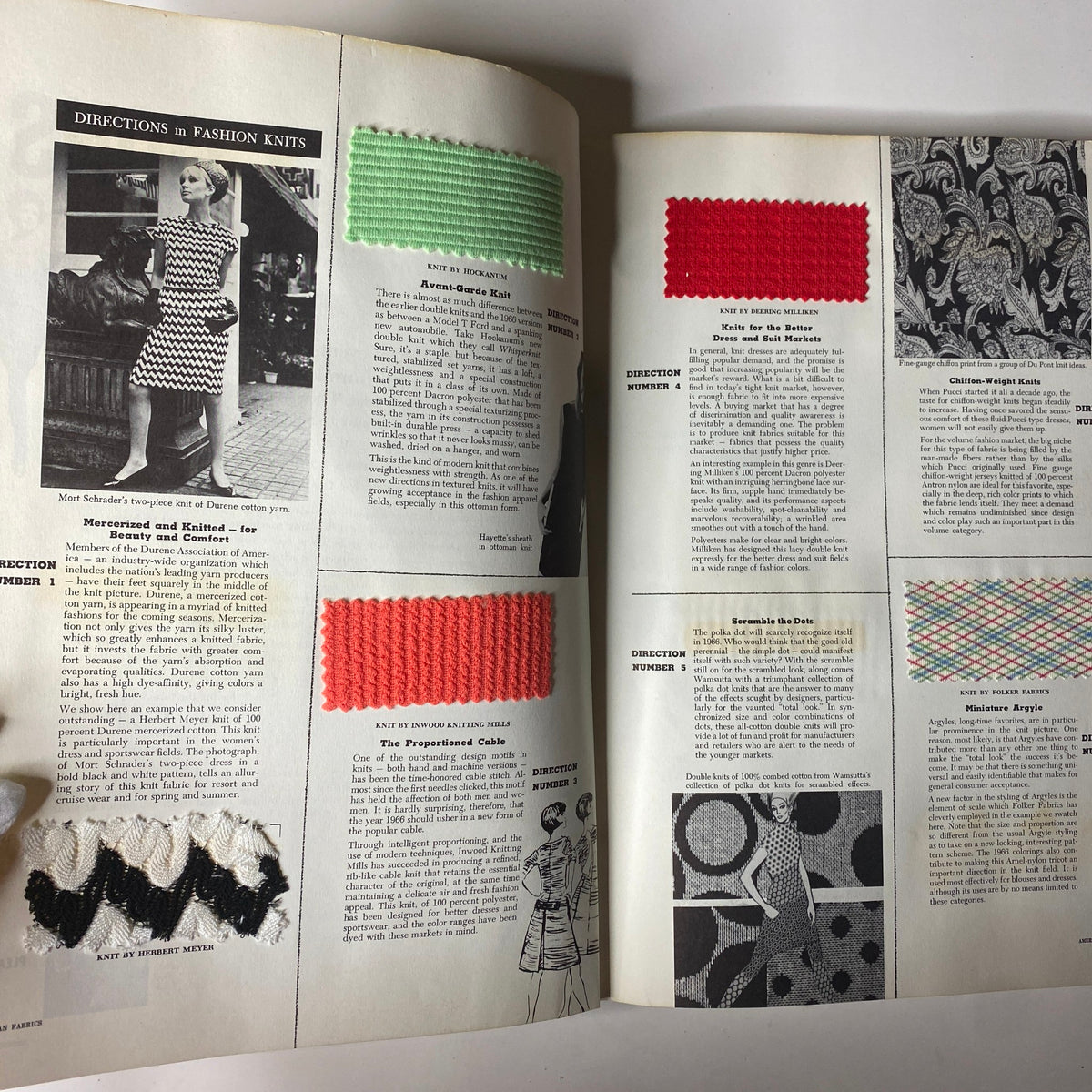
- "Knit Directions in Fabric and Fashion" trend report (p. 3) — metallic evening knits, textured doubles, printed knits — The confirmed seasonal trend survey documents the full range of knitwear applications being advanced for the 1965-66 winter season, from avant-garde experimental designs through mainstream commercial categories, preserving the specific aesthetic vocabulary and commercial direction-setting language of the American knitwear trade press at this pivotal moment.
Condition & Rarity
This catalog is described as being in acceptable condition with a good interior, presenting cover creases, visible marks, wear within, and potential additional rips or blemishes — a condition profile that requires honest assessment for collectors weighing its suitability for specific research or collecting purposes. The acceptable-cover/good-interior split is the most important condition distinction noted, and its significance depends on the intended use: for researchers primarily interested in the thirty-six-page knit feature, the $3 billion sector data, the computerized knitting machine documentation, and the educational glossary, a good interior in a worn cover represents a functionally complete and highly usable primary source. The cover creases and marks are consistent with a professional reference document that was actively consulted throughout a season and then stored rather than preserved with collector intent, and the potential additional rips noted in the listing require examination of the accompanying photographs to assess their placement relative to the specific content sections of greatest research value. The plastic protective covering indicates active preservation care that has stabilized the catalog against further deterioration. Collectors should examine the photographs carefully against their specific research needs — the knit feature pages and the educational glossary section are the primary documentary assets whose condition most directly affects the catalog's utility for the research communities most likely to seek it out.
Looking for More Issues Like This?
American Fabrics winter catalogs from the mid-1960s — and particularly this Number 70 edition with its thirty-six-page knitwear feature, $3 billion sector documentation, and computerized knitting machine primary evidence — are sought by textile historians, industrial technology researchers, fashion industry scholars, and serious collectors who recognize these publications as primary documents of the American knitwear industry's most consequential commercial and technological transformation. If this 1965-66 Winter Catalog is no longer available, the American Fabrics catalog collection at OriginalMagazines.com is the most focused resource for exploring what else has surfaced from this important trade publication's full run. For collectors building a broader documentary record of American fashion, textile innovation, and industrial culture during the year when the knitwear revolution reached its most dramatic commercial expression, the 1965 magazines collection brings together a wide range of primary source material from that pivotal year in American design and industrial history.