


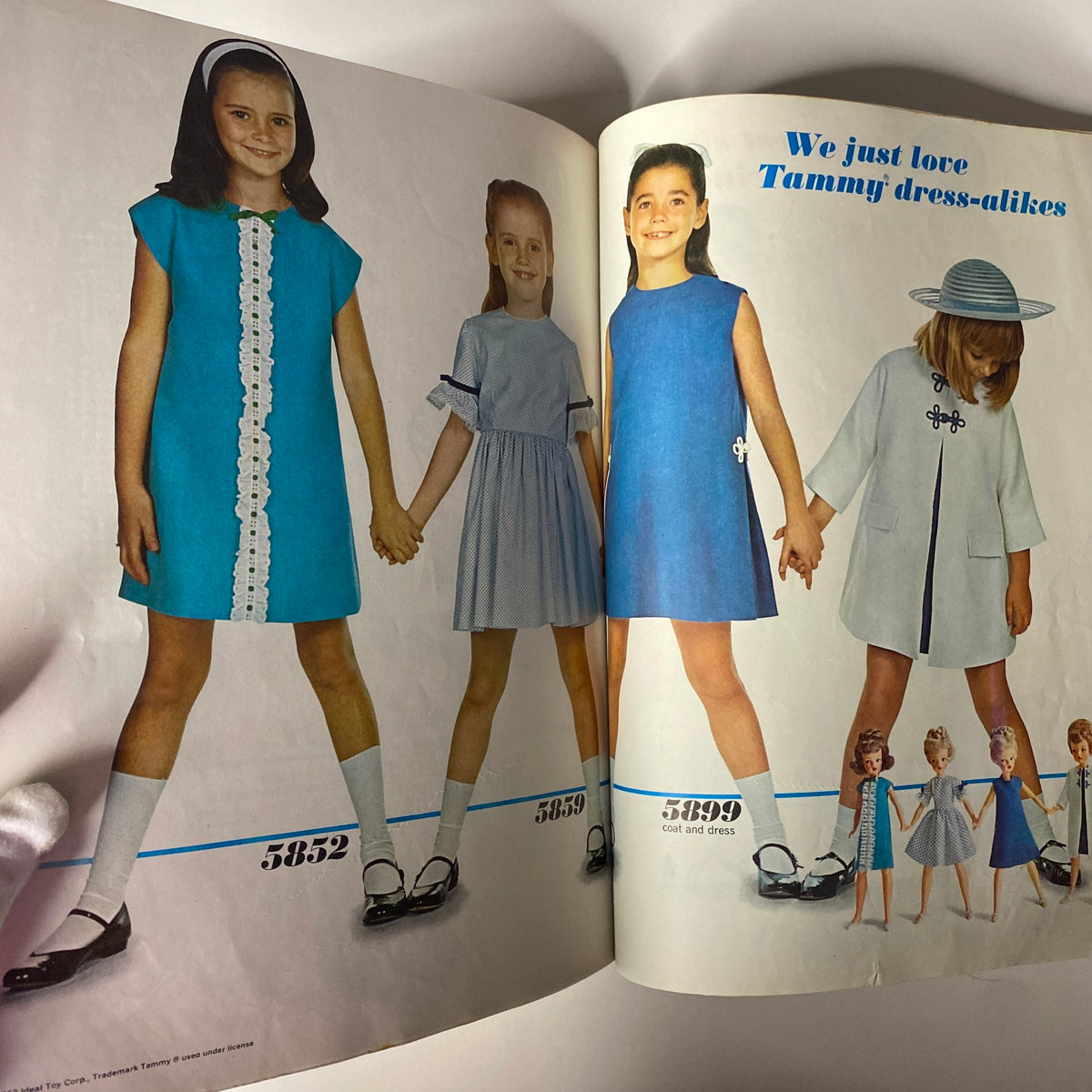


Description
Collector's Note – Why This Issue Matters
The May 1965 Simplicity Catalog arrived at a fascinating inflection point in American fashion history. The early months of 1965 sat squarely between two seismic style shifts — the tail end of the early-60s ladylike silhouette and the approaching wave of mod, youth-driven fashion that would fully detonate by 1966 and 1967. A spring catalog issued in May captures precisely this transitional energy: hemlines were quietly creeping upward, separates were gaining ground on the traditional dress, and the notion of "junior" fashion as its own distinct category was cementing itself in the American market. For anyone studying how mainstream fashion actually moved from the drawing boards of New York and London into the homes of ordinary American women, the Simplicity pattern catalog archive is an irreplaceable primary source — and the May 1965 edition is among the more historically loaded issues of that decade.
What makes a store counter catalog like this particularly valuable to the fashion historian is its function. These were not aspirational glossy magazines aimed at wealthy consumers. They were working documents, placed on the counters of fabric stores from small-town Main Streets to urban department store notions departments, and consulted by the women who actually made the clothes their families wore. The scale categories alone — Jiffy Styles, Personal-Fit Patterns, Proportioned-to-Height Fashions — reveal a sophisticated, consumer-responsive system designed to make couture-inspired silhouettes accessible to sewists of every skill level and body type. Teen Junior and Sub-Teen sections confirm that by spring 1965, Simplicity had fully embraced the generational segmentation that would define American retail for the next half century. Browsing magazines from 1965 across categories reinforces just how culturally charged this single year was.
The "How-to-Sew" section included in this catalog also speaks to the era's educational mission. The postwar home economics tradition was still deeply embedded in American schools and households, and pattern companies like Simplicity actively supported it — including through 4-H programming, which appears as its own category in this very issue. That a spring counter catalog would dedicate space to 4-H sewing projects is a detail that grounds the document firmly in its social context: this was a catalog designed for the full breadth of American domestic life, from resort wear for the aspirational consumer to youth club uniforms for the rural teenager.
About the Publication
Simplicity Pattern Co. was founded in 1927 with an explicit mission to make home dressmaking accessible to everyday consumers through lower-cost, easy-to-follow patterns. By the 1960s, Simplicity had grown into one of the dominant forces in the American home sewing market alongside Butterick, McCall's, and Vogue Patterns. The seasonal and monthly counter catalogs — large-format bound books distributed to fabric and notion retailers — served as the primary browsing and selection tool for customers before individual pattern envelopes were pulled from the drawers. These catalogs were printed in significant quantities but were also heavily used in-store, meaning that surviving copies in collectible condition are considerably rarer than their original print runs might suggest. The May issue specifically addressed the spring and early summer sewing season, featuring the warm-weather categories — sportswear, resort wear, blouses, and lighter dress silhouettes — that made it a high-use reference during the busiest sewing months of the year.
Key Highlights Inside
- Jiffy Styles: Quick-construction patterns aimed at sewists who wanted fashionable results with reduced complexity — an increasingly important category as women's leisure time and the pace of fashion both accelerated in the mid-60s.
- Misses' & Juniors' Dresses: The catalog's core category, reflecting the full range of early-to-mid 1960s dress silhouettes, from structured sheaths to the emerging A-line shapes that would come to define the decade.
- Personal-Fit and Proportioned-to-Height Patterns: Simplicity's proprietary fitting systems, designed to reduce the alterations required by standard sizing — a significant selling point in an era when fit was everything and ready-to-wear sizing was far less standardized than today.
- Teen Junior, Junior Petite & Sub-Teen Sections: Dedicated youth categories reflecting the growing commercial recognition of teenagers as a distinct fashion consumer — a cultural shift that 1965 was actively accelerating.
- 4-H and Resort Wear: An unusually broad pairing that illustrates the catalog's reach across the full spectrum of American life, from rural youth programming to leisure-class vacation dressing.
- Separates, Sportswear, Jumpers, Blouses, Jackets & Hats: The expansion of non-dress categories in this catalog mirrors the broader mid-60s shift toward mix-and-match dressing and away from the single-piece dress as the default female garment.
Condition & Rarity
Simplicity counter catalogs from the 1960s present a specific preservation challenge that makes good-condition survivors genuinely uncommon. These books lived on retail counters, passed through hundreds of hands per season, and were typically discarded or destroyed when the next seasonal edition arrived. Unlike newsstand magazines, they were never intended as keepsakes. A copy described as being in good condition — with intact pages and stored in a protective covering — represents a meaningful find for a collector. The attributes worth examining in any surviving copy of this issue include binding integrity (the large-format spiral or perfect-bound spine was a common failure point), page completeness across all pattern sections, and the clarity of the interior illustrations, which were the functional core of the catalog. Covers and interior pages free from heavy annotation, cutting, or moisture damage are the baseline standard for a collectible-grade example. Given that these catalogs were consumable retail objects rather than archived publications, the attrition rate over sixty years has been substantial.
Looking for More Issues Like This?
Surviving copies of the 1965 May Simplicity Catalog don't surface often — the working life these counter books led made attrition almost inevitable. If this particular issue is no longer available, the broader Simplicity catalog collection at OriginalMagazines.com is the best place to explore other seasonal editions across the decades, each one a distinct snapshot of American home sewing culture. For collectors chasing the specific energy of the mid-60s fashion moment, the full 1965 magazine archive spans categories well beyond sewing and rewards serious browsing.