


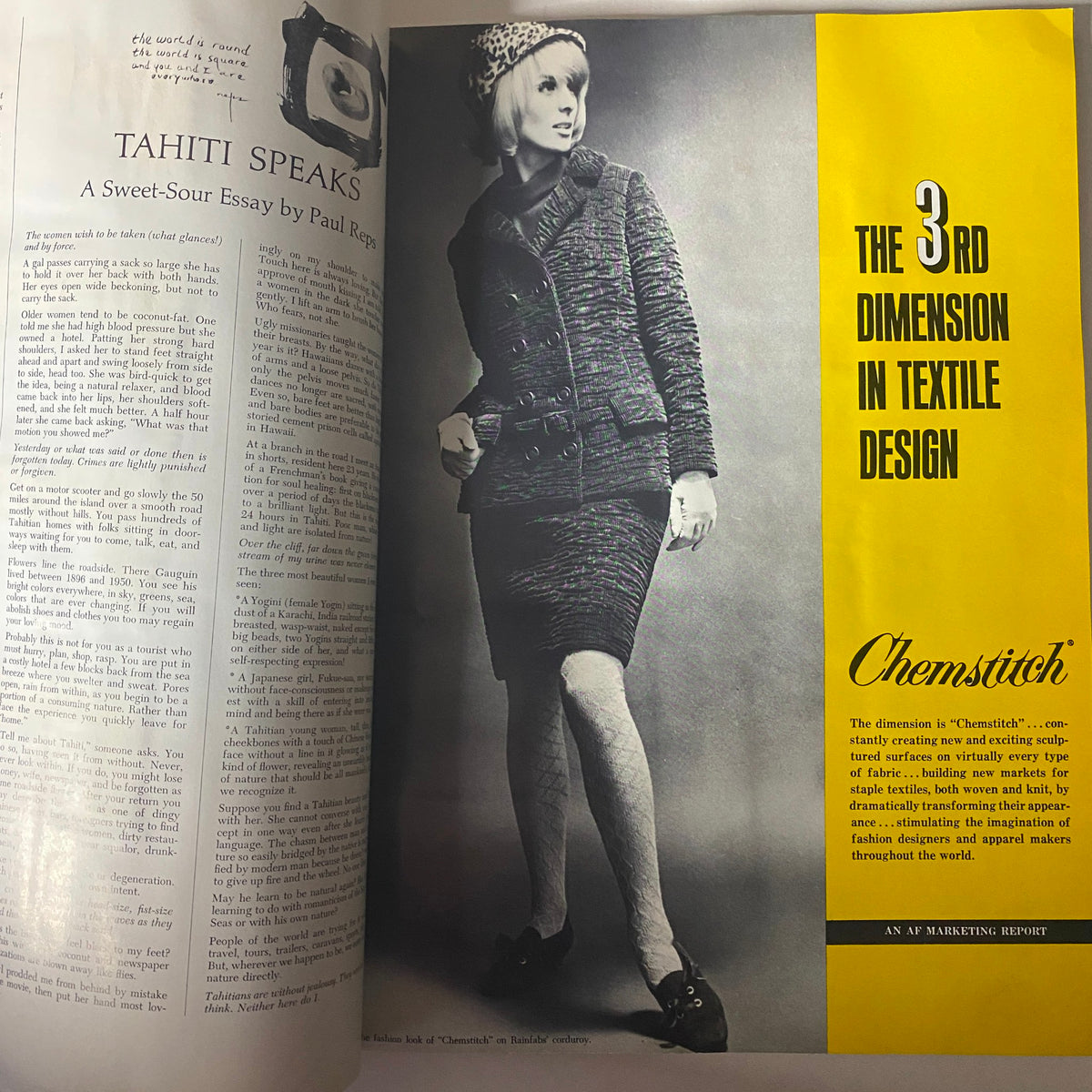


Description
Collector's Note – Why This Issue Matters
The 1967 American Fabrics No. 75 Spring Catalog is a primary document of the American textile industry at one of its most intellectually and commercially ambitious phases — and the confirmed presence of the AF Encyclopedia of Textiles reference and Dr. George E. Linton's source books in the same issue as swatch portfolios of British Regimental Colors, India Madras, Scottish District Checks, Batik and Indonesian designs, alongside reports on stretch fabrics, permanent press, silk charts, knitting structure charts, and calligraphy and Pop Art textile insights makes this one of the most comprehensively documented single issues confirmed in the American Fabrics mid-1960s publishing run. The spring of 1967 was a moment of genuine pluralism in the American textile design vocabulary — the mod aesthetic was at its commercial peak, the Pop Art movement's influence on printed fabric design had achieved mainstream trade press recognition, the Batik and Indonesian pattern revival was part of a broader ethnographic design interest that anticipated the decade's subsequent countercultural aesthetic, and the permanent press and stretch fabric technologies that had been reshaping the industry's commercial landscape for the preceding two years were achieving the market maturity that made comprehensive reporting rather than simply introductory coverage appropriate. An issue that simultaneously covers the AF Textile Encyclopedia as reference infrastructure, international swatch portfolios as design resources, and cutting-edge technology reports as commercial intelligence was serving its professional readership across the full range of what serious textile work required in the spring of 1967. For collectors and researchers building a documentary archive of American textile history, the American Fabrics catalog collection at OriginalMagazines.com provides essential depth across the publication's full run, with the spring 1967 edition representing one of its most reference-dense and most internationally engaged confirmed issues.
The specific combination of reference works documented in this issue — the Illustrated AF Encyclopedia of Textiles and Dr. George E. Linton's source books — places this catalog within the publication's broader institutional role as a knowledge infrastructure builder for the American textile industry. George E. Linton was one of the most prolific and most widely respected technical authors in American textile publishing, his reference works serving as standard professional resources across the industry's design, manufacturing, and retail sectors, and his presence in an American Fabrics issue documents the publication's deliberate positioning of itself as a venue for the most authoritative technical knowledge available to the professional textile community. The AF Encyclopedia of Textiles — one of the most comprehensive professional textile reference works produced in the American trade press tradition — represents the publication's institutional ambition to create lasting reference infrastructure rather than simply seasonal documentation. The international swatch portfolios deserve individual attention as primary design history documentation: British Regimental and Club Colors, India Madras, and Scottish District Checks are each specific and historically resonant textile traditions whose specific commercial availability and design character in the spring of 1967 is documented in this catalog in the form most directly useful to the professional designer and manufacturer — actual reference materials for sourcing and design development rather than abstract descriptions. The full range of 1967 magazines and publications from this year documents American fashion, industry, and culture at one of its most aesthetically extraordinary and most technically innovative moments, and this textile catalog sits within that body of material as a primary source of exceptional reference depth and documentary breadth.
The confirmed Batik and Indonesian design content is worth particular attention from researchers approaching this catalog from a cultural history or design history perspective. The spring of 1967 was among the early years when Indonesian and Southeast Asian textile traditions were beginning their most commercially visible crossover into American mainstream textile design, driven by the combination of the folk revival's interest in non-Western craft traditions, the Peace Corps generation's exposure to international textile cultures, and the specific fashion industry's appetite for the bold pattern energy that Batik's wax-resist printing technique produced. An American Fabrics catalog documenting these traditions alongside Pop Art textile insights — another confirmed content category in this issue — captures the specific pluralism of 1967 textile design culture from within the trade press, preserving primary evidence of how the professional textile industry was simultaneously processing its most avant-garde high-cultural references and its most ethnographically oriented international sources in the same seasonal publication.
About the Publication
American Fabrics was a trade publication serving the American textile and fashion manufacturing industry, providing manufacturers, designers, buyers, and retailers with documentation of new fabric developments, technical innovations, seasonal trend information, and the market intelligence that professional fashion industry participants needed to make informed production and purchasing decisions. By Number 75 in the spring of 1967, the publication had established the multi-dimensional editorial identity visible throughout this issue's confirmed contents — combining seasonal trend and swatch documentation with reference work infrastructure, international portfolio materials, technical reports on major finishing innovations, and the kind of cultural and design theory content, visible in the calligraphy and Pop Art coverage, that distinguished it from more narrowly commercial trade publications. Its audience encompassed the full professional range of the American textile industry, from fiber producers and fabric converters to garment manufacturers, fashion designers, and retail buyers, for whom the combination of reference depth, international design coverage, and technical reporting made this publication uniquely valuable as a professional resource.
Key Highlights Inside
- AF Encyclopedia of Textiles and Dr. George E. Linton source books — reference infrastructure documented — The confirmed presence of the Illustrated AF Encyclopedia of Textiles and Linton's professional source books in this issue preserves primary documentation of the publication's institutional role in building and maintaining the reference knowledge infrastructure of the American textile industry, featuring two of the most authoritative professional reference resources available to the mid-1960s textile professional community.
- British Regimental and Club Colors, India Madras, and Scottish District Checks portfolios — international textile tradition documentation — The confirmed Special Portfolio content preserves primary swatch and design documentation of three specific and historically resonant international textile traditions — British military heraldic color systems, the hand-woven cotton plaid of South India, and the regional tartan tradition of Scotland — in the specific commercial reference form most directly useful to professional designers and sourcing specialists in the spring of 1967.
- Batik and Indonesian designs — early Western commercial documentation of Southeast Asian textile traditions — The confirmed Batik and Indonesian design content is primary trade press documentation of the early phase of Southeast Asian textile tradition's crossover into American mainstream textile design, capturing the commercial availability and design character of these traditions in the specific professional reference form that distinguishes trade press from fashion press coverage.
- Pop Art and calligraphy textile insights — high-cultural design influence in trade press form — The confirmed Pop Art and calligraphy content preserves primary evidence of how the American textile trade press was processing the decade's most avant-garde high-cultural design movements in the professional commercial language of seasonal textile documentation — primary evidence of the specific phase in which these influences had achieved sufficient commercial traction to warrant serious trade press treatment.
- Stretch fabrics and permanent press reports — mid-maturity technology coverage — The confirmed technology reports document permanent press and stretch fabrics at the phase of their commercial development when initial introduction coverage had given way to market maturity analysis, preserving primary trade press assessment of where these two most commercially significant textile innovations of the mid-1960s stood in their development trajectories in the spring of 1967.
- Silk and knitting charts — technical visual reference materials confirmed — The confirmed silk lifecycle and knitting structure chart content preserves primary examples of the visual technical reference materials that distinguished this publication from more purely editorial trade publications, documenting the specific information design approach through which technical textile knowledge was being communicated to professional readership in the spring of 1967.
Condition & Rarity
This catalog is described as being in good condition, protected by a plastic covering, with the listing confirming that the photographed item is exactly what will be received and directing detailed condition assessment to the accompanying photographs — the appropriate approach for a trade publication approaching sixty years old where visual inspection provides the precision that verbal description cannot replicate. For a catalog produced for professional reference use rather than archival preservation, good condition represents a well-maintained survivor of a publication category with naturally limited survival rates. The plastic protective covering indicates intentional long-term preservation care, correlating with better overall physical stability than unprotected examples stored under comparable conditions. The international swatch portfolio pages — the British Regimental Colors, India Madras, and Scottish District Checks sections — are the primary tactile and visual research assets whose condition most directly determines this catalog's utility for the design research communities most likely to seek it out, and the accompanying photographs should be examined with attention to these specific sections alongside the overall structural condition.
Looking for More Issues Like This?
American Fabrics spring catalogs from 1967 — and particularly this No. 75 edition with its confirmed AF Encyclopedia reference, international swatch portfolios, Batik and Indonesian design documentation, Pop Art insights, and permanent press and stretch fabric reports — are sought by textile historians, design history researchers, reference work collectors, and serious professionals who recognize this issue as one of the most reference-dense and most internationally engaged in the publication's full run. If this spring 1967 catalog is no longer available, the American Fabrics catalog collection at OriginalMagazines.com is the most focused resource for exploring what else has surfaced from this important trade publication. For collectors building a broader documentary record of American textile innovation, design culture, and industry history during one of the most aesthetically and technically extraordinary years of the 1960s, the 1967 magazines collection brings together a wide range of primary source material from that pivotal year.