




Description
Collector's Note – Why This Issue Matters
The July 1974 Simplicity Summer Catalog is a precisely dated primary document of American home sewing culture at the height of the mid-1970s summer season — and July 1974 carries specific historical weight. The Watergate crisis was reaching its climax: the House Judiciary Committee voted articles of impeachment against President Nixon on July 27, 1974, and Nixon would resign on August 9. Against that extraordinary political backdrop, the July Simplicity catalog arrived in fabric store counters presenting something entirely apart from the headlines: the breezy, confident summer fashion of mid-decade American women, organized into accessible construction projects for home sewers across the full skill spectrum. That coexistence — the political tumult of the summer of 1974 and the quiet, creative domesticity of a Simplicity summer catalog — is itself a historical observation worth making. For collectors building a primary-source record of mid-1970s American life, retail and craft publications like this one document the everyday culture that persisted through national crisis. The July timing makes this a peak seasonal document: arriving at the heart of summer when home sewers were most actively building warm-weather wardrobes, selecting lightweight fabrics, and looking for quick-construction projects for the remaining warm weeks of the year. Collectors and fashion historians researching the mid-1970s American pattern market will find the Simplicity catalog archive an essential primary resource for understanding how mainstream fashion reached ordinary American households throughout the decade.
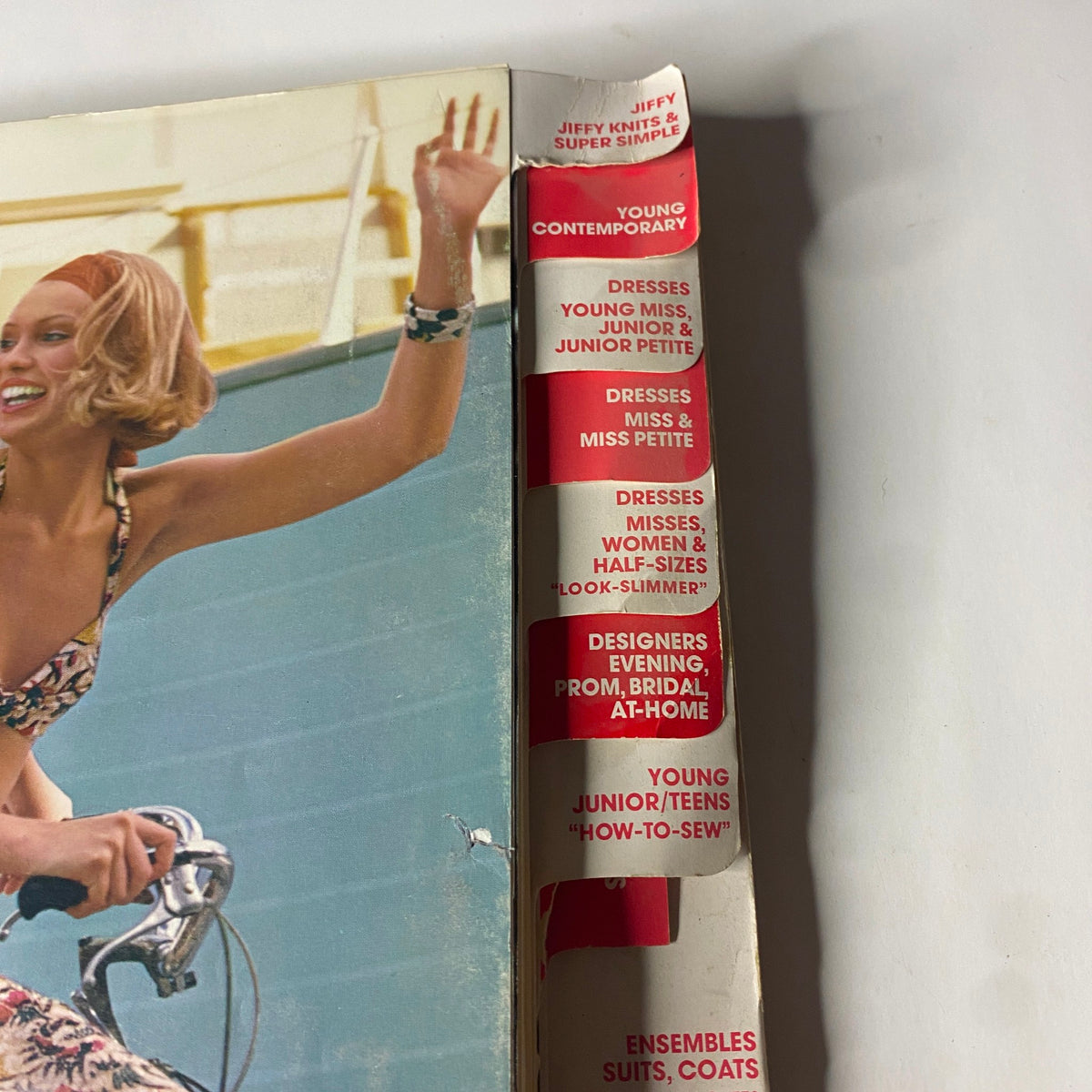
The contents of this catalog illuminate the mid-1974 fashion moment with the specificity that only a dated retail document can provide. The fully established presence of Look-Slimmer patterns within the Misses, Women, and Half-Sizes dress categories reflects Simplicity's continuing commercial emphasis on fit-engineered inclusive sizing — a mid-decade marketing strategy that spoke to a broad consumer base. The Designers section covering Evening, Prom, Bridal, and At-Home occasions documents the ambitious scope of what mid-1970s home sewers were undertaking: formal occasion dressing as a significant portion of the summer pattern line, indicating a consumer base confident in its ability to execute complex construction. Coordinated Ensembles including Suits and Coats in a summer catalog reflect the mid-1970s approach to warm-weather dressing that included transitional layering pieces alongside the expected lightweight summer categories — a practical wardrobe philosophy suited to the decade's mix-and-match ethos. The How-to-Sew content within the Young Junior and Teens section documents Simplicity's consistent strategy of cultivating new home sewers through youth-focused entry-level patterns. The full range of 1974 publications provides essential context for the remarkable and turbulent year this catalog documented.
The condition notes — clean interior pages with light surface wear — are a meaningful distinction for a counter book of this age. A July 1974 Simplicity catalog with clean interiors represents a well-preserved primary source, with the interior page quality being the most significant factor for researchers whose primary interest is the fashion illustration and pattern category documentation. The specific July dating adds research precision that broadly seasonal or undated editions cannot provide.
About the Publication
Simplicity Pattern Co., founded in 1927, was one of the dominant American sewing pattern manufacturers of the twentieth century, built on a philosophy of accessible, affordable patterns for home sewers of all skill levels. Its seasonal counter catalogs — large-format store reference books distributed to fabric retailers rather than sold directly to consumers — presented the full pattern line for each period, organized by garment category, size range, and design tier. By the mid-1970s Simplicity catalogs were sophisticated full-color publications featuring professional fashion photography and illustration, serving today as authoritative primary sources for researchers of 1970s fashion history and American home sewing culture.
Key Highlights Inside
- JIFFY, Jiffy Knits, and Super Simple patterns — Simplicity's flagship quick-construction lines, reflecting the mid-1970s knit fabric culture and the democratization of fast, fashionable summer sewing for home sewers at every skill level.
- Look-Slimmer patterns for Misses, Women, and Half-Sizes — Fit-engineered dress patterns representing one of Simplicity's most consistently marketed mid-decade categories, documenting the company's commercial approach to inclusive sizing with explicit fashion appeal.
- Designers section covering Evening, Prom, Bridal, and At-Home wear — Occasion-dressing patterns reflecting the ambitious scope of mid-1970s home sewing culture and the confidence of a consumer base undertaking formal garment construction across the full range of life's significant occasions.
- Young Contemporary and Young Junior/Teens with How-to-Sew content — Youth-oriented pattern lines paired with beginner instruction, reflecting Simplicity's consistent strategy of cultivating new home sewers through accessible entry-level content within seasonal catalogs.
- Ensembles including Coordinated Suits and Coats — Polished warm-weather coordination patterns reflecting the mid-1970s wardrobe philosophy of mix-and-match dressing that extended beyond casual separates into structured ensemble construction.
- Note: Specific additional section details and confirmed interior page content beyond what is documented in the listing have not been independently verified. The above reflects what is verifiable from the listing description and well-documented knowledge of Simplicity's catalog format and mid-1970s fashion.
Condition & Rarity
Simplicity counter catalogs from the mid-1970s present the standard preservation challenges of large-format retail store reference books — binding stress from seasonal use, corner wear from counter display, and cover handling over a full pattern season. A surviving example from July 1974 rated in good condition with clean interior pages and light surface wear, protected by a plastic sleeve, represents a well-preserved artifact by realistic standards for a counter catalog now more than fifty years old. The specific notation of clean interior pages is the most meaningful condition detail: the fashion illustration and photography pages are the primary research and display value of a Simplicity catalog of this era, and interior cleanliness significantly enhances both usability and collector desirability. When evaluating examples of this catalog, interior page brightness and completeness should be prioritized alongside binding integrity and cover condition — the combination of clean interiors and structural soundness representing the strongest survivable grade for a mid-decade Simplicity summer counter book.
Looking for More Issues Like This?
Specifically dated July Simplicity summer catalogs from the mid-1970s are among the more precisely useful entries in the Simplicity collecting category for fashion researchers, and the 1974 edition's clean interior condition and specific July dating make it a particularly strong working copy of a catalog that documents mid-decade American fashion at one of its most historically charged moments. The Simplicity catalog collection at OriginalMagazines.com is the most comprehensive resource for locating other dated and seasonal editions across the full span of Simplicity's publishing history. Collectors building around the turbulent and historically significant year of 1974 will also want to explore the 1974 magazine collection, which brings together a wide range of period publications that document the style, politics, and everyday life of one of the decade's most consequential years.