


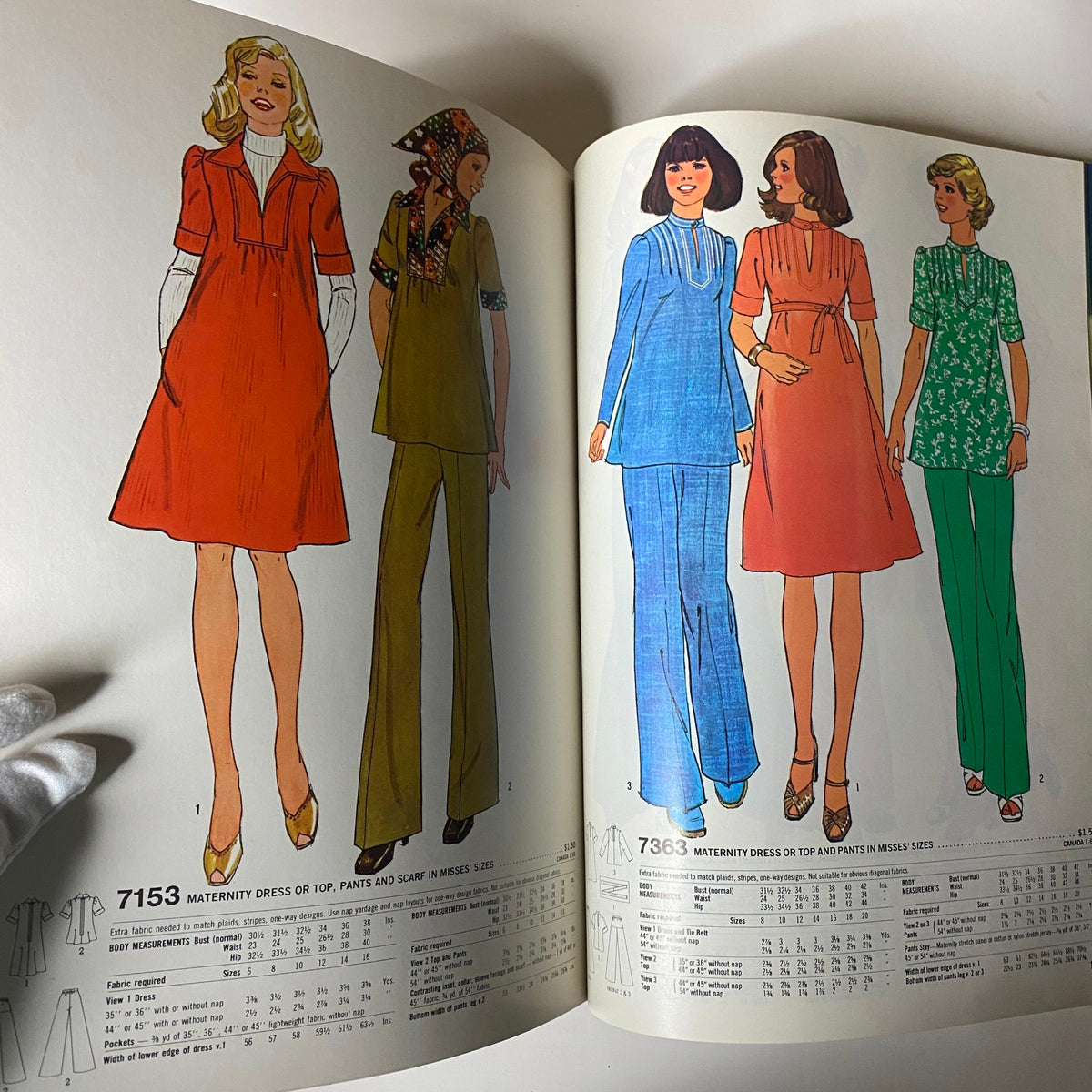


Description
Collector's Note – Why This Issue Matters
The March 1976 Simplicity Catalog is a precisely dated primary document of American home sewing culture at the bicentennial year's opening season — and the spring of 1976 carries its own specific cultural resonance. The United States was in the midst of its two-hundredth anniversary celebrations, a year of national retrospection that paradoxically coexisted with the forward-looking energy of the mid-1970s fashion moment. A March catalog was a pivotal seasonal document in the Simplicity publishing calendar, arriving as home sewers were planning their spring wardrobes and selecting fabrics for the transitional months between winter and full summer dressing. The breadth of this catalog — from beginner-friendly JIFFY knits through designer fashions, evening and bridal wear, and the dedicated LOOK-SLIMMER line — reflects the extraordinary commercial range that Simplicity maintained at mid-decade, serving the full spectrum of American home sewers from complete beginners to ambitious dressmakers tackling formal occasion wear. Collectors and fashion historians researching the mid-1970s American home sewing market will find the Simplicity catalog archive an indispensable primary resource for understanding how mainstream fashion reached ordinary American households throughout the decade, and the March 1976 edition is a particularly well-documented seasonal entry.
Several sections of this catalog carry particular historical weight as documents of mid-1970s fashion. The LOOK-SLIMMER category — explicitly named and positioned as a dedicated section — reflects Simplicity's mid-decade commercial strategy of addressing fit concerns directly and prominently in its marketing language, a approach that spoke to a broad range of home sewers who valued both fashion and flattering construction. The Young Contemporary Designer Fashions section documents the continuing importance of designer-adjacent credibility in the mid-1970s pattern market, where associating home sewing with recognized design sensibilities was central to Simplicity's competitive positioning. The inclusion of Evening, Bridal, and At-Home wear alongside Robes and Lingerie reflects the ambitious scope of mid-1970s home sewing culture — a consumer base confident enough in its skills to tackle the full range of wardrobe occasions from everyday separates to formal gowns. The How-to-Sew and SUPER SIMPLE content speaks to Simplicity's consistent strategy of using seasonal catalogs to recruit and retain beginner sewers, ensuring a continuous pipeline of new participants into the home sewing market. The full range of 1976 publications provides essential context for the cultural and fashion moment this catalog documented — the bicentennial year that was simultaneously a moment of national nostalgia and mid-decade forward momentum.
The March designation is a research-grade detail that distinguishes this from undated or broadly seasonal Simplicity catalogs. A specifically dated March 1976 edition can be cross-referenced against Simplicity's sequential pattern numbering records to establish exactly where the company's line stood at the start of the 1976 spring season, providing chronological precision that fashion historians and serious pattern collectors will find genuinely useful.
About the Publication
Simplicity Pattern Co., founded in 1927, was one of the dominant American sewing pattern manufacturers of the twentieth century, built on a philosophy of accessible, affordable patterns for home sewers of all skill levels. Its seasonal counter catalogs — large-format store reference books distributed to fabric retailers rather than sold directly to consumers — presented the full pattern line for each period, organized by garment category, size range, and design tier. By the mid-1970s Simplicity catalogs were sophisticated full-color publications featuring professional fashion photography and illustration, and they serve today as authoritative primary sources for researchers of American home sewing culture, 1970s fashion history, and the visual and commercial aesthetic of mid-decade American retail publishing.
Key Highlights Inside
- JIFFY and JIFFY KNITS patterns — Simplicity's flagship quick-construction lines, reflecting the mid-1970s knit fabric culture and the democratization of fast, fashionable sewing for home sewers at every skill level.
- Young Contemporary Designer Fashions — Trend-forward patterns reflecting Simplicity's mid-decade strategy of associating accessible home sewing with designer-adjacent credibility, positioned for the young women at the core of the 1970s home sewing market.
- LOOK-SLIMMER styles — A dedicated fit-engineering category that documents Simplicity's mid-1970s commercial approach to inclusive, flattering construction, positioned here as a named section reflecting its established importance in the company's pattern line.
- Evening, Bridal, and At-Home Wear including Robes and Lingerie — A full-occasion range documenting the ambitious scope of mid-1970s American home sewing culture, with formal and intimate garment categories that reflect a consumer base confident in tackling the full wardrobe spectrum.
- How-to-Sew and SUPER SIMPLE patterns — Entry-level content reflecting Simplicity's consistent strategy of recruiting new home sewers through seasonal catalogs, ensuring accessibility across the full skill spectrum.
- Half-Sizes for Misses and Women — A dedicated inclusive sizing category documenting Simplicity's continuing commitment to serving the full range of the American home sewing market with fashion-forward options across size categories.
Condition & Rarity
Simplicity counter catalogs from the mid-1970s present the standard preservation challenges of large-format retail store reference books — binding stress from seasonal use, corner wear from counter display, and cover handling accumulated over a full pattern season. A surviving example from March 1976 rated in good condition, with a protective plastic sleeve applied, represents a well-preserved artifact by realistic standards for a counter catalog now approaching fifty years of age. When evaluating any surviving copy of this catalog, collectors should prioritize binding integrity and spine cohesion, the brightness and completeness of the full-color fashion photography and illustration pages, and the legibility of the category and sizing sections that serve as the primary research reference points. The March 1976 dating adds research precision that undated catalogs cannot provide, making interior page legibility particularly important for collectors and fashion historians using this as a primary source document for mid-decade Simplicity pattern research.
Looking for More Issues Like This?
Specifically dated March Simplicity catalogs from the mid-1970s are among the more precisely useful entries in the Simplicity collecting category for fashion researchers, and the 1976 bicentennial year edition draws particular interest from collectors of mid-decade American fashion and domestic culture. The Simplicity catalog collection at OriginalMagazines.com is the most comprehensive resource for locating other dated and seasonal editions across the full span of Simplicity's publishing history. Collectors building around the mid-1970s fashion and cultural moment will also want to explore the 1976 magazine collection, which brings together a wide range of period publications that document the style, nostalgia, and forward energy of America's bicentennial year.