


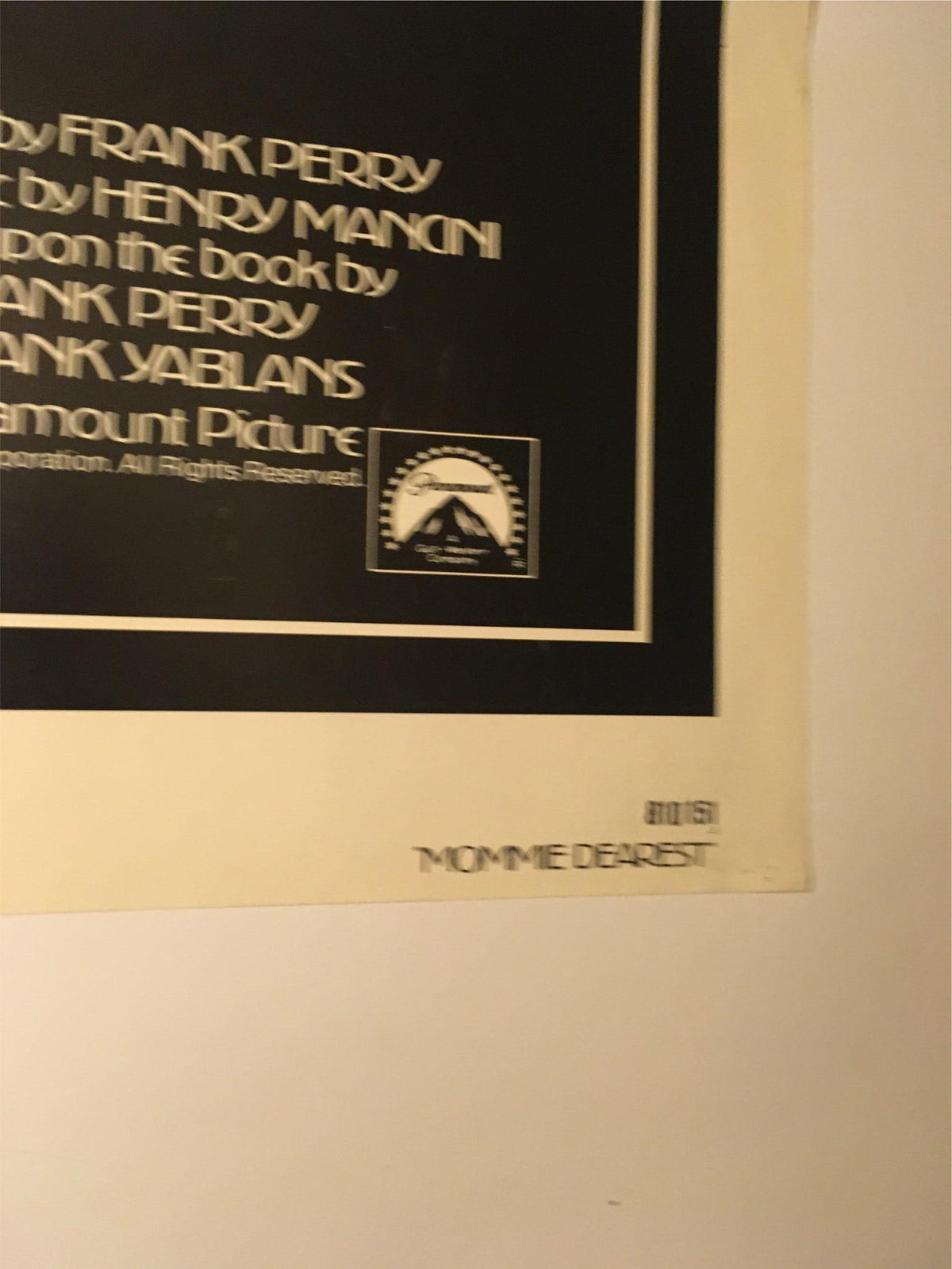


Description
Collector's Note – Why This Issue Matters
The 1981 original theatrical release poster for Mommie Dearest is a primary artifact of one of the most culturally complex and enduringly discussed films in Hollywood history — a film that arrived as a serious biographical drama, generated one of the most celebrated camp phenomena in American cinema, and in the process produced a document of both Joan Crawford's legacy and Faye Dunaway's performance that has proven impossible to resolve into a single clean interpretation across more than four decades of cultural commentary. Mommie Dearest was adapted from Christina Crawford's 1978 memoir, which had been a major bestseller and a cultural event in its own right — the first major Hollywood tell-all by a celebrity's child, presenting a portrait of Joan Crawford as an abusive and psychologically volatile mother that permanently complicated the public memory of one of the studio system's most carefully constructed stars. The film arrived in September 1981 with enormous public anticipation and immediate critical controversy, and its theatrical release poster — produced before the film's mixed-to-negative critical reception had reshaped the marketing — represents the studio's original vision for how to present the material to a mainstream audience. Collectors building a focused archive of 1981 in American film culture will find that 1981 magazine and memorabilia issues document a Hollywood year of considerable range and cultural complexity, with Mommie Dearest among its most discussed and debated releases.
Faye Dunaway's performance as Joan Crawford is one of the most studied and debated in the history of Hollywood biographical films. Her commitment to the role was total and physically transforming — she inhabited Crawford's particular physicality, vocal mannerisms, and psychological intensity with a completeness that divided critics between those who read it as extraordinary acting and those who found it excessive to the point of parody. That ambiguity turned out to be the film's most durable cultural gift: the camp readings that emerged from the film's initial theatrical run — centered most iconically on the wire hangers scene — gave the movie a second life as a cult phenomenon that its original dramatic aspirations had never anticipated. An original theatrical poster from 1981 documents the film as it was intended to be received, before those camp readings had crystallized into the dominant cultural frame through which it is now most commonly understood. The poster presents Dunaway as Crawford in the mode of serious Hollywood biography — glamorous, intense, dramatically significant — and that original framing is precisely what makes it a historically interesting artifact distinct from the memorabilia produced after the cult reading had taken hold. The film's complicated relationship with both its subject and its audience is part of what makes primary documents from its original 1981 theatrical release worth preserving as collector artifacts.
Original theatrical movie posters from 1981 occupy a specific position in the film poster collector market more broadly. This was the final years of the one-sheet poster format as the dominant vehicle for theatrical film marketing before the shift toward more varied and internationally standardized marketing materials that would characterize the mid-to-late 1980s, and original one-sheet posters from this period — particularly those for films with enduring cultural significance — are among the most actively collected in the vintage movie poster market. The Mommie Dearest poster's 41" x 27" dimensions are consistent with the standard one-sheet format of the era, and its original folded condition documents its original distribution method — theatrical posters of this period were typically shipped folded to theater locations and unfolded for display, which means the fold lines visible on surviving examples are the authentic marks of the poster's original circulation history rather than subsequent damage.
About the Publication
Original theatrical movie posters are the official promotional materials produced by film studios and their marketing divisions for distribution to theater locations in connection with a film's theatrical release. They occupy a distinct category within the broader world of film memorabilia — unlike lobby cards, press kits, or studio photographs, theatrical posters were produced specifically for public display rather than for press or industry use, and their design was intended to communicate the film's essential appeal to a general audience with maximum visual impact. Original one-sheet posters from the early 1980s are distinguished in the collector market from the reprint and reproduction posters that began flooding the market in the late 1980s and 1990s — originals were printed on specific paper stock, distributed through theatrical channels, and typically show the folding, edge wear, and aging consistent with their original distribution and display history. The Mommie Dearest one-sheet from 1981 is an original studio-produced theatrical promotional artifact from the film's initial release, representing the official visual presentation of a significant and culturally complex Hollywood production at the moment of its public debut.
Key Highlights Inside
- Original 1981 theatrical one-sheet poster for Mommie Dearest in standard 41" x 27" format — produced for distribution to theater locations in connection with the film's September 1981 release, representing the studio's original visual framing of Faye Dunaway's performance as Joan Crawford before the film's cult reception had reshaped how the material was publicly understood.
- Faye Dunaway as Joan Crawford depicted in the serious biographical drama register of the original theatrical marketing — a document of the film's intended reception distinct from the camp cultural frame that subsequently became dominant, making this poster a historically specific artifact of the film's 1981 debut rather than its later cult status.
- Original folded condition consistent with authentic theatrical distribution history — fold lines on surviving copies of this poster are the marks of original studio distribution methodology rather than subsequent damage, documenting the poster's journey from printing facility through theatrical display channels in the manner standard for one-sheet posters of this era.
- Minor edge wear and corner rips consistent with original theatrical use and four decades of subsequent storage — physical characteristics that are standard for an authentic original theatrical poster from 1981 and that distinguish surviving originals from the reprints and reproductions that entered the market in subsequent years.
- Note: Specific design elements, photography credits, and tagline text beyond what is indicated by the listing description are unconfirmed for this poster. The above reflects what is verifiable from the film title, year, featured performer, format dimensions, and the thoroughly documented production and release history of Mommie Dearest.
Condition & Rarity
Good condition with minor edge wear, corner rips consistent with age, and original fold lines is an honest and realistic assessment for a 1981 theatrical one-sheet poster, and the condition evaluation framework for original movie posters from this era differs meaningfully from the standards applied to magazines and publications. Original theatrical posters were produced on relatively thin paper stock designed for display rather than archival preservation, folded for distribution and then unfolded and pinned or taped for theater lobby display — a lifecycle that introduced the fold lines and edge wear visible on virtually all authentic surviving examples. The fold lines on surviving copies of this poster are therefore authentication indicators as much as condition issues: they document the poster's original distribution methodology and distinguish it from the flat-stored reprints that entered the market later. Corner rips and minor edge wear are similarly standard for authentic originals that have been through original theatrical use and forty-plus years of subsequent storage. Good condition with these specific attributes accurately describes a poster that retains its full visual impact and structural integrity despite the surface evidence of its authentic history, and for collector evaluation purposes the combination of original theatrical distribution evidence and honest disclosure of wear represents a straightforwardly assessed authentic artifact.
Looking for More Issues Like This?
Original theatrical one-sheet posters from 1981 Hollywood releases — particularly those for films with the cultural endurance and complexity of Mommie Dearest — are among the more actively sought items in the vintage movie poster collector market, and authentic originals with documented fold lines and honest condition assessment are worth evaluating carefully when they surface. Collectors building a comprehensive picture of 1981 in American film, culture, and popular media will find the complete 1981 magazine and memorabilia collection a valuable resource for locating other significant documents from this particular year's rich Hollywood and cultural landscape, spanning the full range of publications and memorabilia that documented the era's most significant films and cultural events.