


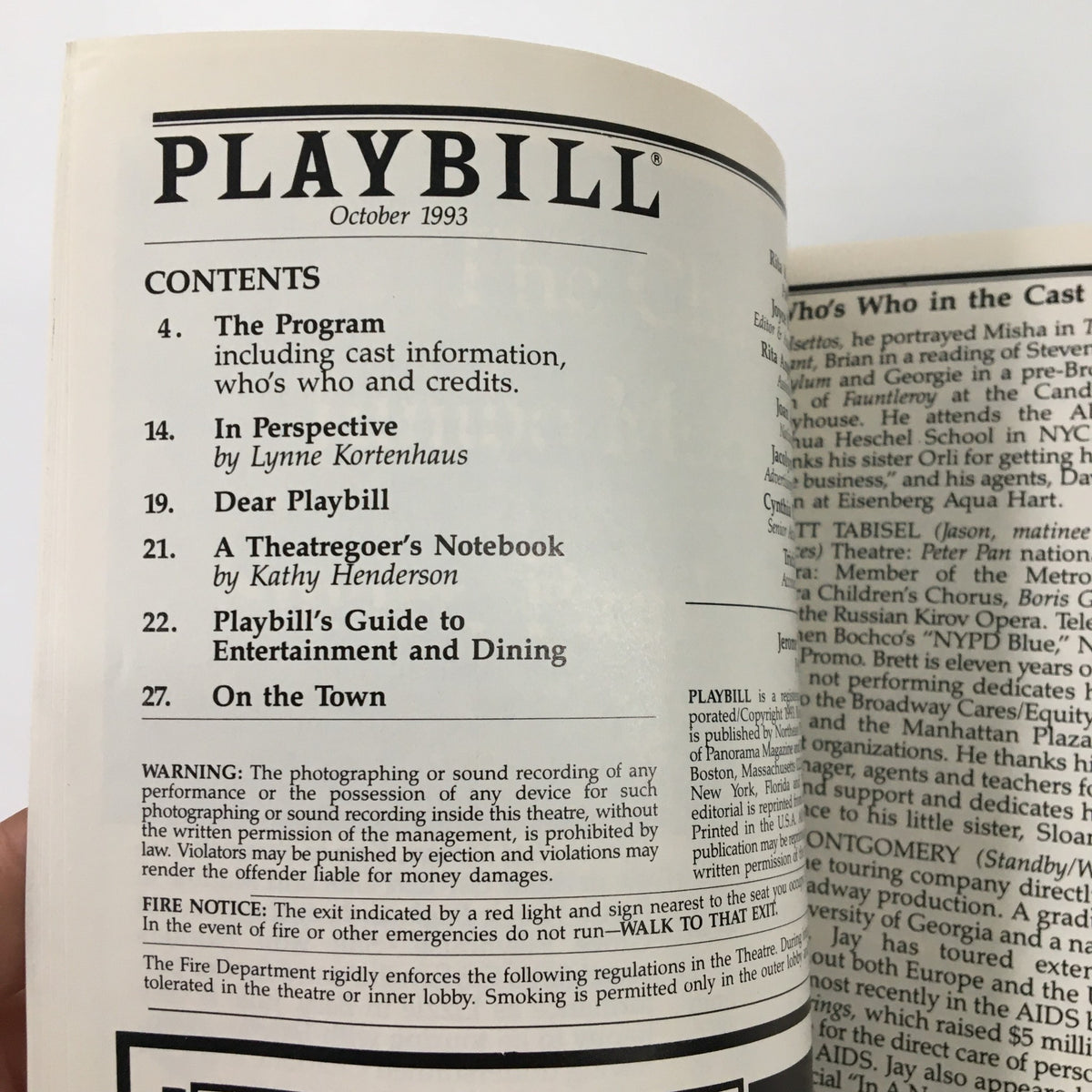


Description
Collector's Note – Why This Issue Matters
The 1993 Playbill from the Colonial Theatre for Falsettos featuring Gregg Edelman is a primary document of one of the most significant and most culturally consequential productions in the history of the American musical theater. Falsettos — William Finn and James Lapine's consolidation of the earlier one-act musicals March of the Falsettos (1981) and Falsettoland (1990) into a single evening — had opened on Broadway at the John Golden Theatre in April 1992 before moving to touring and regional productions, and its treatment of a gay man's relationships, family dynamics, and the AIDS crisis represented a degree of directness about LGBTQ experience that mainstream Broadway had not previously sustained in a production of this ambition and critical standing. The show won two Tony Awards in 1992, including Best Book of a Musical for Finn and Lapine and Best Original Score for Finn, validating its artistic achievement with the industry's highest recognition and cementing its place in the canon of American musical theater at the precise moment when AIDS was at its most devastating and most culturally omnipresent. A 1993 Playbill from the Colonial Theatre — likely a touring or regional production following the Broadway run — documents the show's continuing life beyond its original New York engagement, capturing it in the process of reaching new audiences in new cities and extending its cultural impact beyond the Broadway ecosystem. For collectors building a serious archive of American musical theater at its most historically significant, the Playbill collection at OriginalMagazines.com provides essential depth across the full span of Broadway and touring production documentation, with the early-1990s LGBTQ-themed productions occupying a particularly historically charged tier within that body of material.
Gregg Edelman's association with Falsettos places this Playbill within a specific chapter of a distinguished Broadway career that had already included notable work in major productions. Edelman was one of the most respected singing actors of his generation in the American musical theater, known for the combination of vocal quality, dramatic intelligence, and physical authority that the complex, emotionally layered material of Falsettos specifically required. The show's central relationship — Marvin's navigation of his love for his male partner Whizzer while managing the consequences of leaving his wife and maintaining connection with his son Jason — demanded a leading performer who could hold the emotional weight of all these competing obligations simultaneously, and Edelman's presence in the role in the 1993 Colonial Theatre production reflects the casting judgment that he could deliver on that demand. The Colonial Theatre itself, located in Boston, was and remains one of the most prestigious regional venues in American theatrical life, and a production of Falsettos at the Colonial in 1993 would have brought the show to one of the most sophisticated and theater-literate audiences in the country outside of New York. The full range of 1993 magazines and publications from this year documents American popular culture during one of the most complex periods of the AIDS epidemic's intersection with mainstream cultural life, and this Playbill sits within that body of material as a specific and irreplaceable primary artifact from one of the era's most important theatrical responses to that intersection.
The broader cultural significance of Falsettos in the specific context of 1993 deserves direct engagement for any collector approaching this Playbill from a cultural history perspective. By 1993, the AIDS epidemic had been transforming American cultural life for over a decade, but its representation in mainstream theatrical production had remained fitful and often indirect. Falsettos was one of the works — alongside Angels in America, which had opened on Broadway just weeks after this 1993 Colonial Theatre production — that changed the terms on which LGBTQ experience and the AIDS crisis could be dramatized for mainstream American audiences, treating these subjects with emotional honesty, dramatic sophistication, and human specificity rather than as political argument or social message. A 1993 Playbill from Falsettos documents that cultural moment from within its theatrical production — the show being performed for a Boston audience in the same year that Angels in America was transforming Broadway, and in the same year that the cultural conversation about AIDS, LGBTQ identity, and representation was reaching a level of mainstream urgency and sophistication that American theater was both reflecting and helping to produce.
About the Publication
Playbill is the program publication distributed to audience members at Broadway, touring, and regional theatrical productions, produced continuously since 1884 and serving as the standard documentation of cast, creative team, production history, and institutional information for the American legitimate theater. The 1993 Colonial Theatre Falsettos Playbill was distributed to every audience member attending a performance of the production during its Boston engagement, combining the practical information that theatergoers needed — cast list, scene-by-scene breakdown, biographies of principal performers and creative team — with the advertising content and supplementary editorial material that supported the publication's production costs. Colonial Theatre Playbills from touring and regional productions carry the dual institutional identity of the national production and the local venue, making them primary sources for both the production's documented touring history and the specific theatrical life of the Boston venue during this period. The 1993 Falsettos production represented the continued dissemination of one of Broadway's most culturally significant recent productions to regional American audiences, and the Playbill produced for the Colonial Theatre engagement documents that dissemination at a specific and historically meaningful moment.
Key Highlights Inside
- Gregg Edelman cast documentation and biographical profile — The cast listing and biographical sketch for Edelman in the lead role of Marvin constitutes primary institutional documentation of his specific engagement with this production at the Colonial Theatre in 1993, preserving the specific cast and production configuration of this particular run of Falsettos as distinct from its Broadway original and other touring iterations.
- William Finn and James Lapine creative team documentation — The Playbill's creative credits document the full team behind the production, including the Tony Award-winning authors whose work on Falsettos represented one of the most significant achievements in early-1990s American musical theater. As primary documentation of the creative team's work in a specific production context, these credits have research value for musical theater historians studying the show's development and dissemination.
- Colonial Theatre production context — Boston theatrical culture in 1993 — The Playbill's Colonial Theatre branding places this production within the specific institutional context of one of America's most historically significant regional theatrical venues, documenting the show's engagement with the Boston theatrical market at a specific moment in both the production's touring life and the venue's own programming history.
- LGBTQ theatrical representation documented in primary institutional form — A Playbill from a 1993 production of Falsettos is a primary institutional artifact of the American theater's engagement with LGBTQ experience and the AIDS crisis at one of the most culturally consequential moments in that engagement's history, documenting the show's continued reach into regional American theatrical culture in the year of Angels in America's Broadway premiere.
- Note: Specific additional cast members beyond the confirmed Gregg Edelman listing, production photographs, advertising content, and the full contents of this Playbill have not been independently verified beyond the listing description. The highlights above reflect what is documentable from the listing, the well-established production history of Falsettos, and the confirmed historical context of the 1993 Colonial Theatre engagement.
Condition & Rarity
This Playbill is described as being in good condition with minor wear consistent with its age, protected by a plastic covering — a condition profile that represents a legitimate and well-maintained survivor of a publication that was distributed for active use at a live theatrical performance and has been preserved with intentional care over the subsequent three decades. The plastic protective covering is a meaningful positive indicator, suggesting that the Playbill has been physically shielded from the handling wear and environmental exposure that degrades unprotected paper over extended storage periods, correlating with better overall condition stability than copies that have simply been stored in boxes or on shelves without protection. Minor wear on a Playbill that has been in active storage for over thirty years is honest and expected, and the good condition designation suggests that this wear is generally distributed as handling evidence rather than concentrated in ways that affect the primary content areas — the cast listing, creative team credits, and production documentation that constitute the Playbill's primary research and collector value. Playbills from touring and regional productions of significant Broadway shows are produced in quantities calibrated to individual performance attendance and are not archived or preserved in the systematic way that official Broadway theater archives document original productions, making well-preserved examples of specific touring production programs more specifically uncommon in the collector market than their original Broadway counterparts.
Looking for More Issues Like This?
Playbills from early-1990s productions of Falsettos — and particularly touring and regional productions that document the show's life beyond its original Broadway engagement — are actively sought by musical theater historians, LGBTQ cultural history researchers, and serious Playbill collectors who recognize these programs as primary documents of one of the most culturally significant American musicals of its era at a historically specific and deeply resonant moment in its production history. If this 1993 Colonial Theatre edition is no longer available, the Playbill collection at OriginalMagazines.com is the most comprehensive resource for exploring what else has surfaced from Broadway and touring productions across multiple decades of American theatrical history. For collectors building a broader documentary record of American theater, LGBTQ cultural history, and popular culture during one of the most historically significant years of the early 1990s, the 1993 magazines collection brings together a wide range of primary source material from that extraordinary year.