



Description
The magazine is in very good condition, showing only light edge wear. The photos show the exact item you will receive. Please review all pictures for full condition details. Combined shipping is available. Each issue ships in a protective plastic sleeve.
Note: The content list below is digitally transcribed for searchability. Please refer to the photos for the exact Table of Contents.
PROGRAM TABLE OF CONTENTS
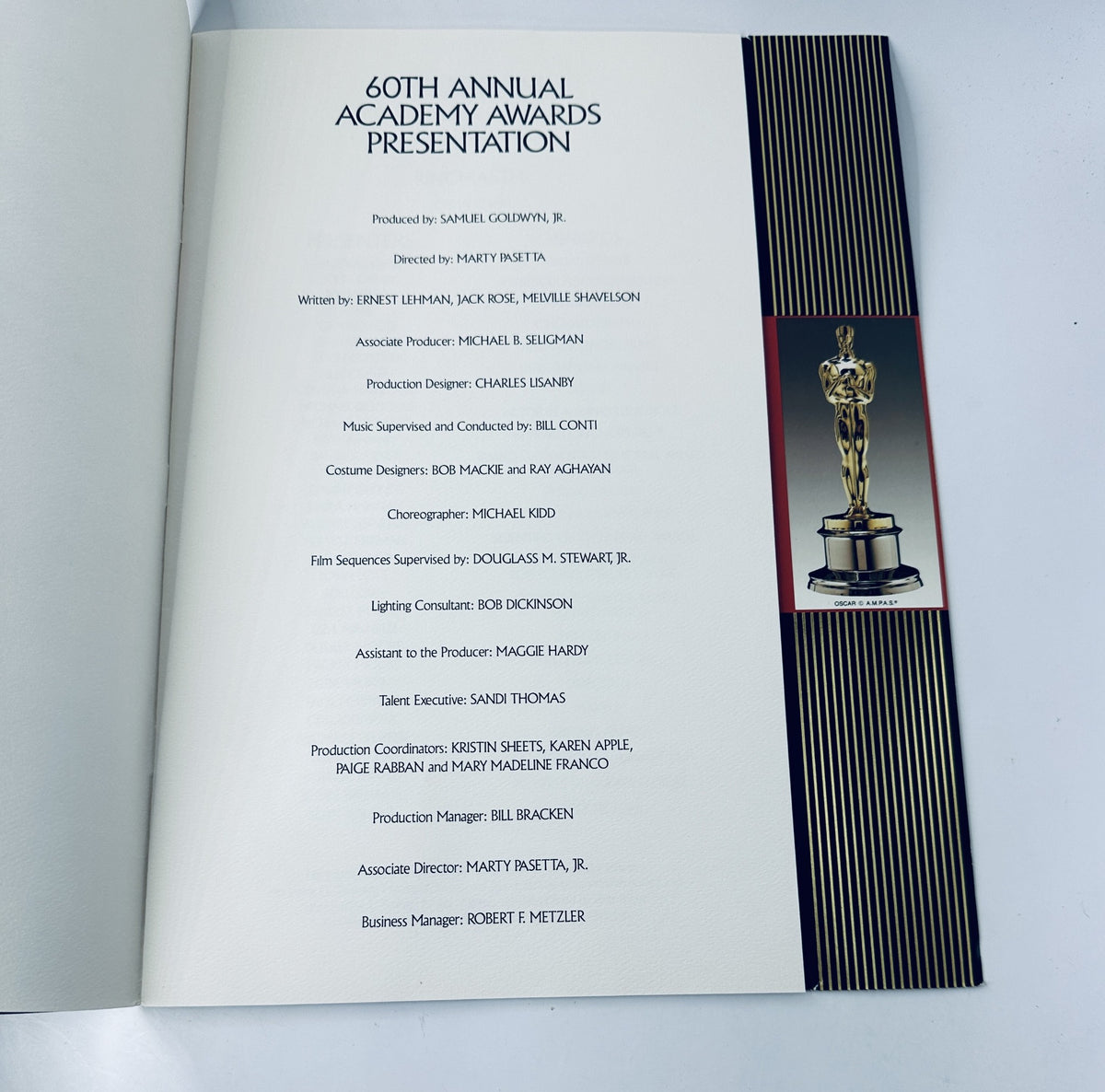
60TH ANNUAL ACADEMY AWARDS PRESENTATION
Produced by: SAMUEL GOLDWYN, JR.
Directed by: MARTY PASETTA
Written by: ERNEST LEHMAN, JACK ROSE, MELVILLE SHAVELSON
Associate Producer: MICHAEL B. SELIGMAN
Production Designer: CHARLES LISANBY
Music Supervised and Conducted by: BILL CONTI
Costume Designers: BOB MACKIE and RAY AGHAYAN
Choreographer: MICHAEL KIDD
Film Sequences Supervised by: DOUGLASS M. STEWART, JR.
Lighting Consultant: BOB DICKINSON
Assistant to the Producer: MAGGIE HARDY
Talent Executive: SANDI THOMAS
Production Coordinators: KRISTIN SHEETS, KAREN APPLE,
PAIGE RABBAN and MARY MADELINE FRANCO
Production Manager: BILL BRACKEN
Associate Director: MARTY PASETTA, JR.
Business Manager: ROBERT F. METZLER
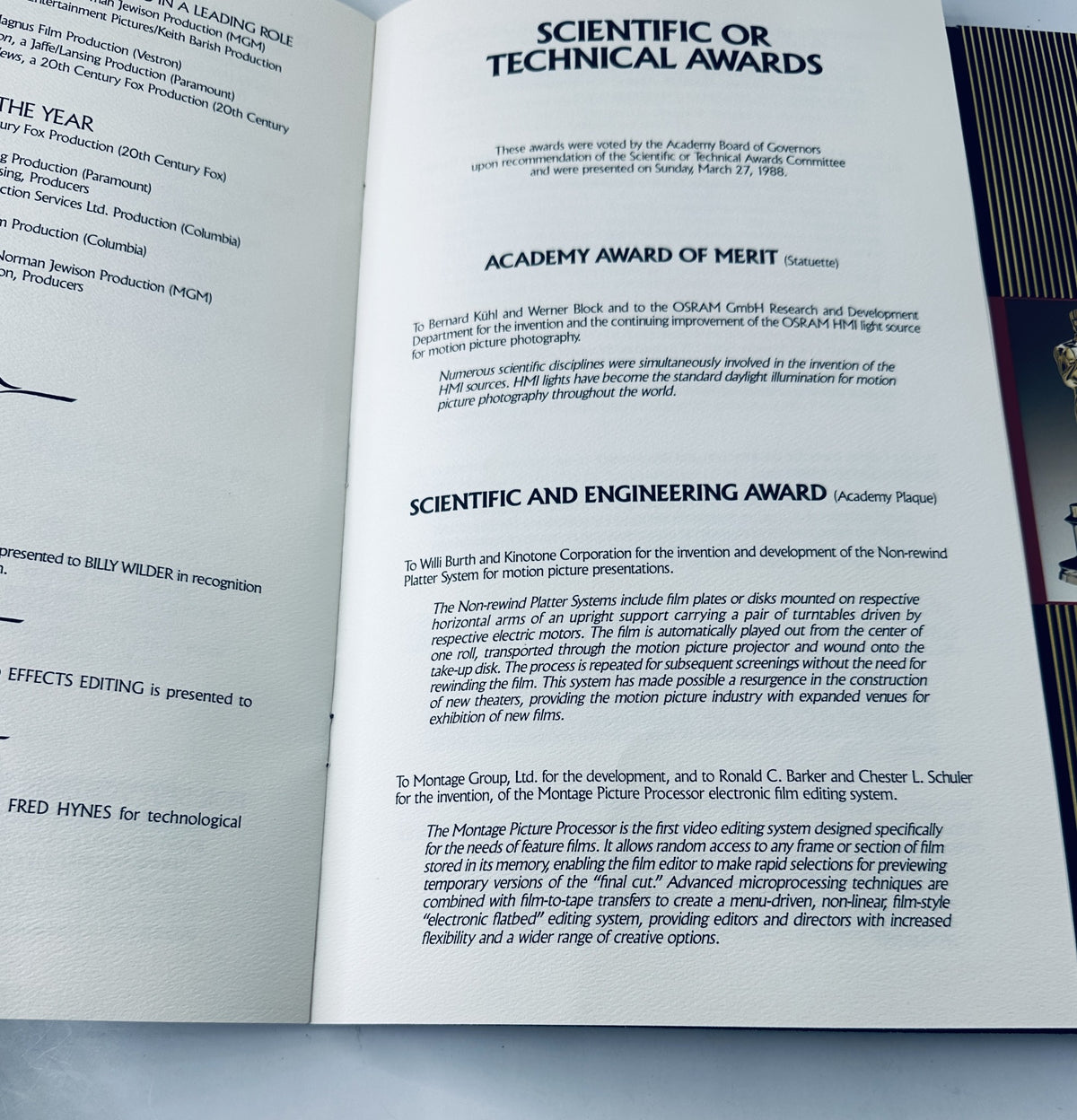
SCIENTIFIC OR TECHNICAL AWARDS
These awards were voted by the Academy Board of Governors upon recommendation of the Scientific or Technical Awards Committee and were presented on Sunday, March 27, 1988.
ACADEMY AWARD OF MERIT (Statuette)
To Bernard Kühl and Werner Block and to the OSRAM GmbH Research and Development Department for the invention and the continuing improvement of the OSRAM HMI light source for motion picture photography.
Numerous scientific disciplines were simultaneously involved in the invention of the HMI sources. HMI lights have become the standard daylight illumination for motion picture photography throughout the world.
SCIENTIFIC AND ENGINEERING AWARD (Academy Plaque)
To Willi Burth and Kinotone Corporation for the invention and development of the Non-rewind Platter System for motion picture presentations.
The Non-rewind Platter Systems include film plates or disks mounted on respective horizontal arms of an upright support carrying a pair of turntables driven by respective electric motors. The film is automatically played out from the center of one roll, transported through the motion picture projector and wound onto the take-up disk. The process is repeated for subsequent screenings without the need for rewinding the film. This system has made possible a resurgence in the construction of new theaters, providing the motion picture industry with expanded venues for exhibition of new films.
To Montage Group, Ltd. for the development, and to Ronald C. Barker and Chester L. Schuler for the invention, of the Montage Picture Processor electronic film editing system.
The Montage Picture Processor is the first video editing system designed specifically for the needs of feature films. It allows random access to any frame or section of film stored in its memory, enabling the film editor to make rapid selections for previewing temporary versions of the “final cut.” Advanced microprocessing techniques are combined with film-to-tape transfers to create a menu-driven, non-linear, film-style “electronic flatbed” editing system, providing editors and directors with increased flexibility and a wider range of creative options.