

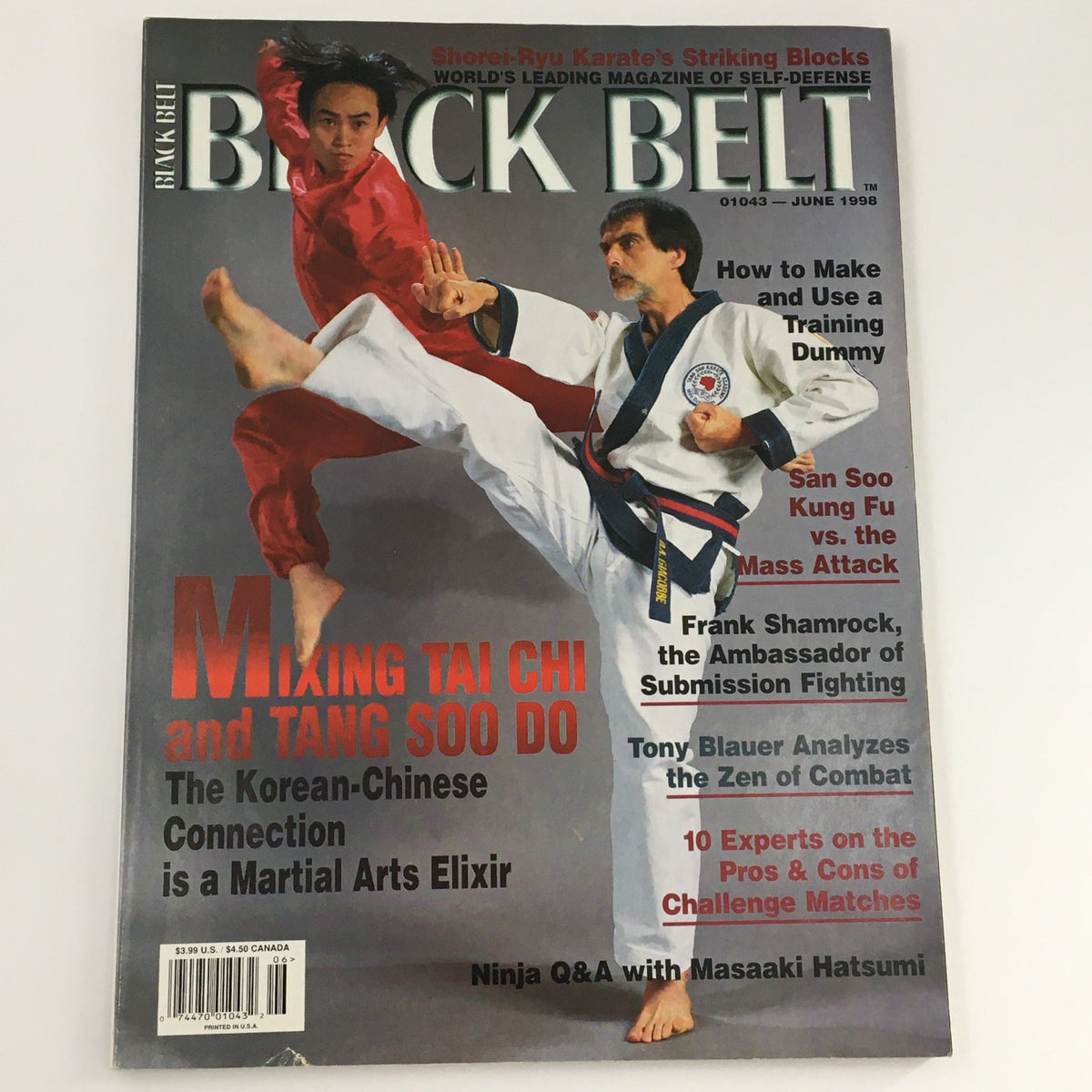


Description
Collector's Note – Why This Issue Matters
Black Belt Magazine June 1998 captures a late-1990s martial arts moment in which traditional disciplines were increasingly being discussed across boundaries rather than treated as isolated systems. The listing identifies the issue’s central feature as the mixing of Tai Chi and Tang Soo Do, a pairing that is especially interesting because the two arts are commonly associated with different training emphases. Tai Chi is widely known for slow, controlled movement, balance, breath, and internal development, while Tang Soo Do is a Korean martial art often associated with striking, forms, discipline, and self-defense. For collectors of vintage Black Belt Magazine issues, this June 1998 number reflects the magazine’s long-standing role in documenting how martial artists compared, combined, and interpreted different traditions. It also represents a period when serious practitioners were increasingly curious about cross-training without abandoning respect for traditional systems.
The date matters because martial arts culture in the 1990s was broadening in public visibility. Traditional dojo and dojang training continued, but martial arts were also being discussed in relation to fitness, personal development, self-defense, cross-training, and practical application. An issue focused on combining Tai Chi with Tang Soo Do fits that period well: it reflects a readership interested not only in preserving established systems, but also in understanding how methods from different traditions might complement one another. Within the wider field of original 1998 magazines, this issue belongs to a print era just before online martial arts forums and digital video began changing how practitioners studied and compared techniques. At that moment, magazines still played a central role in shaping discussion, offering readers curated instruction, commentary, and photography that could be studied repeatedly.
The listing also notes expert interviews, technique breakdowns, and photography of practitioners in action, though it does not provide specific article titles or named interview subjects. That makes the issue useful as a period artifact rather than merely as a martial arts curiosity. It preserves how a major martial arts publication framed hybrid training ideas at the end of the twentieth century, when readers were increasingly open to studying both the philosophical and physical dimensions of combat arts. The Tai Chi and Tang Soo Do theme gives the issue a distinctive place within Black Belt’s broader coverage because it suggests a conversation between softness and structure, internal cultivation and external technique, movement quality and practical martial application.
About the Publication
Black Belt Magazine is one of the best-known American martial arts periodicals, historically aimed at practitioners, instructors, competitors, collectors, and readers interested in martial arts culture. Its editorial format has commonly combined interviews, technique instruction, training commentary, equipment coverage, film and media discussion, self-defense material, and profiles of notable martial artists. By the 1990s, the magazine occupied an important place in martial arts publishing because it served both dedicated students and broader enthusiasts who wanted reliable coverage of karate, kung fu, taekwondo, judo, aikido, kickboxing, mixed systems, and related disciplines. In the pre-social-media era, magazines such as Black Belt were major reference points for readers seeking structured information outside their own schools. The publication’s value to collectors comes from that breadth: each issue can show not only who and what was being covered, but also how martial arts ideas were being explained to the public at a particular moment in time.
Key Highlights Inside
- June 1998 issue of Black Belt Magazine, a long-running martial arts publication with a broad practitioner and enthusiast readership.
- Features an exploration of mixing Tai Chi and Tang Soo Do, as stated in the listing.
- Connects two distinct martial arts approaches: Tai Chi’s emphasis on internal development, balance, and controlled movement, and Tang Soo Do’s Korean striking and forms-based tradition.
- The listing describes the issue as including expert interviews, technique breakdowns, and high-quality photography, though specific article titles and interview subjects are not confirmed.
- Represents late-1990s martial arts publishing, when cross-training, self-defense, fitness, and traditional practice were often discussed together.
- Identified as a newsstand edition, a detail relevant to collectors who distinguish newsstand copies from subscription-labeled examples and prefer uninterrupted cover presentation.
Condition & Rarity
The listing describes the June 1998 Black Belt Magazine issue as being in Very Good to excellent condition, with minimal wear typical for its age. For collectors, the newsstand designation is important because it generally indicates a copy without a subscriber mailing label, leaving the cover presentation cleaner and closer to its original retail appearance. When evaluating surviving copies of late-1990s martial arts magazines, condition points include cover gloss, spine wear, corner sharpness, page completeness, surface marks, and whether the magazine has been protected from bending or moisture. The noted bagged-and-boarded plastic protection is relevant for preservation, as it helps reduce handling wear and supports the magazine’s shape during storage. Martial arts magazines were often purchased for active reading and reference, so clean, complete, well-preserved examples remain preferable for research, display, and archival comparison. Page integrity is especially important for technique-oriented magazines because photographs, captions, and step-by-step material are part of the historical record. Even light wear should be read in context, since magazines from this period were usually made as disposable monthly publications rather than long-term archival objects.
Looking for More Issues Like This?
Specific Black Belt Magazine issues from the 1990s can be challenging to locate by topic, especially when the feature centers on a focused training concept such as combining Tai Chi and Tang Soo Do. Collectors researching related martial arts coverage may want to browse the broader selection of Black Belt Magazine back issues to compare how the publication covered traditional systems, hybrid training, self-defense, and practitioner-focused technique work across different years. Following the magazine issue by issue can reveal how martial arts conversations shifted as readers became more interested in cross-disciplinary training and practical application.
For broader publishing context, the archive of vintage 1998 magazines helps place this issue alongside other sports, fitness, entertainment, and specialty titles from the same year. That wider view is useful for understanding how martial arts magazines fit into the late-1990s print landscape. It also helps collectors compare specialist martial arts publishing with the broader cultural interests of the period.