


Description
Collector's Note – Why This Issue Matters
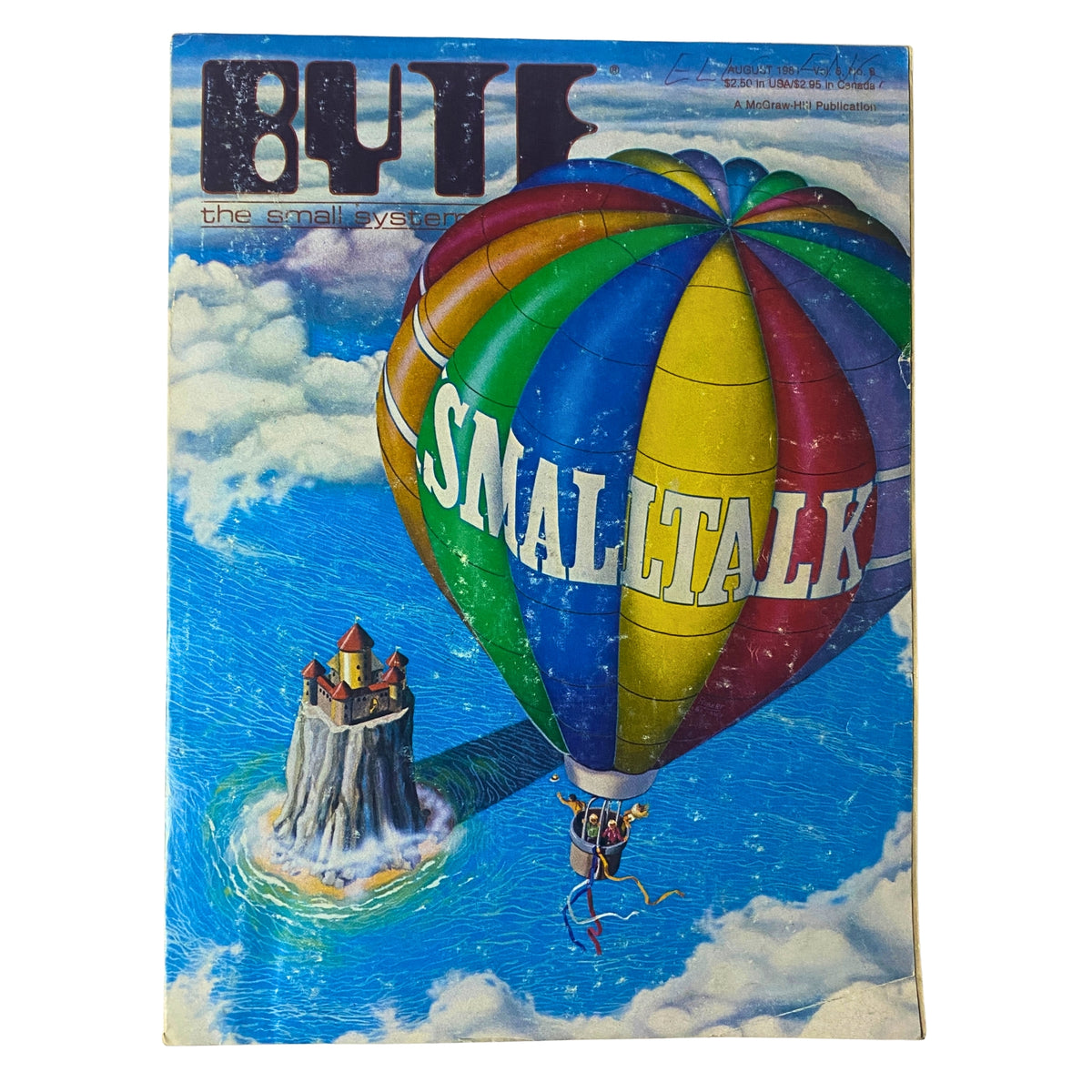
The August 1981 issue of Byte Magazine, Volume 6, Number 8, is widely regarded as one of the most historically significant single issues in the history of computer science publishing. This was not a routine theme issue — it was the first comprehensive public documentation of Smalltalk-80, the object-oriented programming language developed at Xerox PARC's Learning Research Group, written by the researchers who had built it. Adele Goldberg, Daniel H. H. Ingalls, Larry Tesler, L. Peter Deutsch, Trygve Reenskaug, and their colleagues contributed original articles that explained Smalltalk's design philosophy, virtual machine architecture, graphics kernel, and programming model to a technical audience for the first time at this level of depth. The articles were not introductory popularizations — they were substantive technical documents from the people who had done the work, published in the most widely read personal computing magazine in the world at the moment when personal computing was defining itself as a field. For collectors building an archive of Byte Magazine issues documenting computing history, this August 1981 edition is not simply a significant find — it is the issue that serious computing historians specifically seek.
The intellectual lineage running from this August 1981 Byte issue to virtually every aspect of modern software development is direct and traceable. Smalltalk's object-oriented design principles — encapsulation, inheritance, polymorphism, message passing — became the foundational concepts of C++, Java, Python, Ruby, Swift, and every major object-oriented language that followed. The graphical user interface paradigm that Smalltalk pioneered at Xerox PARC directly influenced the Apple Macintosh and subsequently every windowed computing environment in existence. Daniel Ingalls's article "Design Principles Behind Smalltalk" (page 286) is a document that computer science educators still assign to students today. When Steve Jobs visited Xerox PARC in 1979 and saw Smalltalk demonstrated, what he saw was the conceptual foundation documented in these pages. A Byte issue containing first-person technical documentation by Goldberg, Ingalls, Tesler, Deutsch, and Reenskaug is a primary source document for one of the most consequential chapters in the history of computing. Publications from 1981 capture the personal computing revolution at its most conceptually formative moment, and no single issue from that year carries more intellectual weight than this one.
About the Publication
Byte Magazine, founded in 1975 by Wayne Green and Virginia Peschow, was by August 1981 the most widely read and technically authoritative personal computing magazine in the United States, with a circulation approaching half a million and a readership that included the most important practitioners and thinkers in the emerging personal computing industry. Its format combined technical tutorials, hardware and software reviews, programming articles, and special theme issues that addressed significant developments in computing with the depth that its technically sophisticated audience demanded. The Smalltalk special issue was precisely the kind of editorial achievement that defined Byte's authority during this period — a single issue that functioned simultaneously as a trade journal, a technical reference, and a historical document.
Key Highlights Inside
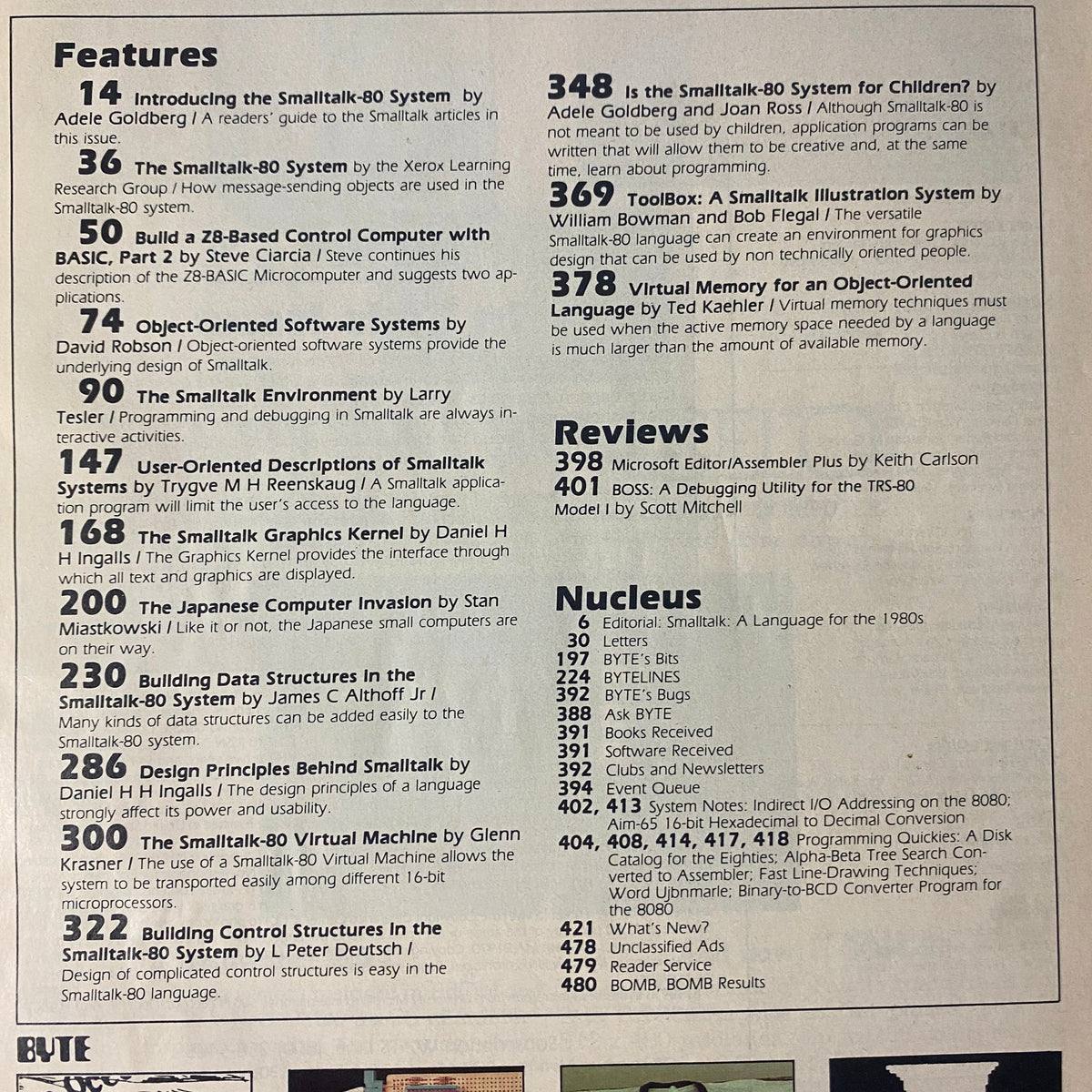
- "Introducing the Smalltalk-80 System" by Adele Goldberg (p.14) and "The Smalltalk-80 System" by the Xerox Learning Research Group (p.36) — the foundational introductory documents for the most influential object-oriented programming system ever developed, written by its creators.
- "Design Principles Behind Smalltalk" by Daniel H. H. Ingalls (p.286) — one of the most cited and historically significant articles in the computing literature, a document of the design philosophy that underlies virtually all modern object-oriented programming.
- "The Smalltalk Environment" by Larry Tesler (p.90) — by a researcher who would go on to join Apple and play a central role in the development of the Macintosh interface, bringing Smalltalk's GUI concepts into the mainstream consumer computing world.
- "User-Oriented Descriptions of Smalltalk Systems" by Trygve M. H. Reenskaug (p.147) — by the inventor of the Model-View-Controller (MVC) architectural pattern, which remains one of the most widely used software design patterns in web and application development today.
- "The Japanese Computer Invasion" by Stan Miastkowski (p.200) — a secondary feature documenting the competitive anxiety that Japanese computing advancement was generating in the American technology industry in 1981, providing broader industrial context alongside the Smalltalk theme.
- Editorial: "Smalltalk: A Language for the 1980s" (p.6) — the editorial framing of the issue's historical significance, written at the moment rather than in retrospect, making it a primary document of how the computing press understood Smalltalk's importance in real time.
Condition & Rarity
Good condition with minor edge and shelf wear and the confirmed absence of a mailing label is a meaningful configuration for this specific issue. The label-free cover confirms newsstand origin — subscriber copies of Byte from this period were delivered with labels applied directly to the cover, and label-free examples are the preferred configuration for display collectors. The plastic protective covering indicates deliberate preservation storage consistent with treating this as a collectible rather than a working reference. For a publication now over forty years old that was actively used by its technically engaged readership, good condition with only minor wear represents a copy that has been handled with more care than most. When evaluating any surviving copy of this issue, cover integrity, the completeness of the Smalltalk feature articles, and the absence of writing or annotation in the technical content are the primary factors — many copies of this issue were used as active working references and bear the marks of that use.
Looking for More Issues Like This?
The August 1981 Byte Smalltalk issue is the single most sought-after issue in the publication's entire run among computing historians and serious collectors — it surfaces with some regularity but rarely in label-free condition with protective covering intact. If this one has already been claimed, the full archive of Byte Magazine issues spans the publication's run from 1975 through its final years and surfaces other historically significant theme issues and landmark technical features. The broader 1981 magazine collection offers additional context for this pivotal year in personal computing history across multiple publications.