



Description
Collector's Note – Why This Issue Matters
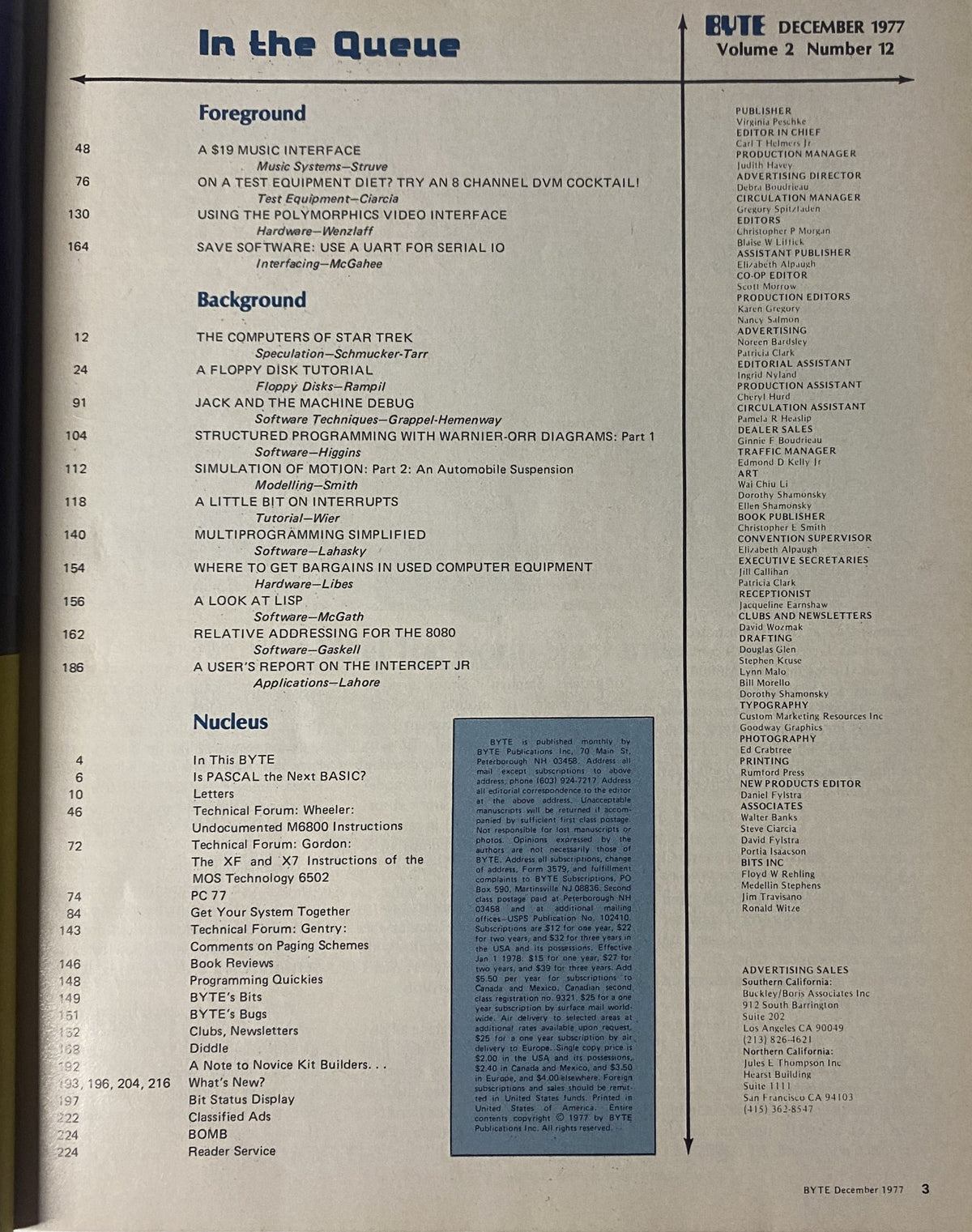
December 1977 is a specific and significant date in the history of personal computing. The Apple II had been introduced in April 1977, the TRS-80 and Commodore PET had both launched earlier that year, and the personal computer was completing its transformation from hobbyist kit to commercial product. BYTE was the essential publication for this community — the magazine that bridged the gap between the technical sophistication of the kit-building era and the expanding audience of enthusiasts who wanted to understand what these machines could do and how to build things with them. Volume 2, Number 12 represents the magazine at the end of its second full year of publication, already established as the most technically serious and editorially ambitious periodical in the personal computing space. The December 1977 issue's table of contents — ranging from a $19 music interface project to tutorials on floppy disks, LISP, structured programming, and multiprogramming — captures exactly the editorial identity that made BYTE indispensable: practical hands-on projects alongside theoretical foundations, accessible to the committed hobbyist but demanding enough to educate engineers. For collectors exploring magazines from 1977, this issue documents personal computing at its most historically consequential transitional moment.
The Robert Tinney cover — "Spaceport Gamma 6 – Holographic Museum of Ancient Technology" — is itself a significant collectible object within the history of computing illustration. Tinney's science-fiction cover paintings for BYTE are among the most recognized and beloved images in the visual culture of early personal computing, and they are actively sought by collectors of both vintage computing memorabilia and science-fiction illustration. The specific cover art for this issue places vintage computers in the future as museum artifacts — a playful, knowing illustration that comments on the rapid pace of technological change with the wit that characterized the best of Tinney's work for the magazine. The "Computers of Star Trek" feature article (p.12) deepens this science-fiction dimension, making this one of the more thematically coherent issues in BYTE's early run. For collectors building a serious archive through original BYTE magazine issues, the Tinney cover issues from the late 1970s are among the most actively pursued objects in the early computing magazine market.
The specific technical content of this issue also deserves attention from the historical perspective. The table of contents includes early coverage of topics that would define the computing decade ahead: floppy disk tutorials, structured programming concepts, LISP introduction, and multiprogramming simplified — all presented at a level of technical seriousness that treated the reader as a genuine engineer or advanced hobbyist. The question "Is Pascal the Next BASIC?" (p.6) is a period document of the programming language debates that would shape the 1980s computing landscape. Steve Ciarcia's practical projects column, the Technical Forum letters, and the "Where to Get Bargains in Used Computer Equipment" guide together paint a comprehensive portrait of the personal computing community as it existed in December 1977.
About the Publication
BYTE magazine was founded in 1975 by Virginia Peschow and Carl Helmers and quickly established itself as the most technically rigorous and editorially ambitious publication in the personal computing space, addressing a readership of committed hobbyists, engineers, and early adopters who were building, programming, and pushing the limits of the nascent personal computer industry. Its editorial format combined practical project guides, programming tutorials, hardware reviews, theoretical articles, and community correspondence in a package that treated its audience as technically sophisticated participants in a genuine technological revolution rather than passive consumers. By late 1977, the magazine was at the height of its early influence, with a readership that represented the core of the personal computing community at the moment the industry was making its decisive transition to commercial viability.
Key Highlights Inside
- Robert Tinney cover art — "Spaceport Gamma 6 – Holographic Museum of Ancient Technology": One of Tinney's celebrated science-fiction cover paintings for the magazine, depicting vintage computers as museum artifacts in a future spaceport — a visually distinctive and historically significant piece of early computing illustration actively sought by collectors.
- "The Computers of Star Trek" — Schmucker & Tarr (p.12): As confirmed in the table of contents — a feature article on the fictional computer systems of the Star Trek universe, providing the science-fiction thematic context for Tinney's cover art and representing the era's engagement with speculative computing futures.
- "A Floppy Disk Tutorial" — Rampil (p.24): As confirmed in the table of contents — a technical tutorial on floppy disk technology at a moment when the format was becoming central to personal computing, representing exactly the kind of foundational technical education that defined BYTE's editorial identity.
- "Is Pascal the Next BASIC?" (p.6): A period document of the programming language debates that would shape the computing decade ahead, capturing the community's active engagement with the question of what language would define personal computing's future.
- "A Look at LISP" — McGath (p.156): Early consumer computing press coverage of LISP — the artificial intelligence programming language that would remain central to AI research for decades — presented to a general hobbyist audience in December 1977.
- Steve Ciarcia project — "On a Test Equipment Diet? Try an 8 Channel DVM Cocktail!" (p.76): A contribution from Steve Ciarcia, one of BYTE's most celebrated practical project contributors, whose work defined the hands-on engineering culture of the magazine's early years.
Condition & Rarity
The listing describes this issue as in good condition with no mailing label, some age-consistent wear, and a plastic protective covering applied. In collector-grade terms, good condition for a publication from 1977 indicates honest age-related deterioration — likely including some toning to the interior pages and wear to the cover edges consistent with nearly fifty years of age on paper stock not designed for archival storage. The absence of a mailing label is a meaningful positive — label adhesive causes irreversible cover surface damage and is present on the majority of surviving subscription copies from this era, making label-free copies preferable for display. The applied protective covering indicates custodial care at some point in the magazine's history. When evaluating any surviving copy of this issue, the meaningful criteria are the vibrancy and clarity of Tinney's cover painting, the completeness of all interior pages including the full table of contents confirmed in the listing, and the absence of moisture damage or significant structural wear to the spine. At the grade described, this is an appropriate copy for reading, research, display, and serious collection purposes.
Looking for More Issues Like This?
A December 1977 BYTE with a Robert Tinney cover, "The Computers of Star Trek" feature, and the full complement of late-1970s computing content described in the table of contents is one of the more historically complete and visually distinctive issues available from the magazine's early run — and Tinney cover issues specifically are among the most actively sought in the early computing magazine collector market. If it is no longer available, the original BYTE magazine collection at OriginalMagazines.com is one of the most comprehensive archives of the publication accessible to collectors. For those interested in the broader landscape of the personal computing revolution's formative years, the 1977 magazine collection is worth exploring — it is the year the personal computer became a commercial reality.