

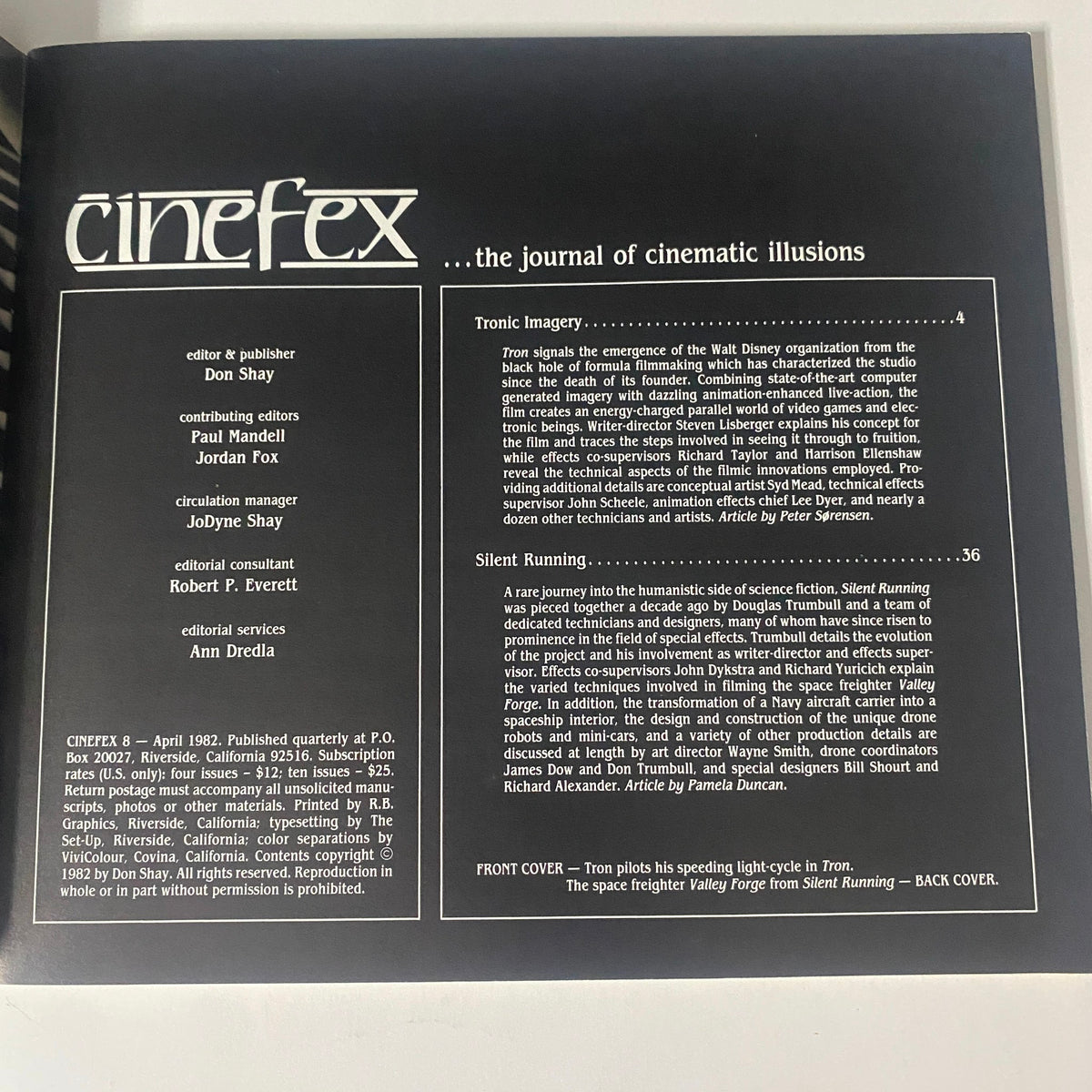


Description
Collector's Note – Why This Issue Matters
Cinefex Issue No. 8, published in April 1982, documents two films that sit at opposite ends of the same technological arc — and understanding that arc is what makes this issue so valuable as a historical document. Silent Running, released in 1972, was one of the first films to demonstrate that a small crew with practical ingenuity and genuine artistic commitment could produce visual effects work of extraordinary quality outside the Hollywood studio system. Douglas Trumbull, its director and effects supervisor, had come directly from his work on 2001: A Space Odyssey and brought that film's rigorous approach to photographic effects to a project made on a fraction of the budget. Tron, released in June 1982, was attempting something categorically different: a film in which computer-generated imagery would not supplement the photographic image but replace it entirely for significant sequences. The two films together represent a before and after in the history of cinematic visual effects — and Cinefex had the foresight to document both in a single issue published at the precise moment the transition was occurring.
The Tron coverage is of particular historical significance. The film's production had been watched closely by everyone in the effects industry, and the technical challenges it had posed — creating convincing CGI environments and characters at a time when the computational resources available were almost laughably limited by contemporary standards — had generated intense professional interest. The article's access to writer-director Steven Lisberger, effects supervisors Richard Taylor and Harrison Ellenshaw, and conceptual designers including Syd Mead gives this feature a documentary depth that no subsequent retrospective can fully replicate. Syd Mead's contribution to Tron's visual language — coming immediately after his equally foundational work on Blade Runner, documented in the concurrent Issue No. 9 — makes his presence in this article a reminder of how concentrated the creative talent defining science-fiction's visual vocabulary was in 1982. For collectors who follow vintage Cinefex magazine issues, this issue and the Blade Runner issue that followed it represent a paired document of the most transformative six months in the history of science-fiction film.
The Silent Running section adds a different kind of historical value. By 1982, the film was a decade old and had achieved a devoted cult following, but detailed technical documentation of its production had never been assembled in this form. John Dykstra — who would go on to found Industrial Light and Magic's optical department and win the first visual effects Oscar for Star Wars — is among the collaborators interviewed here, and his early career work on Silent Running has rarely been documented with this level of specificity. The account of how Trumbull's team transformed a Navy aircraft carrier into a convincing spaceship interior is exactly the kind of practical problem-solving history that Cinefex preserved and that no other publication thought to record. Collectors building archives around publications from 1982 will find this issue sits alongside the Blade Runner edition as one of the two most historically significant Cinefex issues of a remarkable year for science-fiction cinema.
About the Publication
Cinefex was founded by Don Shay in 1980 with a singular editorial mission: to document the art and craft of motion picture visual effects with the depth and technical specificity that the subject deserved but had never previously received. Each issue was devoted entirely to one or two productions, combining long-form interviews with the artists and technicians directly responsible for the work with detailed behind-the-scenes photography and production stills. The publication's quarterly schedule, its heavy paper stock, and its refusal to dilute its focus with broader entertainment coverage gave it an authority and density that made it the essential reference for visual effects professionals and serious film enthusiasts across its entire publishing run. Issue No. 8 represents the magazine in its third year, still in its founding creative phase, documenting films that were simultaneously contemporary releases and immediate landmarks.
Key Highlights Inside
- "Tronic Imagery" (p.4), by Peter Sørensen — a comprehensive technical account of Tron's production, featuring interviews with director Steven Lisberger, effects supervisors Richard Taylor and Harrison Ellenshaw, and conceptual designer Syd Mead, documenting the first major Hollywood attempt to build significant film sequences entirely from computer-generated imagery.
- "Silent Running" (p.36), by Pamela Duncan — a detailed production history of Douglas Trumbull's 1972 landmark, including accounts from John Dykstra and Richard Yuricich of how the Valley Forge was constructed, the drone robots designed, and a Navy aircraft carrier transformed into a convincing spacecraft interior.
- Documentation of Syd Mead's conceptual work on Tron, creating a direct editorial connection to his concurrent work on Blade Runner — giving this issue particular significance for collectors tracking the visual design lineage of early 1980s science-fiction cinema.
- Front cover featuring Tron on his light cycle; back cover featuring the Valley Forge — two images that together frame the issue's central argument about the breadth and variety of visual effects approaches available to science-fiction filmmakers in 1982.
- John Dykstra interview content documenting his pre-Star Wars career work on Silent Running — a rarely detailed chapter in the career of one of visual effects history's most consequential figures.
Condition & Rarity
Near mint is the condition designation that serious Cinefex collectors actively pursue, and for Issue No. 8 it carries particular weight. The magazine was printed on heavier stock than standard newsstand publications, which provides better long-term structural resilience — but its dual status as both a collectible and a working technical reference meant that many copies were consulted extensively by effects professionals and students who had no preservation interest. The Tron content specifically would have been of immediate practical relevance to anyone working in or studying computer graphics in 1982 and 1983, meaning professionally used copies are common in the surviving pool. A near mint example with only the faintest signs of handling indicates deliberate preservation rather than active use — the exception in this issue's collecting history rather than the rule. Protective sleeve storage reflects appropriate archival practice. For any surviving copy of this issue, the primary evaluation points are spine tightness, cover surface integrity on both the Tron light cycle image and the Valley Forge back cover, and the absence of page tanning or moisture damage consistent with what near mint implies.
Looking for More Issues Like This?
Cinefex Issue No. 8 in near mint condition is one of the more actively sought issues in the publication's run — the Tron and Silent Running pairing, combined with the Syd Mead and John Dykstra content, gives it a depth of interest that extends well beyond single-film collectors. If this issue is no longer available, the full vintage Cinefex collection at OriginalMagazines.com is the essential resource for other issues documenting landmark productions across the publication's history. The 1982 magazine archive covers the full year across multiple titles for collectors building a focused early-eighties science-fiction and film culture library.