


Description
Collector's Note – Why This Issue Matters
Cinefex Issue No. 7, published in January 1982, is one of the most significant single issues in the magazine's entire publishing history — a definitive retrospective on Willis O'Brien that remains, decades after its publication, the most comprehensive profile of the stop-motion pioneer available in any periodical format. Willis O'Brien's place in the history of cinema is foundational and specific: his work on the 1925 adaptation of The Lost World, his creation of the Kong character and his stop-motion effects for the 1933 King Kong, and his Academy Award-winning work on Mighty Joe Young (1949) established the technical and artistic vocabulary of creature animation that influenced every subsequent practitioner of the craft — including Ray Harryhausen, who had worked as O'Brien's assistant on Mighty Joe Young and whose own career represented the direct continuation of O'Brien's legacy. Don Shay's profile in this issue — tracing O'Brien from his earliest puppet animation experiments through his landmark achievements and his unrealized projects — is the kind of sustained, primary-source-informed journalism that Cinefex produced better than any competing publication, and for a subject of O'Brien's historical importance, it represents an irreplaceable primary document. For collectors building archives of vintage Cinefex magazine issues, this issue is among the handful that are consistently cited by film historians and animation scholars as essential reference material.
The January 1982 publication date places this issue in a specific and interesting context for stop-motion animation history. The early 1980s were the period when the computer graphics revolution that would eventually displace practical effects was still far from realized — stop-motion, puppetry, and practical creature effects were at their most technically sophisticated and commercially dominant phase, and the interest in their history and craft was intense among both practitioners and enthusiastic audiences. The Raiders of the Lost Ark and Star Wars era had brought practical effects to unprecedented mainstream attention, and O'Brien's foundational role in the tradition that produced those achievements was being reassessed with new appreciation. A comprehensive O'Brien retrospective in January 1982 was not merely academic — it was relevant contemporary cultural journalism about the roots of the most celebrated practical effects tradition in cinema. Collectors of 1982 magazines focused on film history and visual effects will find this issue occupies a specific and well-defined position within the genre's historical literature.
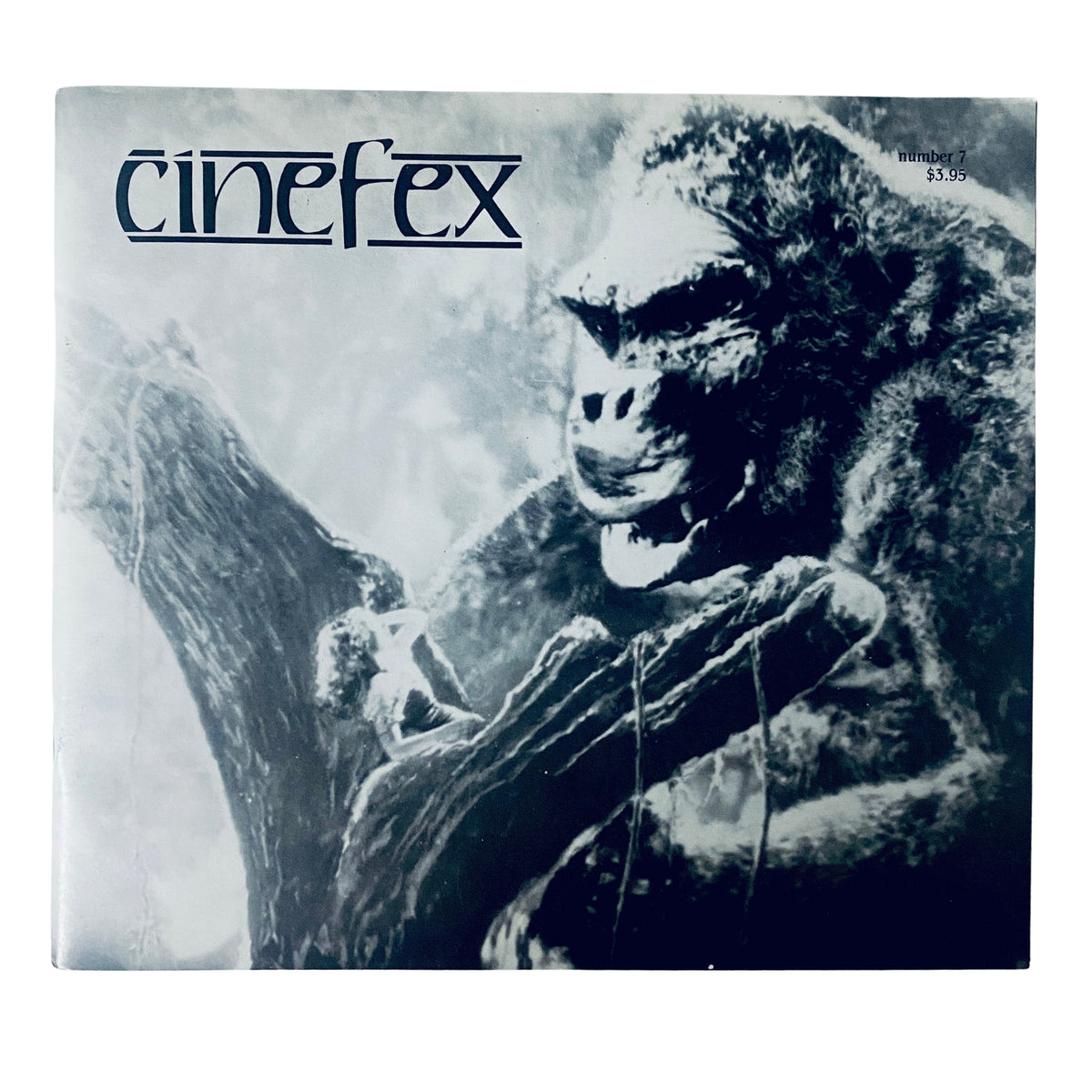
The confirmed cover imagery — Kong cradling Ann Darrow in a tree on the front, with Mighty Joe Young's gorilla inspecting chickens on the back — provides visual bookends for the O'Brien retrospective's thematic range: the grandeur and menace of his most famous creation on one side, the warmth and comic character of his later work on the other. Both images are drawn from films that have never left the permanent canon of American cinema, and their use as this issue's framing images reflects Cinefex's consistent editorial instinct for selecting visuals that communicate the historical and artistic stakes of the subject matter they introduce.
About the Publication
Cinefex was a quarterly magazine dedicated to the craft of cinematic visual effects, founded in 1980 by Don Shay and published through 2020. Its editorial format focused on long-form, technically detailed examinations of visual effects work in specific films, supplemented by historical retrospectives on practitioners and techniques that had shaped the field. Its audience was film industry professionals, serious students of the craft, and the dedicated enthusiast community that followed visual effects with the same intensity that cinephiles brought to direction or performance. By January 1982 it had published only seven issues but had already established its reputation as the most authoritative and rigorously researched publication in its field — a reputation it maintained throughout its forty-year run. The O'Brien retrospective in this seventh issue is characteristic of the historical work that complemented the magazine's production-focused coverage and gave it documentary value beyond any single film cycle.
Key Highlights Inside
- "Willis O'Brien — Creator of the Impossible" — Don Shay (page 4) — A confirmed comprehensive profile tracing O'Brien's career from early puppet animation experiments through The Lost World, King Kong, and Mighty Joe Young, including assessment of his unrealized projects — primary source journalism from the publication of record for cinema visual effects history.
- Front cover — Kong and Ann Darrow, King Kong (1933) — A confirmed cover image from one of the most iconic films in American cinema history, providing visual framing for the O'Brien retrospective's central achievement.
- Back cover — Mighty Joe Young (1949) — A confirmed back cover image from O'Brien's Academy Award-winning work, bookending the issue's coverage with his most celebrated later achievement.
- Very good condition — clean and bright interior confirmed — The listing specifically confirms clean, bright interior pages alongside very good overall condition — a strong survival grade for a forty-plus-year-old specialty quarterly.
- No mailing label — confirmed newsstand copy — The absence of a label preserves the full King Kong cover image without address obstruction, confirming the preferred state for display-grade collecting of this issue.
Condition & Rarity
Very good condition with minor edge wear, clean and bright interior, no mailing label, and protective sleeve represents a strong collector-grade example of this specific issue. Cinefex was printed on high-quality paper stock with excellent reproduction standards designed to showcase production photography and behind-the-scenes imagery, and issues that have been carefully stored typically retain their visual quality well over four decades. The confirmed clean interior is a particularly meaningful positive for a reference-oriented publication whose primary value lies in the readability and completeness of its text and image content. The no-label status confirms the full Kong cover photograph is unobstructed. Issue No. 7 is among the more actively sought numbers in the Cinefex collecting community specifically because of the O'Brien retrospective's canonical status in stop-motion animation historical literature, and very good condition examples with clean interiors represent the upper tier of what the collector market encounters for this specific number.
Looking for More Issues Like This?
Cinefex Issue No. 7 is consistently cited by stop-motion animation historians and film effects scholars as a foundational reference, and finding a very good condition copy with clean interior and no label is a genuine find in this specialized collecting category. The broader Cinefex archive at OriginalMagazines.com spans many issues of the publication's forty-year run and is worth exploring carefully for other landmark retrospective and production-focused numbers. For collectors focused on the specific early-eighties practical effects golden age that gave this O'Brien retrospective its cultural moment, the full 1982 magazine collection covers a range of film and entertainment titles from one of cinema's most technically accomplished and historically rich years.