


Description
Collector's Note – Why This Issue Matters
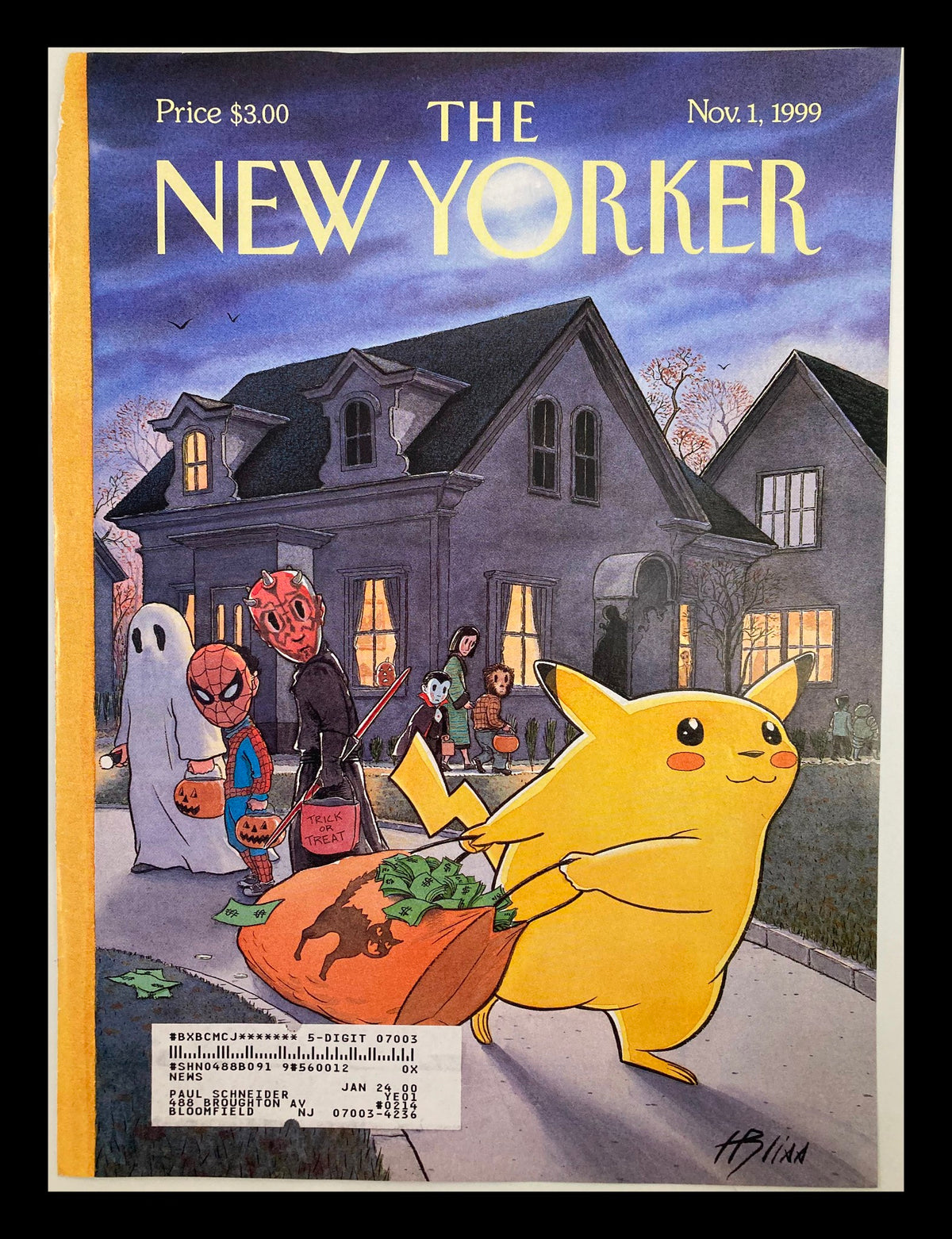
The November 1, 1999 New Yorker cover by Harry Bliss depicts Pikachu — the iconic electric mouse Pokémon that had become the most recognizable character in one of the fastest-spreading pop culture phenomena the entertainment industry had ever produced. By the fall of 1999, Pokémon had moved from a Japanese Game Boy game to a global trading card game, an animated television series, a theatrical film, and a toy empire that was generating billions of dollars annually and consuming the attention of children across North America, Europe, and beyond. The New Yorker's decision to put Pikachu on its Halloween-adjacent November 1 cover was a specific editorial statement: an acknowledgment by one of America's most culturally self-conscious publications that Pokémon had crossed from children's entertainment into a phenomenon that demanded serious adult attention — or at least sophisticated comic acknowledgment. Harry Bliss, whose work for The New Yorker consistently found humor in the collision between high culture and mass culture, was a precise fit for that assignment.
The timing within 1999 adds further context. The Pokémon Trading Card Game had caused genuine disruption in American elementary schools that year, with cards being banned, stolen, and traded with an intensity that alarmed parents and fascinated sociologists. The first Pokémon theatrical film — Pokémon: The First Movie — had opened in American theaters in November 1999, the same month as this cover, to enormous box office returns despite mixed critical reception. A New Yorker Pikachu cover appearing in this precise window is a document of peak cultural saturation — the moment when a phenomenon originating in Japanese game design had become sufficiently embedded in American life that the magazine's sophisticated readership could be assumed to recognize the character without explanation. For collectors tracking late-1990s publications documenting pop culture history, this cover represents an intersection of two very different cultural worlds that rarely met so directly.
About the Publication
The New Yorker, founded by Harold Ross in 1925, was by 1999 one of the most prestigious general interest magazines in the United States, combining long-form journalism, fiction, poetry, criticism, and cover art under a masthead that carried significant cultural authority. Its covers, produced by a rotating roster of artists, had long functioned as a form of visual commentary on American life — capable of being simultaneously celebratory, ironic, and analytically precise depending on the artist and subject. Harry Bliss joined The New Yorker's contributor roster in the 1990s and became known for single-panel cartoons and cover work that engaged everyday American culture with warmth and wit. A Bliss Pokémon cover in November 1999 is characteristic of the magazine's practice of using popular culture as a lens rather than simply as a subject.
Key Highlights Inside
- Cover art by Harry Bliss depicting Pikachu of Pokémon — published at the peak of the franchise's North American cultural penetration in fall 1999, coinciding with the theatrical release of Pokémon: The First Movie.
- Halloween-adjacent publication date of November 1, 1999 — suggesting the cover likely engaged the holiday in some visual capacity, consistent with The New Yorker's tradition of seasonally themed cover art.
- Important note for collectors: this listing is for the detached cover page only, not a complete issue. Interior content is not present and cannot be assessed or referenced.
Condition & Rarity
This listing is explicitly for the cover page only — a detached front cover rather than a complete magazine. That distinction is the primary collector consideration: the cover's value here is as a standalone piece of printed art and cultural documentation, evaluated independently of any interior content. The label present on the front identifies the original issue as a subscriber copy. Minor wear throughout and binding wear are consistent with a cover that was separated from a complete magazine rather than preserved intact. The plastic protective covering indicates subsequent flat storage with preservation intent, which is favorable for the surface integrity of the printed image. When evaluating any surviving example of this cover, the primary condition factors are the clarity and color saturation of Bliss's Pikachu illustration, the flatness of the paper, and the absence of fold lines or moisture damage across the printed surface.
Looking for More Issues Like This?
New Yorker covers engaging major pop culture phenomena are among the more collectible configurations in the publication's modern archive — and a Harry Bliss Pikachu cover from peak Pokémon 1999 occupies a specific and memorable position in that history. If this piece has already found a home, the full archive of New Yorker issues and covers is worth exploring for other landmark cover art across the publication's decades of publication. The broader 1999 magazine collection offers wider context for this culturally dense year across multiple publications.