



Description
Collector's Note – Why This Issue Matters
The May 1968 issue of Ebony Magazine is one of the most historically significant issues in the publication's entire fifty-year archive — and one of the most important memorial publications produced in American magazine journalism. Dr. Martin Luther King Jr. was assassinated on April 4, 1968, in Memphis, Tennessee. Ebony's May issue, which would have been prepared in the immediate aftermath of his death, represents the Black press's most authoritative and deeply felt response to the loss of the civil rights movement's most recognized leader. The cover image by Moneta Sleet Jr. — the Pulitzer Prize-winning photographer whose work for Ebony had documented the civil rights movement across its most significant years — gives this issue an immediate primary source authority that no subsequent tribute could replicate. Sleet's Pulitzer, awarded in 1969, was the first ever given to a Black photographer, and it was awarded specifically for his photograph of Coretta Scott King at her husband's funeral — an image that may be documented in this very issue. For collectors building an archive of Dr. Martin Luther King Jr. magazine tributes and civil rights history, this May 1968 Ebony is the primary periodical document of his death's immediate impact on the Black American community and press.
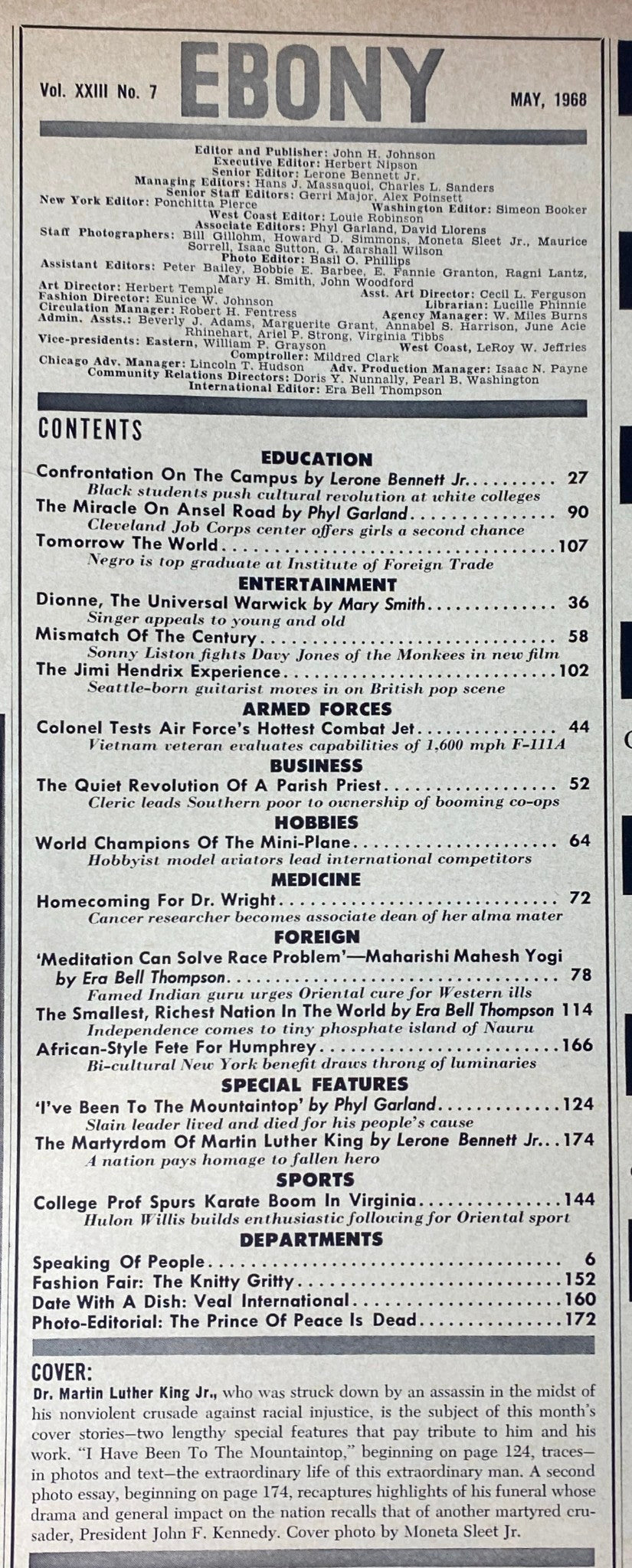
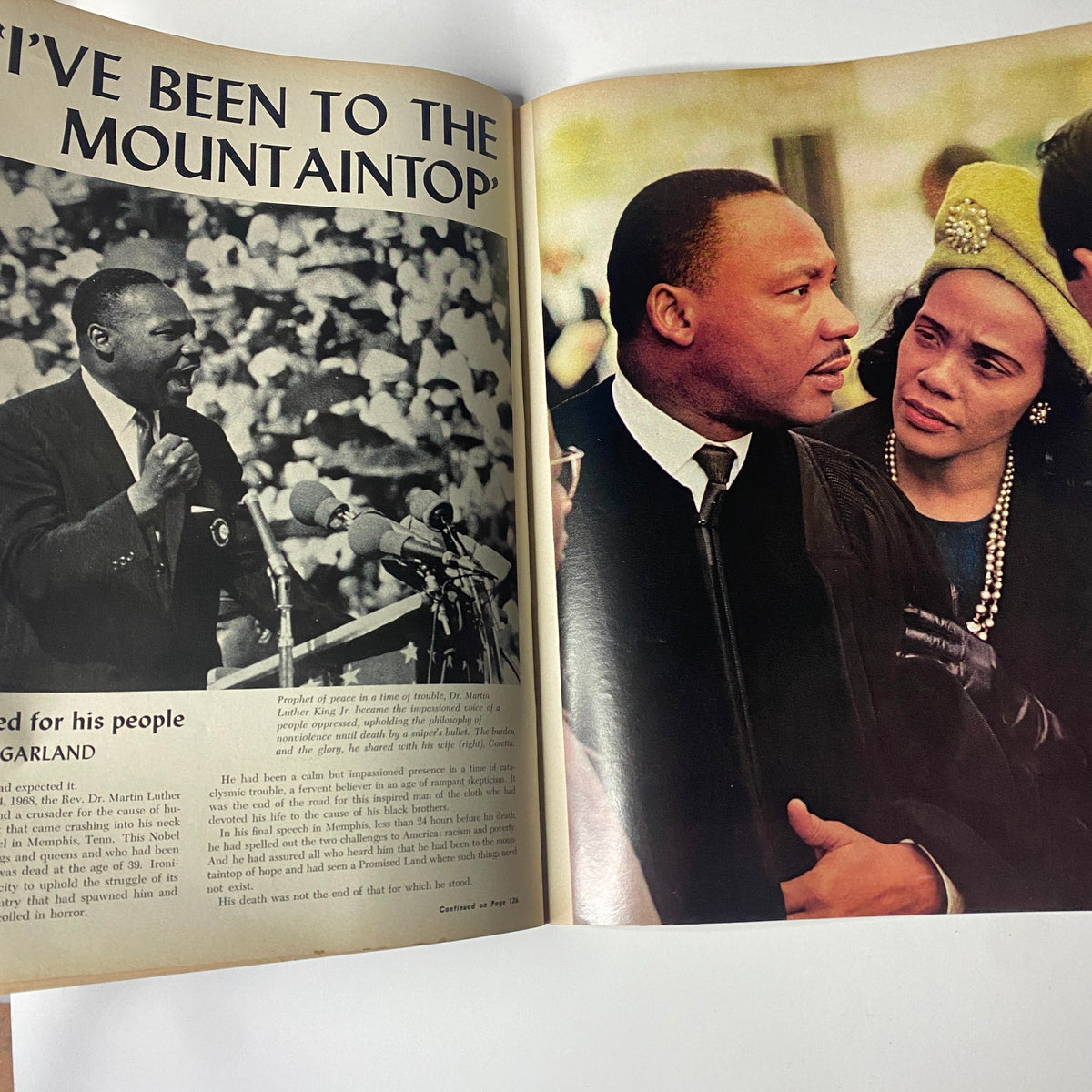
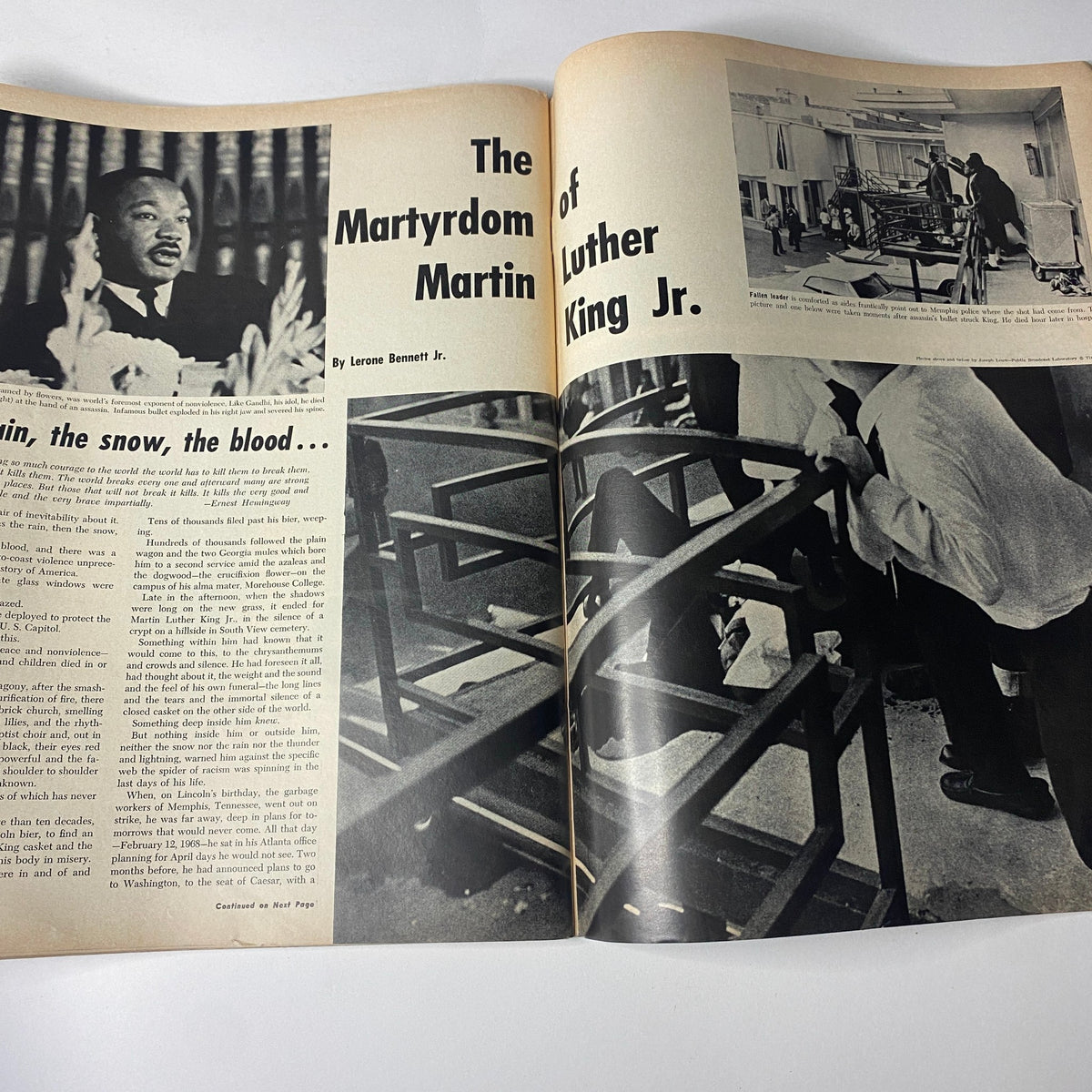
The confirmed table of contents gives this issue extraordinary depth as a historical document. Lerone Bennett Jr.'s "The Martyrdom of Martin Luther King" represents a major analytical tribute from Ebony's most distinguished contributing historian — Bennett had been writing serious civil rights history for the magazine for years, and his assessment of King's legacy weeks after the assassination is a primary source of the first order. Phyl Garland's tribute to "I've Been to the Mountaintop" — King's final speech, delivered the night before his death — documents the prophetic dimension of that speech as it was immediately understood by the Black press. The funeral photo-essay "The Prince of Peace Is Dead" provides visual documentation of national mourning at its most acute. Beyond the King memorial content, the confirmed features are remarkable in their own right: the Jimi Hendrix Experience feature (page 102), Dionne Warwick coverage, the Maharishi Mahesh Yogi piece by Era Bell Thompson on race and meditation, and Lerone Bennett's "Confrontation on the Campus" together document a Black America simultaneously in grief and in motion. Ebony Magazine issues from the civil rights era are primary sources of extraordinary importance, and this May 1968 edition is the most historically weighted of the decade. Publications from 1968 document one of the most catastrophic and consequential years in American history.
About the Publication
Ebony Magazine, founded by John H. Johnson in 1945, was by May 1968 the most widely read African American magazine in the United States, with a circulation exceeding one million copies per month and a readership that cut across class, region, and political affiliation within the Black community. Its combination of aspirational lifestyle content, celebrity coverage, and serious political and cultural journalism gave it a unique position in American publishing — simultaneously a celebration of Black achievement and the most authoritative platform for Black American political and cultural discourse. A King memorial issue in Ebony in May 1968 reached this enormous readership at the moment of the community's deepest collective grief, and the editorial team's choices about what to include and how to frame the tribute were themselves acts of historical and political significance.
Key Highlights Inside
- Cover photograph by Moneta Sleet Jr. — the Pulitzer Prize-winning photographer whose work documenting King's funeral would earn him the first Pulitzer ever awarded to a Black photographer in 1969, making this cover a document of that specific and historic body of work.
- "The Martyrdom of Martin Luther King" by Lerone Bennett Jr. (p.174) — a major analytical tribute by Ebony's most distinguished contributing historian, written weeks after the assassination, representing one of the most authoritative immediate assessments of King's historical significance.
- "I've Been to the Mountaintop" by Phyl Garland (p.124) — a tribute to King's final speech, delivered the night before his death, documenting the prophetic dimension of that address as immediately understood by the Black press.
- "Photo-Editorial: The Prince of Peace Is Dead" (p.172) — a visual commemoration of King's funeral and national mourning, providing primary photographic documentation of grief at its most acute and immediate.
- "The Jimi Hendrix Experience" (p.102) — documentation of Hendrix at the peak of his UK breakthrough, published in the same issue as the King memorial, capturing Black American cultural life in all its complexity and momentum in May 1968.
- "Confrontation on the Campus" by Lerone Bennett Jr. (p.27) and "Maharishi Mahesh Yogi on Race in America" by Era Bell Thompson (p.78) — confirming the issue's engagement with the full range of 1968's cultural and political conversations alongside the memorial content.
Condition & Rarity
Good condition with a plastic protective covering is an appropriate assessment for a monthly magazine now over fifty-five years old that carried the most emotionally significant content the publication had produced since its founding. The issue was actively read by a deeply engaged readership in the weeks after King's assassination, and surviving copies in good condition represent examples that were handled with unusual care given the emotional weight of their content. The listing confirms the protective covering indicates deliberate subsequent preservation. For a monthly publication of this vintage, the primary condition factors are cover portrait clarity and surface integrity — the Moneta Sleet Jr. cover photograph is the primary visual and historical attribute — and the completeness of the memorial content pages, which constitute the issue's most historically significant editorial material.
Looking for More Issues Like This?
The May 1968 Ebony King memorial issue is among the handful of American magazine publications from the civil rights era that can be described without qualification as irreplaceable primary historical documents — the combination of Moneta Sleet Jr.'s cover photography, Lerone Bennett Jr.'s analytical tribute, and Ebony's mass-circulation platform makes this one of the most significant periodical responses to King's death. If this issue has already been claimed, the archive of Dr. Martin Luther King Jr. magazine tributes and civil rights history is the natural first stop. The full Ebony Magazine collection and the 1968 magazine archive offer additional context for this extraordinary and tragic year in American history.