



Description
Collector's Note – Why This Issue Matters
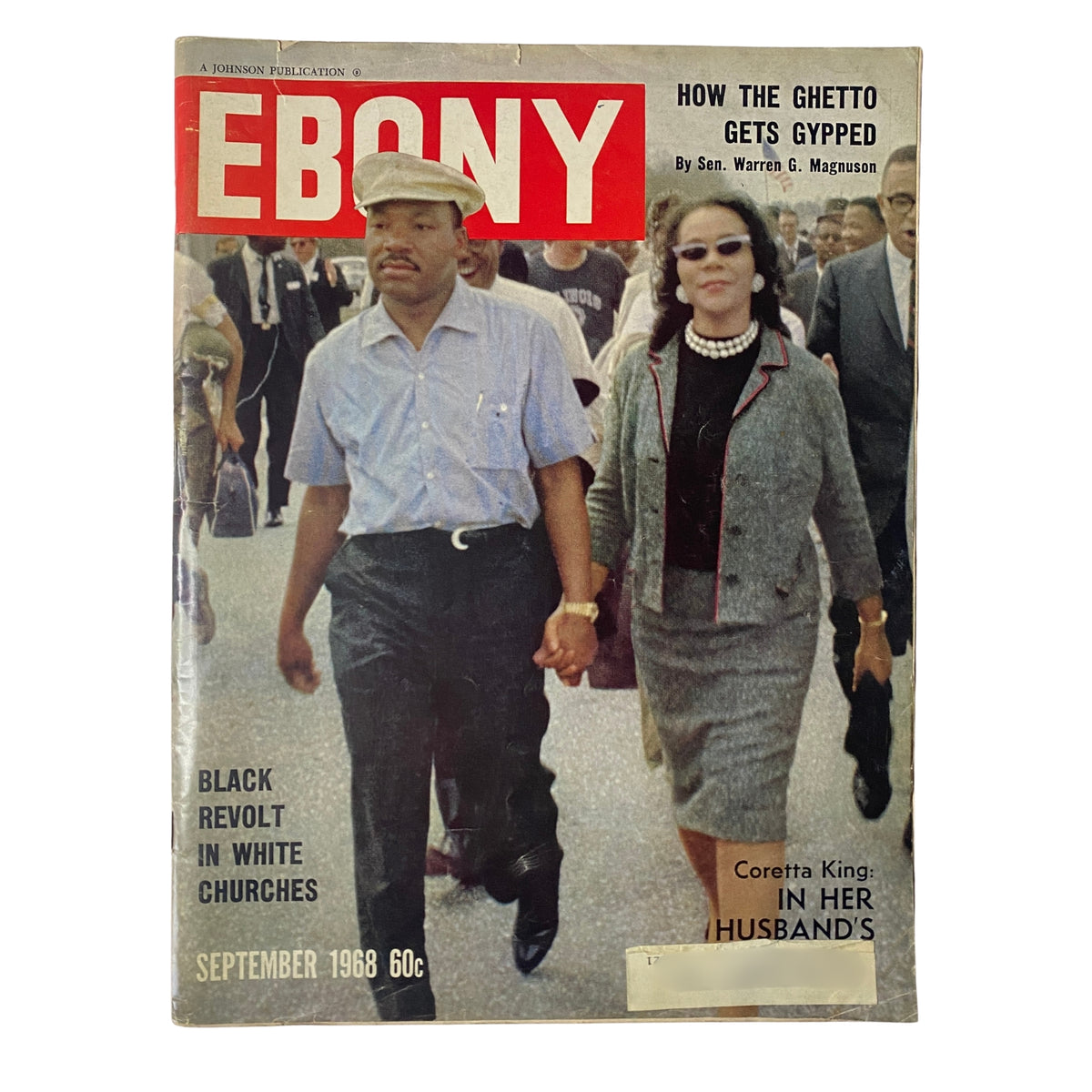
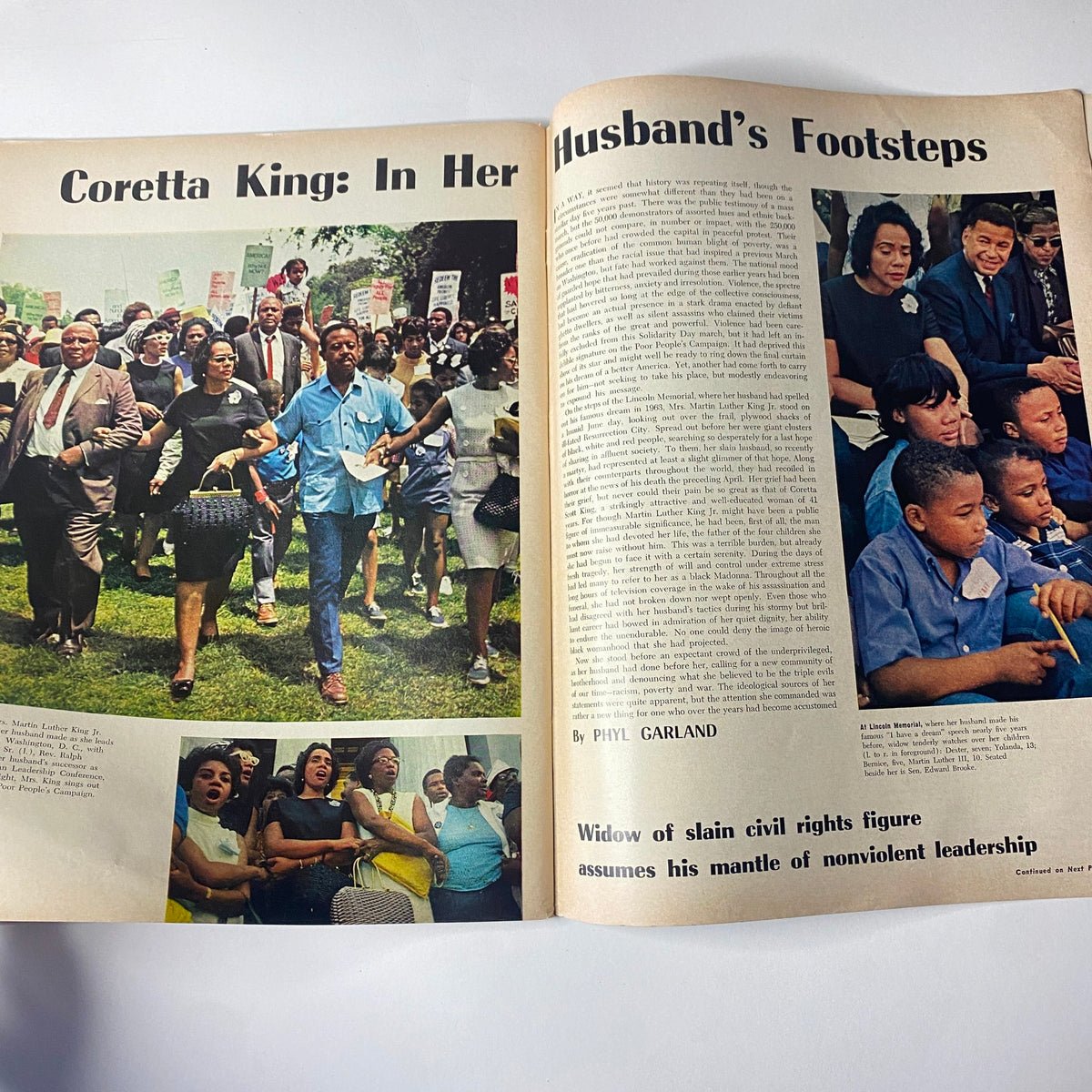
September 1968 is one of the most historically significant publication dates in Ebony Magazine's history, and this issue — Vol. XXIII, No. 11 — is a primary document of Black America navigating the most traumatic months of the civil rights era's most turbulent year. Dr. Martin Luther King Jr. had been assassinated on April 4, 1968 — five months before this issue's publication — and Coretta Scott King was in the specific and extraordinarily difficult biographical moment of establishing herself as an independent voice in the movement her husband had led while simultaneously managing her grief, her family, and the enormous expectations that had been placed on her by history. Phyl Garland's "In Her Husband's Footsteps" profile is a primary document of Coretta Scott King at that precise biographical moment, engaging her emergence as a leading civil rights voice in the months immediately following the assassination before the full shape of her subsequent decades of advocacy had been established. The cover photograph — Moneta Sleet Jr.'s image of the couple during the 1965 Selma to Montgomery march — is a primary document in its own right: Sleet was the first Black American to win the Pulitzer Prize for Photography, receiving it in 1969 for his photograph of Coretta Scott King at her husband's funeral. His cover work for this September 1968 Ebony thus sits at the intersection of two historically significant photographic bodies of work from the same photographer in the same year. For collectors building an archive of Martin Luther King Jr. magazine covers and memorial features, this September 1968 Ebony is a primary document of the immediate post-assassination period through the specific lens of the publication that had been the most authoritative voice in Black American media for more than two decades.
The editorial architecture surrounding the King cover feature is a primary source document of extraordinary density. David Llorens's "Separatism In Perspective" on page 88 engages the specific ideological landscape of 1968 Black political thought — the year of King's death, the year of the Poor People's Campaign, the year of the Black Power movement's most visible assertion — with the analytical intelligence that distinguished Llorens's Ebony journalism throughout this period. Alex Poinsett's "The Black Revolt In The White Churches" on page 63 documents the specific challenge to superficial religious integration that was one of the less-discussed dimensions of 1968 Black political activism, engaging the institutional church as a site of racial contestation that complemented the street-level activism more commonly covered. Senator Warren G. Magnuson's "The Ghetto Gets Gypped" on page 112 is a documented congressional voice engaging systemic economic exploitation of urban communities, representing the specific intersection of federal policy attention and Black economic rights that characterized the post-King political landscape. "The Electronic Nigger" on page 97 — Ed Bullins's play, which won an Obie Award in 1968 — is a documented engagement with one of the most significant works of the Black Arts Movement at the moment of its critical recognition. Collectors researching Ebony Magazine issues from the civil rights era will find this September 1968 edition a primary source document of unusual depth and range. Collectors researching Black cultural magazines from 1968 will find this the most historically significant Ebony issue of the year.
The Willie Horton feature on page 103 — "Can Willie Horton Survive?" — documents the Detroit Tigers outfielder during his 1968 season, a year in which Horton was one of the central figures on the Tigers team that would win the World Series in October 1968, a championship that carried enormous significance for the city of Detroit just one year after the 1967 riots that had devastated it. Horton, who had grown up in Detroit and remained committed to the city through the riots and beyond, was a figure of specific meaning for Black Detroit in 1968 that an Ebony feature in September — just weeks before the World Series — captures at a historically precise moment. The "Photo-Editorial: Vote Black! Vote Block!" feature on page 136 documents the specific political mobilization context of September 1968 — the Democratic National Convention had occurred in August, the general election was six weeks away, and the question of how Black Americans should engage the 1968 election in the aftermath of King's assassination was among the most actively contested political questions in the country. An Ebony editorial calling for Black political engagement in September 1968 is a primary document of that specific and historically consequential electoral moment.
About the Publication
Ebony Magazine was founded by John H. Johnson in Chicago in November 1945 and by September 1968 had sustained twenty-three years as the most widely circulated Black-oriented publication in the United States, its editorial format combining celebrity profiles, civil rights coverage, social commentary, fashion, entertainment, and the documentation of Black achievement across every sector of American life. Its specific authority in September 1968 — five months after King's assassination, in the most turbulent year of the civil rights era — gave its editorial choices a weight and cultural significance that went beyond normal journalistic authority. An Ebony feature on Coretta Scott King in this specific month was not merely profile journalism but an act of community leadership, the publication's formal statement about how Black America should understand and honor the transition taking place in its most important movement.
Key Highlights Inside
- "In Her Husband's Footsteps" by Phyl Garland on page 154 with a Moneta Sleet Jr. cover photograph — a primary document of Coretta Scott King's emergence as an independent civil rights voice five months after her husband's assassination, with photography by the first Black American Pulitzer Prize photographer, constituting one of the most historically significant individual features in Ebony's entire 1968 archive.
- "Separatism In Perspective" by David Llorens on page 88 and "The Black Revolt In The White Churches" by Alex Poinsett on page 63 — primary documents of the specific ideological and institutional debates animating Black political thought in September 1968, engaging the full range of the post-King political landscape from Black Power separatism to religious institutional racism with the analytical depth that distinguished Llorens and Poinsett as the most important Ebony journalists of this period.
- "Photo-Editorial: Vote Black! Vote Block!" on page 136 — a documented Ebony political editorial from September 1968, six weeks before the general election and one month after the Democratic National Convention, constituting a primary source document of Black political mobilization strategy at the most consequential American electoral moment of the decade.
- "The Electronic Nigger" on page 97 — a documented engagement with Ed Bullins's Obie Award-winning play, one of the most significant works of the Black Arts Movement, at the moment of its critical recognition, representing Ebony's consistent commitment to documenting Black artistic achievement alongside civil rights and political journalism.
- "Can Willie Horton Survive?" on page 103 — a profile of the Detroit Tigers outfielder during his 1968 season, just weeks before the Tigers' World Series championship that would carry enormous significance for a city still recovering from the 1967 riots, documenting a figure of specific meaning for Black Detroit at a historically precise pre-championship moment.
- "The Ghetto Gets Gypped" by Sen. Warren G. Magnuson on page 112, "A Big Boost For Small Business" by Mary Smith on page 76, "The Negro In Hawaii" on page 26, and the "Afro-Asian Men's Wear" fashion feature on page 122 — the full political, economic, cultural, and fashion range of a September 1968 Ebony documenting Black American life in all its dimensions at the most historically consequential moment of the post-King transition period.
Condition & Rarity
Ebony Magazine issues from September 1968 are approaching their fifty-eighth year of existence, and the condition landscape for surviving copies of this specific issue reflects both the general attrition of that age and the specific collecting significance of a King-Coretta cover from the immediate post-assassination period. Good condition is an honest and appropriate assessment for a fifty-seven-year-old monthly magazine — it describes a copy that retains structural integrity and readable content while carrying the authentic physical evidence of nearly six decades of existence. For an issue whose primary collector value rests on the Moneta Sleet cover photograph and the full documented editorial content, good condition represents a complete and accessible primary source of major historical significance. Ebony's paper stock in this period was not designed for archival longevity, and surviving copies in good condition with all pages intact represent meaningful survivors from the print run. The plastic protective sleeve provides ongoing archival protection. Collectors evaluating surviving examples of this issue should prioritize the Sleet cover image integrity, the completeness of the King-Coretta profile and the Llorens and Poinsett features, and overall structural soundness as the primary condition criteria most directly relevant to this issue's research and documentary value.
Looking for More Issues Like This?
A good-condition copy of Ebony September 1968 with the Moneta Sleet Selma march cover, Phyl Garland's Coretta Scott King profile, and the full documented table of contents is one of the most historically significant issues in Ebony's entire archive — the five-months-post-assassination timing, the Sleet photography, and the editorial breadth collectively give this issue a primary source weight that collectors of civil rights history, Black cultural journalism, and the King legacy pursue with sustained and well-founded interest. If this issue is no longer available, the Martin Luther King Jr. magazine collection at OriginalMagazines.com is the most focused resource for other significant King-related covers and features across publications and years. The full Ebony Magazine collection offers surviving issues from across the publication's history for collectors building a broader archive of its civil rights and Black Power era coverage, and the 1968 magazine collection brings together issues from across that year's major publications for collectors working to document the full breadth of American print culture during the most consequential year of the decade.