
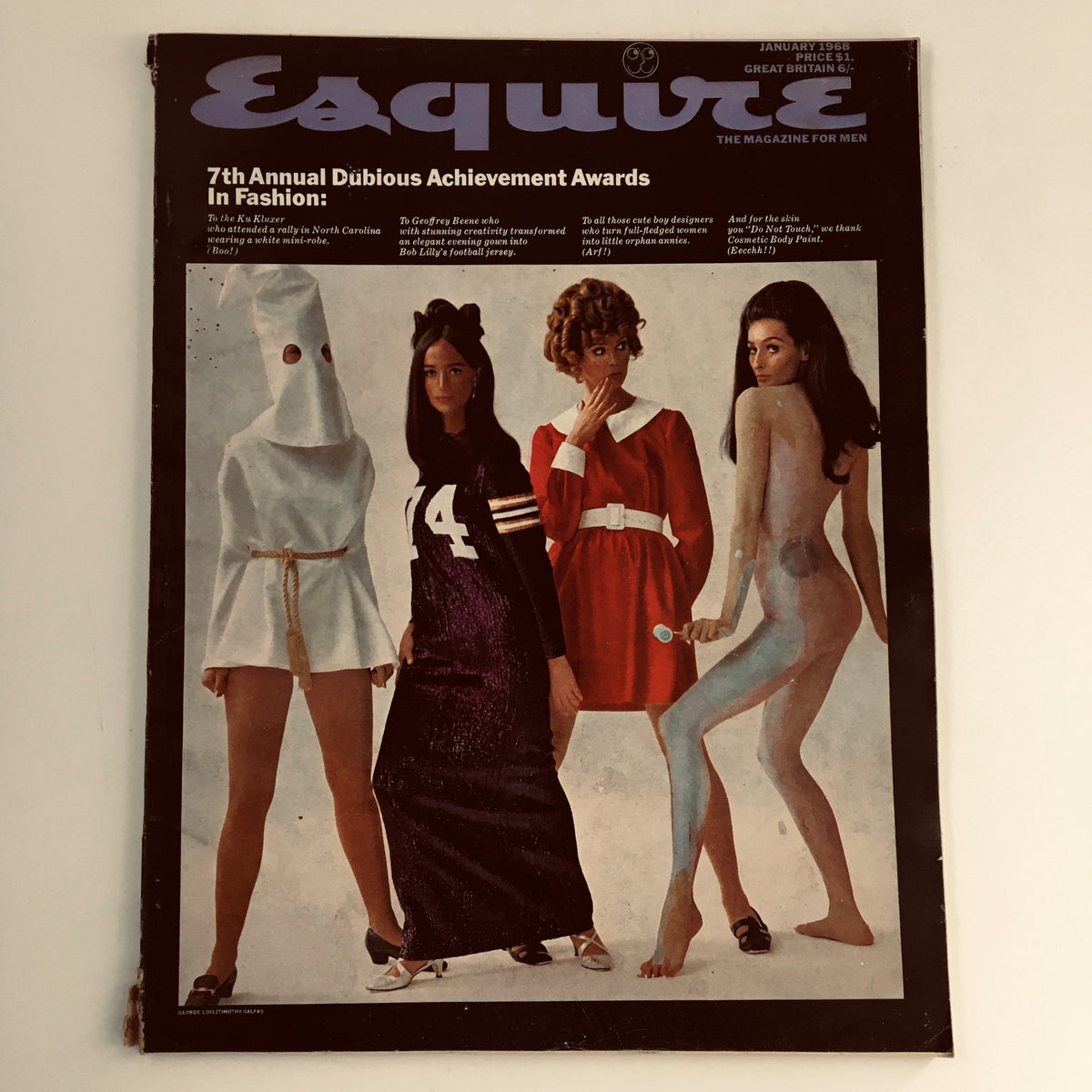


Description
Collector's Note – Why This Issue Matters
The January 1968 issue of Esquire featuring the 7th Annual Dubious Achievement Awards is a primary document of one of the most celebrated and most historically significant recurring features in American magazine journalism — and the 7th Annual edition is particularly meaningful because it was reviewing the events of 1967, one of the most turbulent and most culturally consequential years of the twentieth century. The Dubious Achievement Awards had been an Esquire tradition since the early 1960s, and by their seventh iteration they had developed into a fully mature satirical institution: an annual roundup of the year's most absurd, hypocritical, and self-defeating achievements by politicians, corporations, celebrities, and public institutions, delivered in the specific Esquire voice that combined genuine wit with genuine outrage in proportions that made it simultaneously entertaining and politically serious. The 1967 events being satirized in this January 1968 retrospective were extraordinary in their range and their historical weight: the Summer of Love, the Six-Day War, the first Super Bowl, the death of Che Guevara, the Detroit and Newark riots, the escalation of Vietnam with the Tet Offensive approaching, and the specific political absurdities of the Johnson administration's last full year before the 1968 presidential race had begun to fully develop. A January 1968 Esquire Dubious Achievement Awards issue is therefore primary satirical documentation of 1967 — one of the most eventful years in postwar American history — in the specific editorial voice of the publication that was producing the most culturally ambitious and most politically acute journalism in the American magazine market. For collectors building a serious archive of Esquire's legendary satirical tradition, the Esquire magazine collection at OriginalMagazines.com provides essential depth across the publication's full run, with the Annual Dubious Achievement Awards issues representing a particularly historically significant and most actively collected tier within that body of material.
The Esquire of January 1968 was operating under the editorial direction of Harold Hayes, whose tenure from 1963 to 1973 is widely regarded as the most historically significant period in the publication's editorial history — the era of New Journalism, when Esquire was publishing Tom Wolfe, Gay Talese, Norman Mailer, and their contemporaries in the specific long-form narrative journalism that would transform American magazine writing. The Annual Dubious Achievement Awards in this context was not simply a humor feature but an integral expression of the publication's specific editorial identity: the same satirical intelligence, moral seriousness, and cultural ambition that informed its New Journalism pieces was visible in the specific targets and the specific tone of its annual year-in-review satire. A January 1968 Dubious Achievement Awards issue is therefore primary documentation of Esquire's editorial voice at what is generally recognized as the peak of its cultural authority and its creative ambition — the mid-Hayes era, when the publication was simultaneously producing some of the most significant literary journalism in American history and delivering the most pointed cultural satire in the American magazine market. The no-label newsstand condition confirmed in the listing preserves the full visual integrity of the January 1968 cover design without subscription label disruption — a meaningful positive for a publication whose cover art was itself one of its most celebrated features, the specific Esquire covers of the late 1960s having achieved a canonical status in the history of American magazine design. The full range of 1968 magazines and publications from this year documents American culture at one of its most turbulent and most historically consequential moments.
The specific timing of the January 1968 Dubious Achievement Awards within the broader Esquire publishing calendar gives this issue an additional dimension of historical interest for serious collectors. This issue was produced and distributed in the first days of 1968 — a year that would prove to be one of the most historically extraordinary in American history, encompassing the Tet Offensive, the assassinations of King and Kennedy, the Chicago convention, and the Nixon election. The satirical retrospective on 1967 that this issue delivers was therefore arriving in readers' hands in the opening weeks of what would prove to be an even more extraordinary year, and the specific satirical targets and editorial judgments preserved in the 7th Annual Dubious Achievement Awards carry the additional historical weight of being produced at the precise threshold of 1968 — looking backward at 1967 with the specific critical intelligence of an editorial team that was about to spend the following year documenting one of the most dramatic and most consequential years in American public life.
About the Publication
Esquire magazine was founded in 1933 and had established itself by the mid-1960s under editor Harold Hayes as the most culturally ambitious and most editorially significant men's general-interest magazine in the United States, its combination of New Journalism long-form reporting, cultural criticism, fiction, and the specific satirical intelligence of its Annual Dubious Achievement Awards making it the standard against which American magazine journalism was measured during its Hayes-era peak. By January 1968, the publication was at or near the height of its cultural authority, its covers, its features, and its recurring satirical features collectively constituting one of the most significant documentary archives of American cultural and political life during the late 1960s.
Key Highlights Inside
- 7th Annual Dubious Achievement Awards — 1967 in satirical retrospective documented — The confirmed 7th Annual Dubious Achievement Awards feature constitutes primary satirical documentation of 1967 — one of the most eventful years in postwar American history — in the specific editorial voice of the publication that was producing the most culturally ambitious and most politically acute journalism in the American magazine market at the peak of Harold Hayes's legendary editorial tenure.
- January 1968 Esquire editorial context — Hayes-era peak satirical intelligence documented — The January 1968 date places this issue in the specific phase of Esquire's most historically significant editorial period, when the publication's combination of New Journalism ambition and satirical intelligence was most fully developed and most culturally authoritative, preserving primary documentation of the publication's voice at its acknowledged creative peak.
- 1967 retrospective — Summer of Love, Vietnam, Detroit riots, and the year's absurdities documented — The Dubious Achievement Awards' annual retrospective format preserves primary satirical documentation of 1967's most extraordinary public events and public figures — the Vietnam escalation, the civil rights crisis, the counterculture's commercial emergence, and the specific political hypocrisies that Esquire's editorial intelligence was most equipped to identify and most motivated to document.
- No-label newsstand edition — full January 1968 Esquire cover design preserved — The confirmed no-label newsstand origin preserves the full visual integrity of the January 1968 cover design — the Esquire covers of this era having achieved canonical status in American magazine design history — without subscription label disruption, representing a meaningful positive for a publication whose cover art was itself one of its most celebrated primary artistic achievements.
- Note: The specific satirical targets, individual Dubious Achievement Award categories, contributing writers, and the complete editorial contents of this issue beyond the confirmed 7th Annual Dubious Achievement Awards feature have not been independently verified beyond the listing description. The highlights above reflect what is documentable from the listing and the well-established historical context of Esquire's January 1968 publication and the Dubious Achievement Awards tradition.
Condition & Rarity
This issue is described as being in good condition with minor wear throughout, some marks, binding wear, no label, and a plastic protective covering — a condition profile that is honest and representative for a news and culture magazine now over fifty-five years old that was produced for active reading use. The no-label newsstand status is the most significant positive condition attribute, preserving the January 1968 cover design in complete presentation without the subscription label disruption that characterizes the majority of surviving copies from this distribution era. The marks and binding wear should be assessed from the accompanying photographs relative to their placement on the primary content pages and cover design. The plastic protective covering indicates deliberate preservation care. Esquire Annual Dubious Achievement Awards issues from the Hayes editorial era — and particularly this 7th Annual edition reviewing 1967 at the threshold of one of the most historically extraordinary years in American history — are among the most specifically sought issues in the Esquire collector community, recognized as primary satirical documents of the late-1960s American cultural and political landscape at the publication's acknowledged creative peak.
Looking for More Issues Like This?
Esquire Annual Dubious Achievement Awards issues from the Harold Hayes editorial era — and particularly this January 1968 seventh edition that delivers a satirical retrospective on 1967 in the specific voice of American magazine journalism's most culturally authoritative publication at its creative peak — are among the most actively sought categories in vintage magazine collecting, recognized by American journalism historians, cultural critics, and serious Esquire archive collectors as primary documents of the publication's most historically significant period. If this January 1968 issue is no longer available, the Esquire magazine collection at OriginalMagazines.com is the most comprehensive resource for exploring what else has surfaced from this important publication's extraordinary archive. For collectors building a broader documentary record of American political satire, cultural journalism, and popular life during one of the most historically turbulent years of the twentieth century, the 1968 magazines collection brings together a wide range of primary source material from that extraordinary year.