
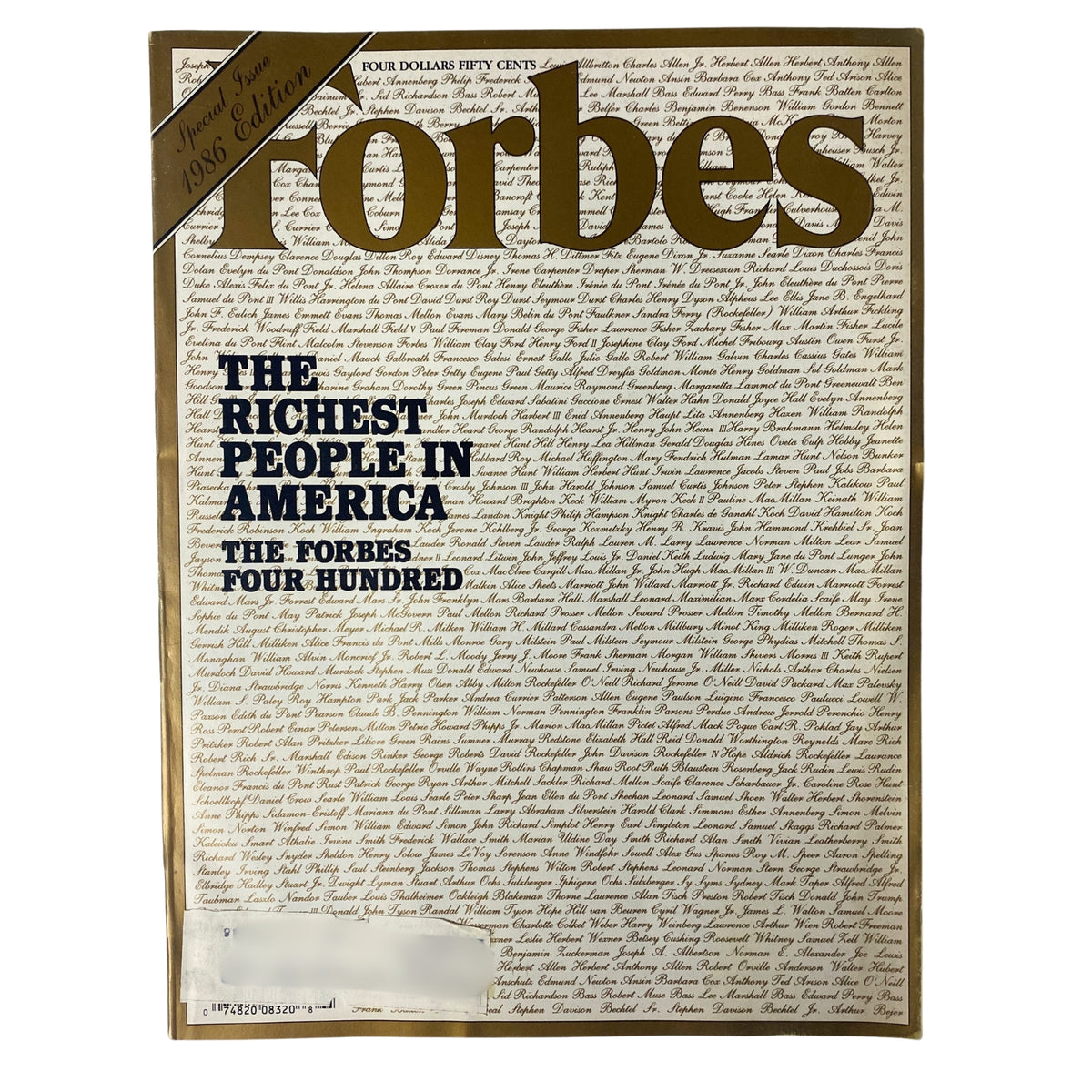
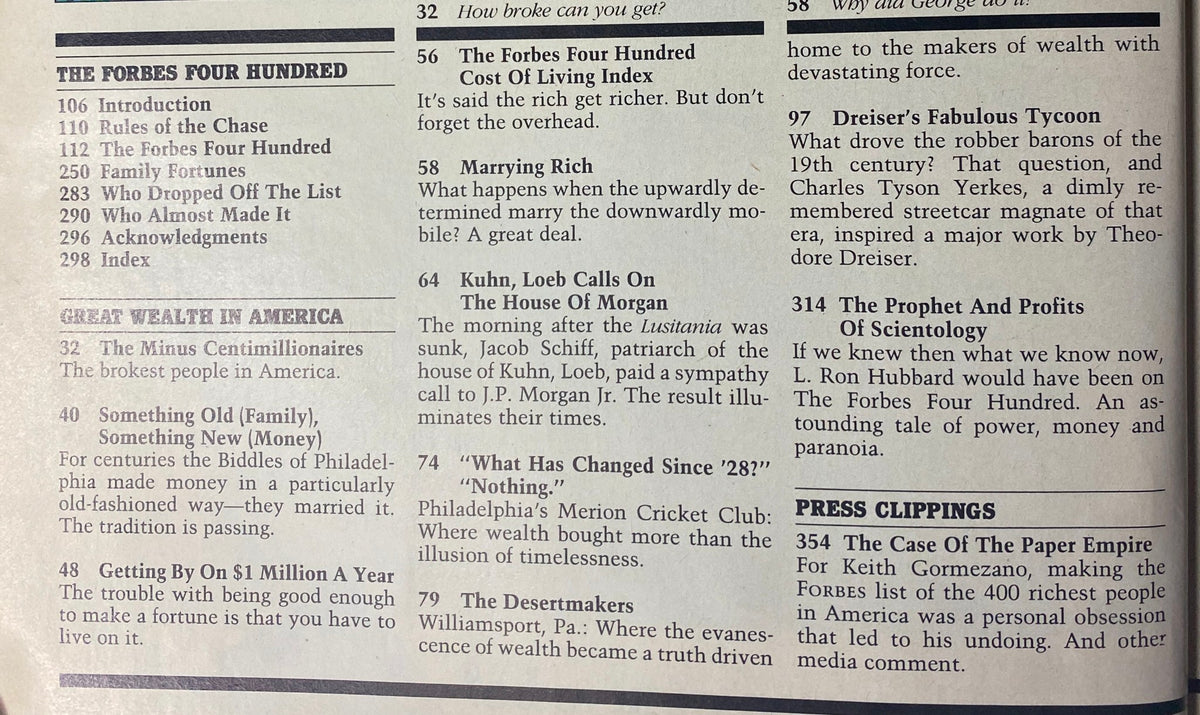

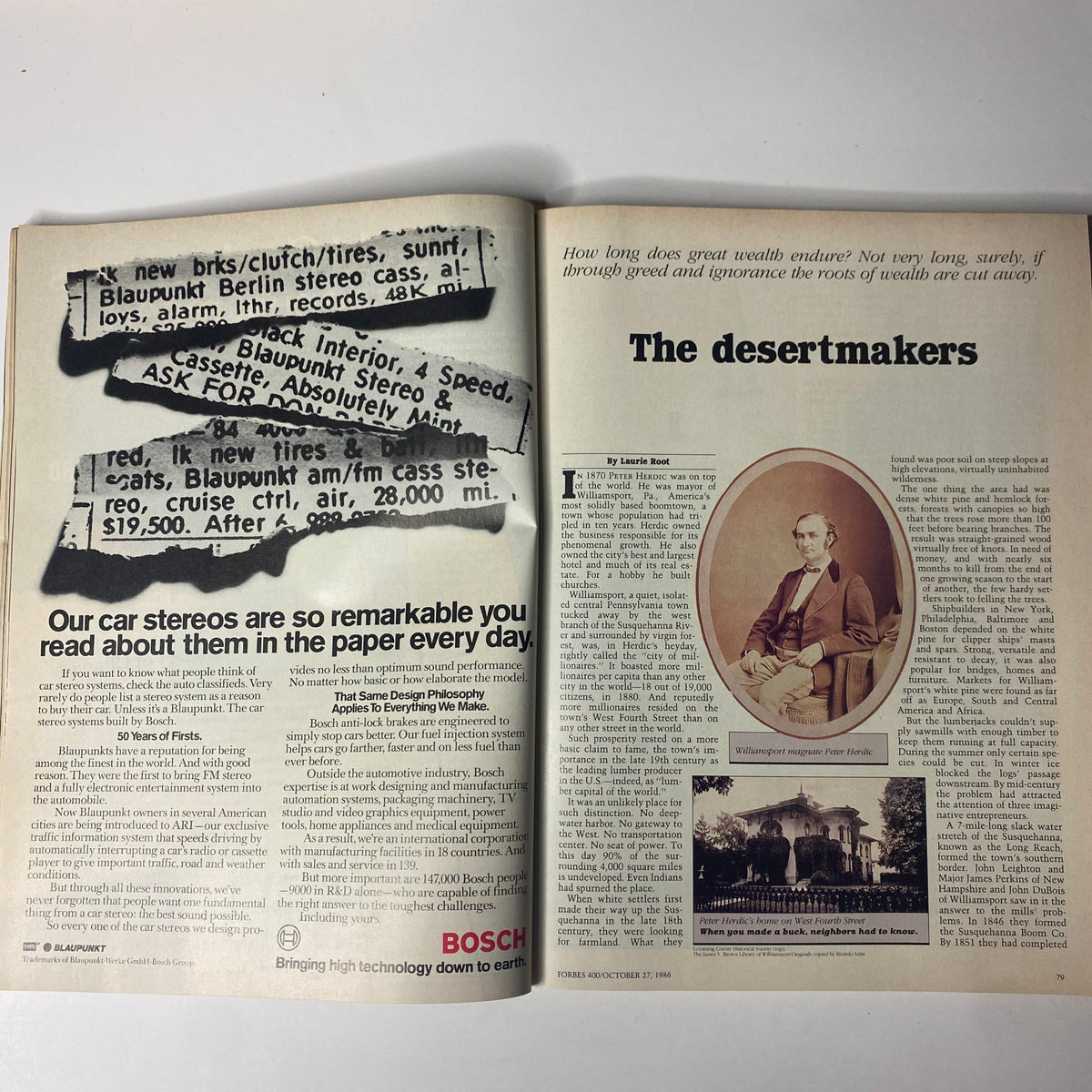



Description
Collector's Note – Why This Issue Matters
The 1986 Forbes 400 special edition lands in the middle of one of the most economically turbulent and culturally charged years of the decade. By the fall of 1986, the Reagan bull market was approaching its most exuberant phase — the Dow Jones had crossed 1,800 for the first time in history earlier that year, junk bond financing was reshaping corporate America at a dizzying pace, and the Tax Reform Act of 1986 was being signed into law, fundamentally restructuring the incentives that governed how large fortunes were built and maintained. The Forbes 400 list, now in its fourth year as an annual institution, was tracking the results of all of this in real time, and the 1986 edition captures the specific composition of American wealth at a moment of genuine structural transformation.
What distinguishes the mid-decade Forbes 400 issues from both the landmark 1983 inaugural edition and the later years is the accumulating comparative data they represent. By 1986, the list had been published four times, and year-over-year movement had become one of its most revealing editorial features — who was rising, who had fallen, which industries were minting new fortunes, and which established wealth was being eroded by the same forces that were enriching others. The leveraged buyout boom driven by figures like Carl Icahn and T. Boone Pickens was generating new entries and dramatic movements on the list, while the ongoing contraction in oil and energy was pushing some of the Texas fortunes that had dominated earlier editions down the rankings. For collectors who follow vintage Forbes magazine special editions, the 1986 issue documents this churn at its most dynamic.
The comprehensive introduction and methodology section noted in the listing is itself historically significant. By the fourth year of publication, Forbes had refined its approach to wealth estimation in response to criticism, legal pressure from subjects who disputed their rankings, and the practical challenge of valuing illiquid assets like real estate and private companies. The editorial transparency about how the rankings were constructed is a document of that ongoing negotiation between the magazine's journalistic ambitions and the resistance of its subjects. Collectors building focused archives around publications from 1986 will find this issue one of the most substantive single documents of the year's economic and cultural landscape available in magazine form.
About the Publication
Forbes was founded by B.C. Forbes in 1917 and developed under Malcolm Forbes's leadership into one of the three dominant American business publications, distinguished by its personality-driven coverage, its celebration of entrepreneurial wealth, and its willingness to make bold editorial statements rather than simply report. The Forbes 400 special edition, launched in 1983, had by 1986 become the most anticipated single issue in American business journalism — an annual cultural event that generated news coverage, legal threats from subjects, and genuine public fascination with the question of who, exactly, held the most wealth in America and how they had come to hold it. The 1986 edition was produced at a moment when that fascination was at its most intense, coinciding with the peak of the decade's wealth-celebration culture.
Key Highlights Inside
- The 1986 Forbes 400 ranking — the fourth annual edition of the list, now carrying sufficient historical depth to reveal meaningful year-over-year wealth trajectory patterns across the full roster.
- Comprehensive introduction and methodology explaining how the Forbes 400 rankings are established — a document of the evolving relationship between the magazine's wealth-estimation process and the practical and legal challenges of valuing private fortunes.
- Detailed profiles of the wealthiest individuals and their industries, capturing a wealth landscape being actively reshaped by leveraged buyouts, junk bond financing, real estate, and the ongoing contraction of energy sector fortunes.
- Examination of economic forces behind the era's great fortunes, set against the backdrop of the Tax Reform Act of 1986 — legislation that fundamentally altered the incentive structures governing wealth accumulation in America.
- Rankings reflecting the fourth year of the list's existence, during which the LBO boom driven by corporate raiders was generating dramatic movements in the rankings that earlier editions could not have anticipated.
Condition & Rarity
The listing grades this issue as Very Good with minor edge wear and confirms the inclusion of a protective covering — a solid condition assessment for a nearly forty-year-old special edition magazine. Forbes special editions from the 1980s were produced at a heavier page count than standard weekly issues, and spine integrity across that full count is the primary structural condition point to evaluate in any surviving copy. Minor edge wear at this age is consistent with careful rather than archival storage and does not affect the interior content or the cover presentation. The listing does not specify label status, which collectors for whom cover presentation is a priority should confirm when evaluating specific copies. Very Good condition with a protective sleeve represents a well-preserved example of a publication that was widely read as a practical reference document as well as collected as an artifact — meaning many copies experienced heavy use that has not always been kind to long-term preservation.
Looking for More Issues Like This?
The mid-1980s Forbes 400 special editions represent the franchise at its most culturally electric, and the 1986 edition — capturing the LBO era at full velocity — is consistently sought by collectors focused on Reagan-era economic history. If this issue is no longer available, the full vintage Forbes magazine collection at OriginalMagazines.com is the best place to browse for other landmark issues including the complete run of Forbes 400 annual editions. The 1986 magazine archive covers the full year across multiple titles for collectors building a focused mid-decade economic and cultural library.