
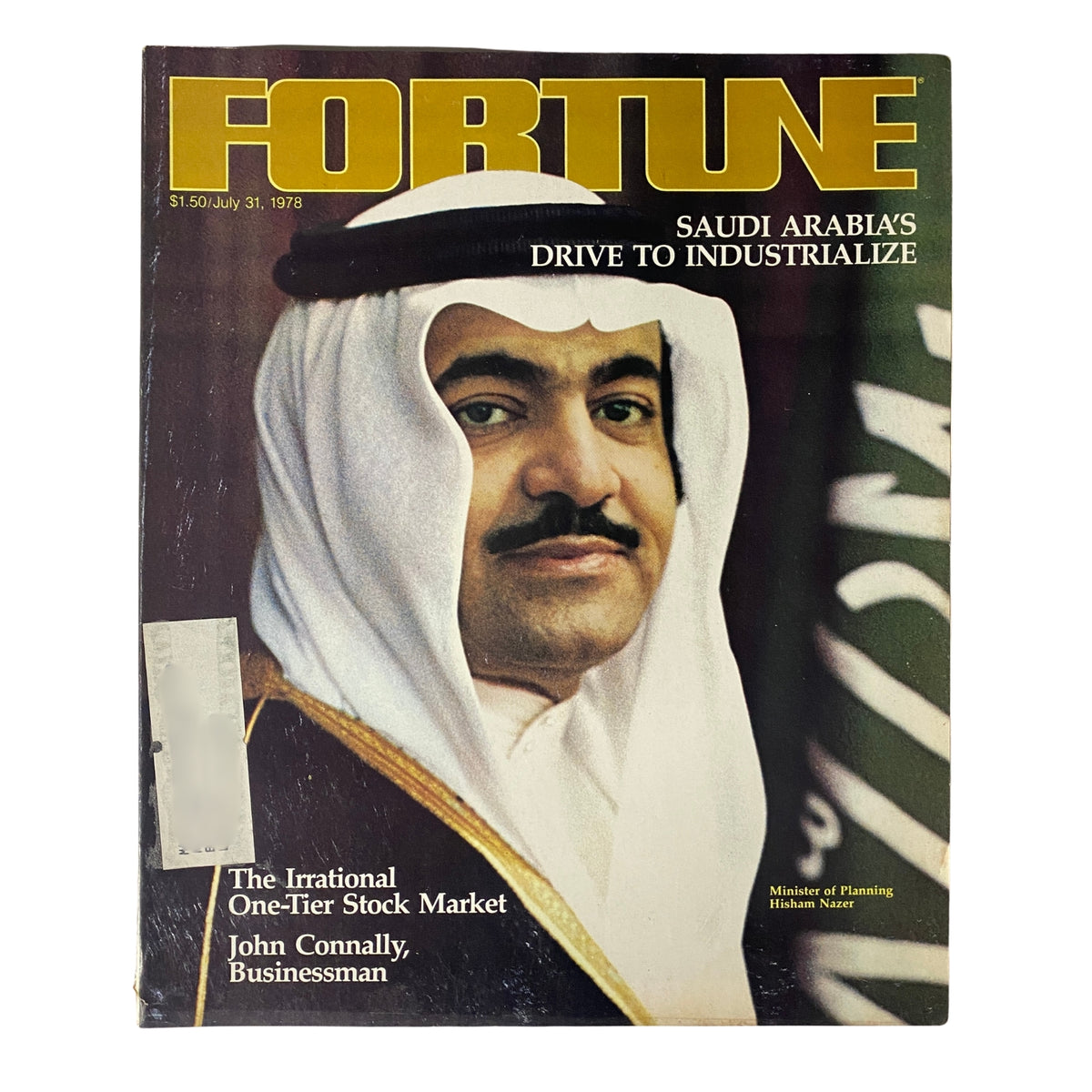


Description
Collector's Note – Why This Issue Matters
The summer of 1978 was a moment of profound and unsettled recalibration in the global economy. The oil shocks of 1973 and 1974 had permanently altered the relationship between energy-producing nations and the industrialized West, and the countries of the Arabian Peninsula were in the middle of a transformation whose full dimensions were only beginning to be understood outside the region. Saudi Arabia, flush with petrodollar revenues and engaged in one of the most ambitious national development programs in modern history, had become one of the most consequential economic actors on the world stage — and yet the internal machinery of that transformation remained largely opaque to Western business audiences. A Fortune cover story on Hisham Nazer, Saudi Arabia's Minister of Planning, in July 1978 represented exactly the kind of primary-source journalism that serious collectors of business history prize most: direct, reported access to a figure at the operational center of a story that was reshaping the global economy in real time. For those assembling an archive of Fortune magazine issues from the late seventies, this issue stands as one of the more geopolitically significant cover stories the publication produced in that decade.
Hisham Nazer occupied a position of extraordinary influence within the Saudi state during this period. As Minister of Planning from 1975 to 1983, he was the principal architect and administrator of Saudi Arabia's Second and Third Five-Year Development Plans — the frameworks through which the kingdom was channeling its oil revenues into infrastructure, industrialization, education, and institutional development at a pace and scale that had no modern precedent. His willingness to engage with Fortune for a cover story in 1978 reflected the Saudi government's deliberate strategy of communicating its development ambitions to the international business and investor community, and the resulting coverage gave Fortune's executive readership an unusually direct window into how one of the world's most powerful oil states understood its own economic future. Collectors focused on the history of Middle Eastern economic development, the political economy of oil, or the journalism of international business during the Cold War era will find this issue a document of exceptional specificity and depth. Those building a broader record of magazines from 1978 will recognize it as one of the year's more globally oriented business cover stories.
What deepens this issue's value as a historical artifact is the broader editorial context surrounding the Nazer cover story. The late 1970s were a period of mounting anxiety in the American and global economies — inflation was accelerating, recession fears were circulating, and the fiscal pressures on governments at every level were becoming a dominant theme in business journalism. This issue engages that anxiety directly, with additional coverage of recession risks, the financial strains on state and local budgets, leadership transitions at Prudential, and takeover battles within the oil industry. That combination — a window into the ascending economic power of Saudi Arabia alongside a frank accounting of the stresses bearing down on the American economy — makes this issue a remarkably complete document of the late-seventies economic moment, told from the perspective of the publication best positioned to cover it.
About the Publication
Fortune was founded in 1930 by Henry Luce as a prestige business magazine conceived from its first issue as an object of substance and authority — visually ambitious, editorially rigorous, and addressed without apology to the most powerful decision-makers in American commerce and industry. By 1978 it had spent nearly five decades establishing itself as the definitive voice of American business journalism, known for its long-form investigative features, its data-driven financial analysis, and its annual rankings of corporate America that had become essential reference points for the business community. Its readership in this period was the executive and investor class — CEOs, institutional fund managers, senior government officials, and the financially sophisticated professional upper-middle — and its editorial ambitions matched that audience's expectations. A late-seventies Fortune cover story carried genuine weight in boardrooms, government ministries, and investment offices well beyond its publication date, and the magazine's willingness to devote cover real estate to a Saudi planning minister reflects both its global editorial reach and its understanding of where the most consequential economic stories of the moment were actually unfolding.
Key Highlights Inside
- Cover story: Hisham Nazer, Saudi Arabia's Minister of Planning — A rare and substantive profile of one of the most influential economic officials in the Middle East at the height of Saudi Arabia's petrodollar-driven national development program. Nazer's insights into the kingdom's economic strategy and development planning represent primary-source material of significant value to historians of the global oil economy, Middle Eastern economic development, and late-Cold-War international business relations.
- Recession risks and economic trend analysis — Coverage of the mounting recession anxieties that were beginning to define the late-seventies economic conversation in the United States, documenting the specific fears and analytical frameworks that business journalists and economists were deploying in the summer of 1978 — just over a year before the second oil shock would dramatically worsen the outlook.
- Financial pressures on state and local governments — A feature examining the fiscal strains bearing down on subnational governments in the United States, capturing a structural problem in American public finance that was generating significant political and economic debate in this period and would intensify considerably over the following years.
- Prudential leadership transitions — Coverage of executive changes at one of America's largest and most influential financial institutions, documenting the corporate governance dynamics of the late-seventies insurance and financial services industry at a moment of broader institutional uncertainty.
- Oil industry takeover battles — Reporting on competitive dynamics and consolidation activity within the oil industry, placing the domestic corporate story alongside the international context established by the Nazer cover in a way that gives the issue unusual thematic coherence as a document of the global oil economy in 1978.
Condition & Rarity
Surviving copies of this issue presenting in good condition with minor wear consistent with nearly five decades of age represent a solid and fully functional collectible example of a late-seventies Fortune issue. The condition notes indicate typical age-related edge wear without significant structural damage — a realistic and honest baseline for a periodical of this vintage that was produced for professional consumption rather than long-term preservation. Fortune in 1978 was a working magazine circulated among busy executives and consumed in offices, on flights, and in waiting rooms; copies that survived in collectible condition did so largely by chance or by the early recognition of a particular issue's historical significance. The paper stock used in late-seventies Fortune issues is susceptible to tanning and mild brittleness at the page edges if stored in warm or humid conditions, making interior page quality an important secondary condition point for collectors evaluating any surviving example. Spine integrity, cover surface clarity, and the absence of address labels or subscription stamps are the primary attributes that determine display grade for issues of this publication and era. A copy presenting cleanly across those criteria, with well-preserved interior pages, represents a genuinely strong surviving example of a cover story with lasting historical significance.
Looking for More Issues Like This?
The July 31, 1978 Hisham Nazer cover is one of the more geopolitically distinctive entries in Fortune's late-seventies catalog — a cover story with genuine primary-source value for anyone researching the political economy of oil, Saudi Arabian development history, or the international business journalism of the Carter era. If you're building a serious run of the magazine, the Fortune magazine collection at OriginalMagazines.com is the most comprehensive resource for surveying available issues across the publication's decades of business journalism. For collectors working by era, the 1978 magazines collection brings together business, news, and culture titles from across that economically turbulent and historically significant year in American and global print culture.