


Description
Collector's Note – Why This Issue Matters
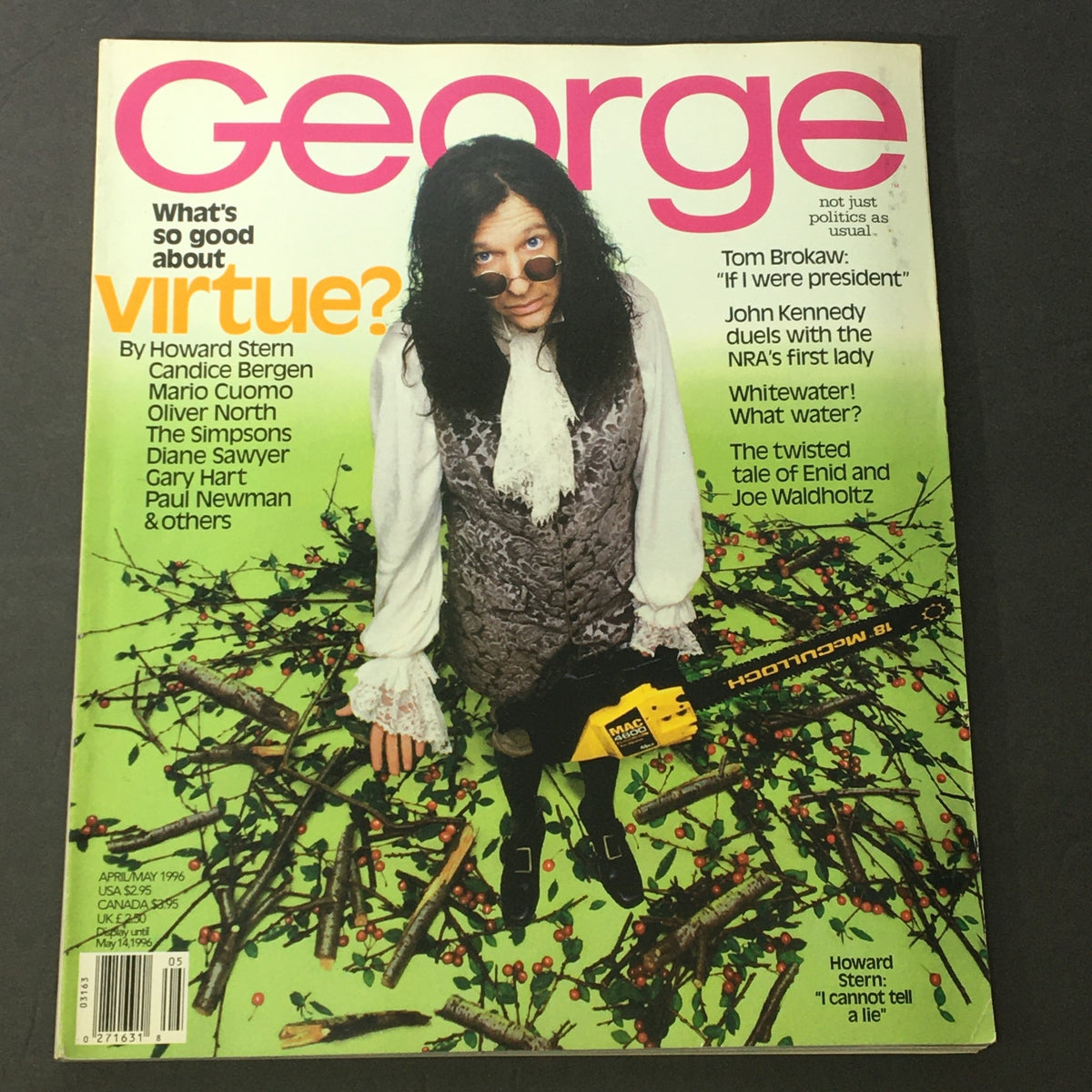
George Magazine's April/May 1996 issue — featuring Tom Brokaw, John F. Kennedy Jr., and Howard Stern — is a document of one of the more audacious editorial concepts of the 1990s magazine landscape. George was Kennedy's own creation, launched in September 1995 as a politics-as-lifestyle publication that treated American political culture with the same glossy, celebrity-inflected approach that fashion and entertainment magazines applied to their subjects. The concept was inseparable from its founder: John F. Kennedy Jr. was the most famous private citizen in America, a figure who had grown up entirely in public view from the moment his father was assassinated in 1963, and whose every personal and professional move was tracked with an intensity that few public figures outside of actual heads of state experienced. His decision to launch a political magazine rather than pursue acting, law, or politics directly was itself a cultural event, and George's early issues carried enormous curiosity value simply because of who was behind them. Collectors exploring the George Magazine archive will find the publication's first year of operation — of which this April/May 1996 issue is a part — the most historically charged, when the novelty and ambition of the concept were still fully intact.
The specific combination of subjects named in this issue is worth examining. Tom Brokaw was at the height of his authority as anchor of NBC Nightly News, one of the three network news anchors who still commanded the kind of mass audience trust that the fragmented media landscape of the late 1990s and 2000s would steadily erode. Howard Stern, by contrast, represented the deliberately transgressive end of American media — his syndicated radio show was the most-listened-to morning program in the country's major markets, his 1993 autobiography Private Parts had been a massive bestseller, and the film adaptation was in production in 1996. The presence of both figures in the same issue reflects George's editorial strategy of treating the full spectrum of American public life — from establishment journalism to shock media — as equally valid subject matter for political and cultural analysis. That refusal to observe conventional hierarchies of seriousness was central to Kennedy's vision for the magazine. The magazine landscape of 1996 was crowded and competitive, and George's willingness to put Brokaw and Stern in the same issue was a deliberate statement about the breadth of its ambitions.
George published from 1995 until May 1999, when it folded following Kennedy's death in a plane crash on July 16, 1999. The magazine's entire run now carries the particular weight of that ending — a project that died with its founder, unfinished and unrepeated. Early issues from 1995 and 1996, when the concept was newest and Kennedy's editorial voice was most directly present, are the most historically significant entries in the archive. This April/May 1996 issue, from the magazine's first full year of publication, belongs to that foundational tier.
About the Publication
George was founded by John F. Kennedy Jr. and co-publisher Michael Berman in 1995 as a monthly political lifestyle magazine published by Hachette Filipacchi Media. Its editorial concept positioned American politics as a form of popular culture — covering politicians, journalists, and public figures with the visual production values and celebrity-oriented approach of mainstream glossy magazines. Kennedy served as editor-in-chief throughout the publication's existence and was its primary public face, writing editor's letters and conducting high-profile interviews that gave the magazine a distinctive personal voice. George published until 1999 and ceased publication following Kennedy's death, leaving a run of less than four years that is now collected as both a publishing curiosity and a primary document of 1990s American political culture.
Key Highlights Inside
- Tom Brokaw feature — Coverage of the NBC Nightly News anchor at the height of his influence as one of the three major network news anchors whose combined viewership still constituted the dominant form of American television journalism in the mid-1990s.
- Howard Stern feature — Coverage of the radio provocateur during the period surrounding the production of the Private Parts film adaptation, when his cultural profile was at its broadest — a presence in a political magazine that reflects George's deliberate blurring of entertainment and political culture.
- John F. Kennedy Jr. as editor-in-chief — As with all George issues from its founding year, Kennedy's editorial presence gives the issue a biographical dimension that extends beyond its specific content, documenting the only media enterprise he would ever create.
- First-year George editorial identity — April/May 1996 falls within the magazine's first full year of publication, when its editorial voice and approach to politics-as-lifestyle coverage were most actively being defined and tested.
Condition & Rarity
George Magazine issues from 1996 are thirty years old — recent enough that surviving copies are not uncommon, but old enough that storage conditions have begun to differentiate meaningfully between well-preserved and carelessly kept examples. Minor edge wear and the possibility of small rips or marks, as noted, are standard findings for a newsstand copy of this age that has passed through multiple hands. The absence of a mailing label confirms newsstand provenance, which preserves the full visual integrity of the cover without adhesive label damage — a meaningful positive for a magazine whose covers were among its most distinctive design elements. George's large-format glossy stock ages reasonably well compared to newsprint-based publications, but spine stress from the magazine's substantial page count is among the most common condition issues in surviving copies. Protective plastic covering indicates deliberate preservation storage. For collector evaluation, the cover surface condition and the extent of any rips or marks — their location relative to the cover imagery — are the primary factors to assess in available photographs.
Looking for More Issues Like This?
George Magazine's complete run spans fewer than four years, and early issues from Kennedy's founding period are the ones collectors pursue most purposefully — a short archive with no possibility of addition, anchored by one of the most singular editorial personalities in American magazine history. The full George Magazine collection at OriginalMagazines.com is the place to explore what survives from across the publication's brief run. For collectors building a broader picture of the mid-1990s media landscape this issue inhabits, the 1996 magazine collection gathers contemporaneous coverage across multiple publications from one of the most media-saturated years of the decade.