
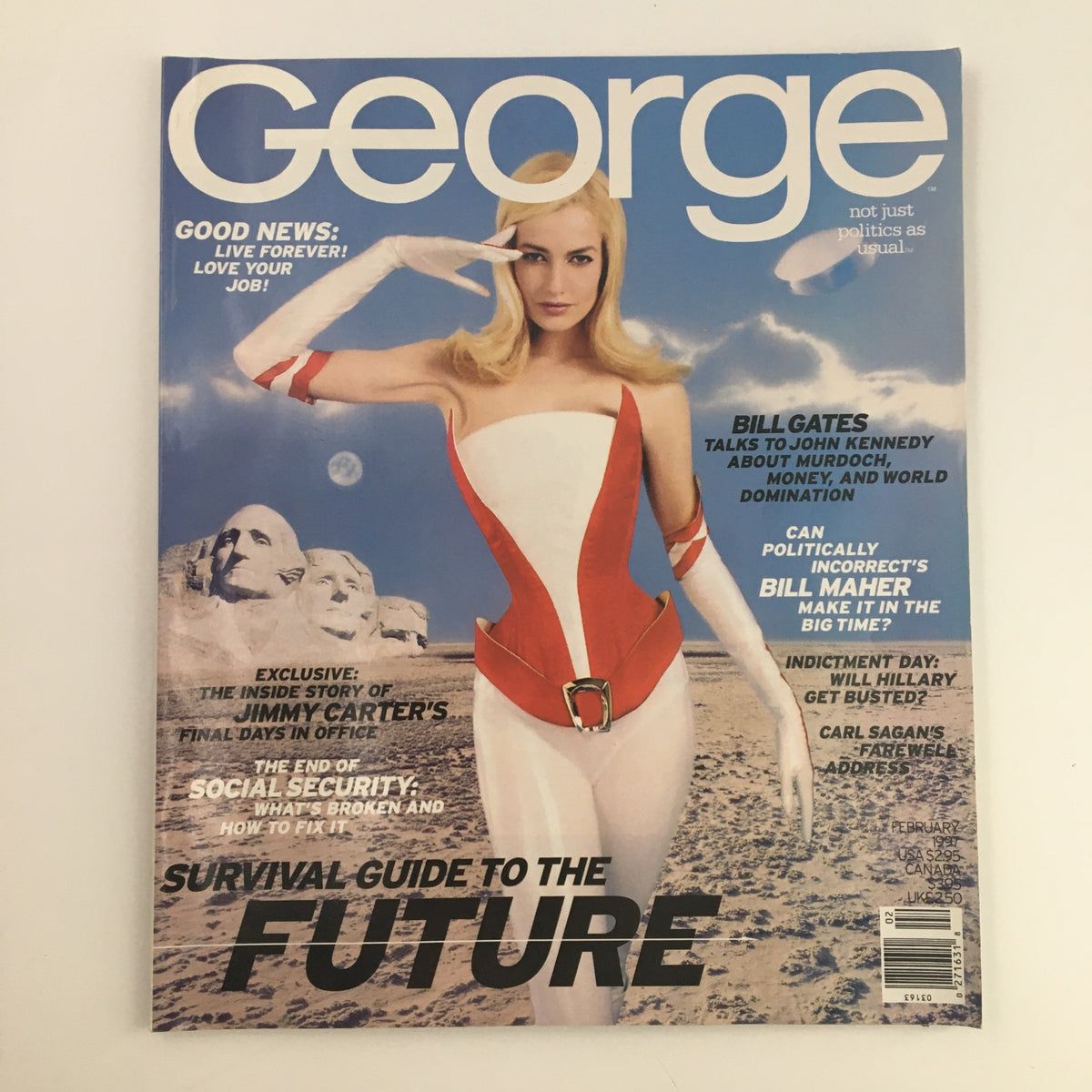


Description
Collector's Note – Why This Issue Matters
February 1997 arrived at a hinge point in modern history. The internet was no longer a curiosity — it was becoming infrastructure. Bill Gates had just published The Road Ahead and Microsoft's dominance of the personal computing era was at its zenith, even as antitrust scrutiny was quietly gathering on the horizon. To find Gates in the pages of George Magazine — a publication that deliberately blurred the boundary between politics and celebrity — says something about how the culture had begun to treat technology founders as a new class of public figure, as consequential as any senator or general.
The pairing of Gates with Jimmy Carter and Carl Sagan gives this issue an unusual intellectual weight. Carter, two decades removed from the White House, had spent the intervening years quietly building one of the most respected post-presidencies in American history through the Carter Center's democracy and public health work. Sagan, by contrast, was no longer alive when this issue hit newsstands — he had died in December 1996, just weeks before publication. His inclusion here, whether as a tribute or a feature completed before his passing, gives the issue an elegiac quality that collectors and science history enthusiasts recognize immediately. For anyone tracing the arc of late-twentieth-century public intellectualism, this convergence of figures is not accidental. It reflects exactly the editorial sensibility that made 1997 one of the more historically rich years in the magazine's run.
George was founded by John F. Kennedy Jr. and launched in 1995 with a mission that no other mainstream title had seriously attempted: treating politics as pop culture, and pop culture as politics. By early 1997, with Bill Clinton freshly re-elected and the country riding an economic expansion that felt, to many, like a permanent condition, the magazine was in its stride. This issue captures that particular late-90s mood — optimistic, technology-forward, and strangely innocent about what the digital revolution was actually about to cost. The cover model for this issue is Karen Mulder, the Dutch supermodel whose crossover presence in a political magazine was itself a statement about the George brand's willingness to fuse fashion and civic life.
About the Publication
George was a monthly American political magazine published from 1995 to 2001, co-founded by John F. Kennedy Jr. and publisher Hachette Filipacchi Media. Its editorial formula was unlike anything else on the newsstand: it covered Washington policy and global affairs through the lens of celebrity journalism, casting politicians as cultural figures and inviting genuine stars — athletes, models, actors — into conversations about power and governance. At its peak, George reached a circulation of around one million readers, attracting an audience that skewed younger and more culturally engaged than the traditional newsweekly readership. It was visually ambitious, frequently deploying high-fashion photography alongside serious political reporting, and its covers — often featuring celebrities styled as historical or political icons — became talking points in their own right.
Key Highlights Inside
- Bill Gates on technology and innovation: Gates is featured reflecting on the digital revolution during one of the most consequential periods of his public career, situated between the release of Windows 95 and the mounting legal pressures that would culminate in the landmark U.S. v. Microsoft antitrust case.
- Jimmy Carter on the presidency and humanitarian work: Carter's post-presidential chapter, defined by Habitat for Humanity building projects and the Carter Center's international election monitoring, was in full momentum by 1997 — making his reflections on leadership particularly substantive for a magazine aimed at civically minded readers.
- Carl Sagan and the cosmos: Sagan had died on December 20, 1996, making any content featuring him in this February issue either a posthumous tribute or material completed in the final weeks of his life. Either context adds historical resonance for readers interested in the history of science communication and popular astronomy.
- Cover featuring Karen Mulder: The Dutch supermodel's appearance on the cover exemplifies George's signature editorial approach — using fashion and celebrity as an entry point into a publication fundamentally concerned with political culture.
- Cultural context of early 1997: Clinton's second inauguration had just taken place, the Dow was approaching 7,000 for the first time, and the World Wide Web was transforming from novelty to necessity. George captured this atmosphere more vividly than most political titles of the era.
Condition & Rarity
Surviving copies of this issue are graded Good, reflecting minor cover and back-cover wear consistent with nearly three decades of age — a realistic and honest condition for any newsstand periodical from 1997 that has been stored rather than displayed. The pages are reported intact with no missing or compromised content, which is the most important structural criterion for a reading-grade or display-grade collectible. No subscription label is present, confirming newsstand origin rather than subscriber delivery — a distinction that matters to serious collectors because newsstand copies were handled more variably and are statistically less common in preserved condition than their mailed counterparts. The addition of a protective plastic sleeve indicates conscious preservation at some point in the copy's history, which typically correlates with reduced handling wear and stable page integrity. George Magazine, given its relatively short publication run and the tragic death of Kennedy Jr. in 1999 — which ended the title — has seen sustained collector interest that keeps clean copies of individual issues from becoming easy finds.
Looking for More Issues Like This?
This February 1997 issue draws together three figures — Gates, Carter, and Sagan — in a way that rarely comes together in a single magazine, and copies in preserved condition surface infrequently. If you're building out a broader run, the full George Magazine collection is the best place to see what's currently available across the publication's history. Collectors with a specific interest in Karen Mulder's extensive editorial work can browse her dedicated magazine collection, and anyone hunting by era will find a wide selection across titles in the 1997 magazines collection.