




Description
Collector's Note – Why This Issue Matters
By January 1999, George magazine was navigating a complicated cultural moment — and this issue captures it with characteristic sharpness. The cover features Robert Duvall, one of Hollywood's most decorated and uncompromising character actors, accompanied by a tagline that says everything about where celebrity culture stood at the turn of the millennium: "Actor Robert Duvall is not Leonardo DiCaprio." It's a deliberate provocation, positioning Duvall's decades of craft — The Godfather, Apocalypse Now, Tender Mercies — against the teen-idol hysteria that had engulfed Hollywood in the wake of Titanic's record-breaking 1997 release. That a political magazine chose this as its January cover says as much about the era's blurred lines between pop culture and public life as any editorial it ever ran. Collectors drawn to the Robert Duvall archive in print media will find this among his most culturally pointed cover appearances.
The issue arrives at a pivotal point in George's own history. Founded in 1995 by John F. Kennedy Jr. and publisher Michael Berman, the magazine had carved out a genuinely original niche — politics refracted through the lens of celebrity, style, and American mythology. Kennedy's editorial vision was to make civic life compelling to readers who might otherwise tune it out entirely. By early 1999, with Kennedy's death still six months away, the magazine was in its final creative chapter. This January issue belongs to that last, fully realized period of the publication — before the tragedy of July 1999 would reframe everything the magazine had been. Those building a complete run of George magazine treat issues from this final year with particular care.
The Duvall cover choice also reflects something honest about George's editorial sensibility. This was not a magazine that chased the obvious. Choosing a 68-year-old character actor over the reigning box office phenomenon of the decade was a statement — about taste, about what endures, about the difference between fame and stature. For collectors focused on late-'90s media culture or the intersection of Hollywood and American public life, this issue functions as a primary document. The magazine landscape of 1999 was months away from seismic disruption on multiple fronts, and issues like this one preserve the texture of that last pre-internet-dominance moment in print journalism.
About the Publication
George was an American monthly magazine published from October 1995 until January 2001, founded by John F. Kennedy Jr., who served as editor-in-chief until his death in a plane crash in July 1999. Headquartered in New York, it positioned itself at the intersection of politics and popular culture — treating governance, policy, and public figures with the same visual ambition and personality-driven coverage that lifestyle magazines applied to entertainment. Its audience was broadly educated, politically aware, and culturally curious rather than strictly partisan. Each issue blended long-form political profiles, cultural commentary, and high-production photography in a format that had no real precedent and few imitators. At its peak, George reached a circulation of around 400,000 and was considered one of the more genuinely innovative magazine launches of the 1990s.
Key Highlights Inside
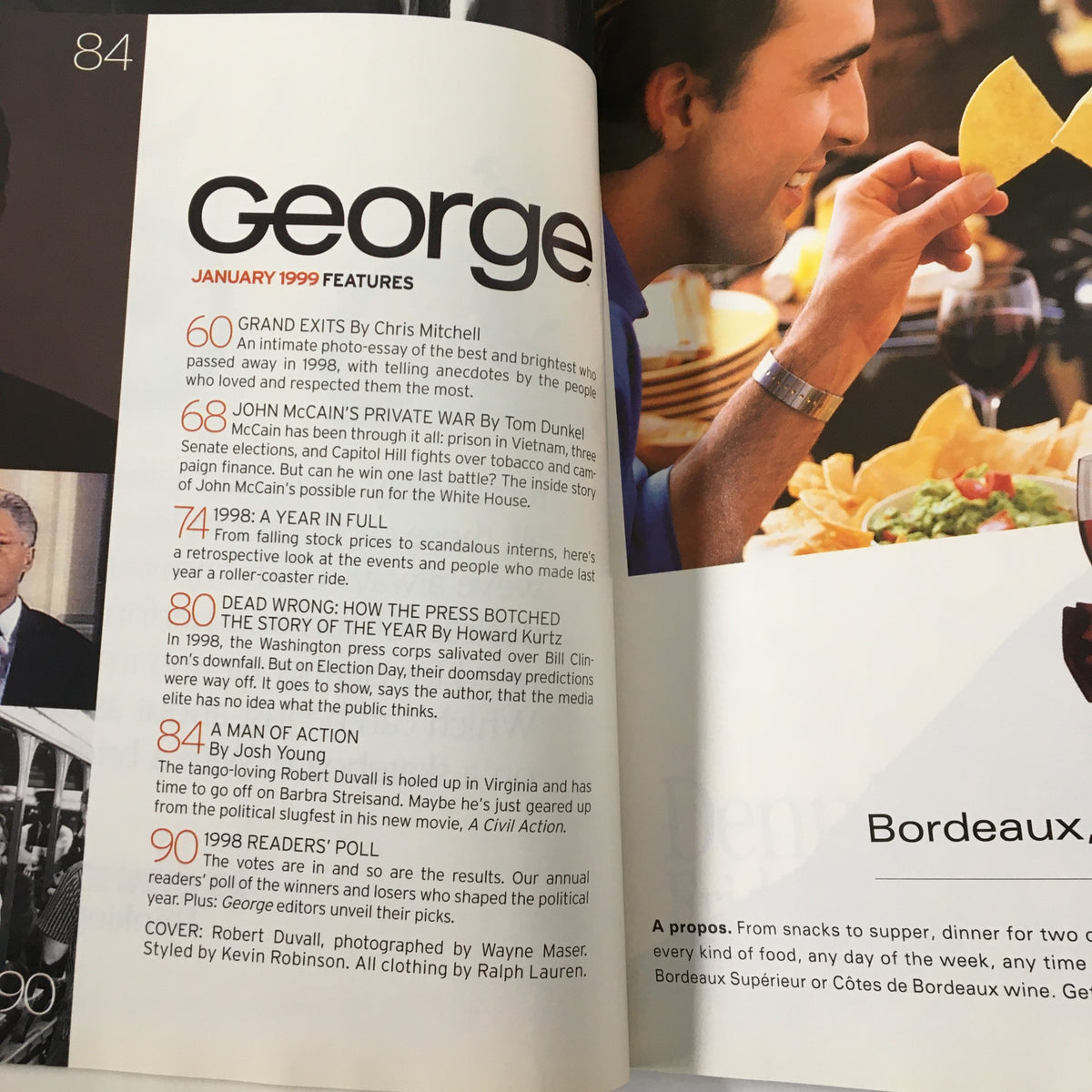
- A cover profile of Robert Duvall built around the pointed contrast embedded in the tagline — exploring his career, his reputation for craft over commerce, and his standing in Hollywood relative to the celebrity culture of the late 1990s.
- The cover concept itself functions as editorial commentary on how Hollywood measures an actor's worth, a theme consistent with George's habit of using celebrity as a lens for examining broader cultural and public-life questions.
- Photography and visual presentation consistent with the magazine's reputation for treating its subjects — political or cultural — with the production values of a prestige lifestyle publication.
- Note: Specific additional article titles and interior features for this issue are unconfirmed beyond what is reflected on the cover. The above reflects only what is verifiable from the listing and the magazine's documented editorial approach.
Condition & Rarity
This issue is graded in good condition, indicating minor wear consistent with nearly 25 years of age — the kind of honest patina that distinguishes a genuinely circulated copy from a warehouse remainder. The presence of a label on the front cover identifies it as a newsstand or subscriber copy rather than a file or comp copy, which for many collectors actually reinforces provenance. The plastic protective covering applied to this copy suggests it has been stored with some intentionality, which typically means page integrity and spine stability are better than unprotected copies of the same vintage. When evaluating any surviving copy of this issue, collectors should prioritize: cover gloss retention around the Duvall portrait, spine tightness (critical for a saddle-stitched or perfect-bound monthly of this period), and the condition of the interior photography spreads, which in George issues were printed on heavier stock and tend to age more gracefully than newsprint-heavy editorial pages.
Looking for More Issues Like This?
The January 1999 issue is a genuinely difficult find in collector-grade condition — late-run George issues were printed in smaller quantities than the magazine's mid-period peaks, and few were preserved carefully. If this one has moved on, it's worth browsing the broader collection of Robert Duvall magazine appearances for other significant cover and feature appearances across his career. The full George magazine archive is also worth exploring for anyone building a run of this historically significant publication — particularly issues from the 1998–1999 window. And for collectors working through the era more broadly, the complete 1999 magazine collection spans the full range of titles from that final, richly documented year of pre-millennium American print culture.